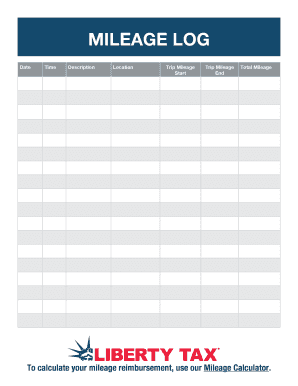
MILEAGE LOG DateTimeDescriptionLocationTrip Mileage StartTrip Mileage EndTotal MileageTo calculate your mileage reimbursement, use our Mileage Calculator.

How it works
  • Open form

    Open form follow the instructions

  • Easily sign form

    Easily sign the form with your finger

  • Share form

    Send filled & signed form or save

How to fill out the Mileage Log - Liberty Tax online

Filling out the Mileage Log - Liberty Tax online is a straightforward process that helps you accurately track your mileage for reimbursement. This guide provides a step-by-step overview to assist you in completing each section of the form with ease.

Follow the steps to fill out the Mileage Log effectively.

  1. Select the ‘Get Form’ button to access the Mileage Log and open it in your preferred editor.
  2. Begin by entering the date of your trip in the designated field. Ensure that the date format aligns with standard practices for clarity.
  3. Next, record the time you started your trip. This information should include both the hour and the minute.
  4. In the description field, briefly explain the purpose of your trip. This could be a client meeting, a business event, or other related activities.
  5. Indicate the starting location of your trip in the relevant field. This may include your home address or your primary workplace, depending on your trip start point.
  6. Enter the trip mileage start point, noting the odometer reading at the beginning of your trip.
  7. Once you have completed your trip, record the location where your trip ended.
  8. Fill in the trip mileage end point by noting the odometer reading at the conclusion of your trip.
  9. Calculate the total mileage for the trip by subtracting the start mileage from the end mileage. Enter this total in the designated field.
  10. After completing all fields, review your entries for accuracy. You can then save your changes, download the completed log, print it, or share it as necessary.

Start filling out your Mileage Log online today for efficient record-keeping!

Get form

Experience a faster way to fill out and sign forms on the web. Access the most extensive library of templates available.

Related content

Federal court permanently bars former Liberty Tax...

Jun 4, 2021 — March 16, 2020 — A federal court in Tampa, Florida has permanently...

Learn more
VITA VIRTUAL TAX SERVICE - Fremont Adult Education

state and federal tax credits, depending on income and family size. Our EXPERTS can do it...

Learn more
2017 Publication 946 - Internal Revenue Service

Apr 15, 1976 — Standard mileage rate. Use Form 4562 to figure your deduction for...

Learn more
Questions & Answers

Get answers to your most pressing questions about US Legal Forms API.

Contact support

What does IRS require for mileage log?

Your mileage log must be able to prove: The amount: the number of miles driven for each business-related trip. The time: the date and time you take each trip. The place: the destination for each business-related trip.

The IRS requires detailed logs, including the date, miles, addresses, and purposes of each trip, as well as year-starting and year-ending odometer readings. Personal trips should also be logged for clarity.

Mileage can either be written off in part or in whole. If you have a dedicated vehicle that you only use for work purposes, you can write off 100% of your mileage on your tax return. If you have a personal vehicle that you sometimes use for your business, you can write off only the miles driven while you work.

Standard Mileage Rates & The Actual Expense Method To support business mileage deductions with the actual expense method calculation, you should keep all invoices, receipts, and a mileage log of all business miles driven.

A mileage log book is a record you keep for tracking distances traveled for work purposes. A logbook can help you deduct expenses from your tax payments, whether you are self-employed, or own a small business.

Write down the date, the purpose of your trip, your starting and ending locations, and the beginning and ending odometer readings on each trip. Subtract the starting reading from the ending reading to find out how many miles you drove. Make sure to keep this record updated regularly for accurate tracking.

The IRS defines adequate records for your mileage log the mileage for each business use. the total mileage for the year. the time (date will do), place (your destination), and business purpose of each trip. odometer readings at the start and end of the year.

How do I track miles for taxes? You can keep a mileage logbook or use an app for this purpose. Be sure to record your odometer reading at the beginning and end of the period for which you are recording mileage, and note down the date, destination, distance, and purpose for each trip you've driven throughout the year.

Get This Form Now!

Use professional pre-built templates to fill in and sign documents online faster. Get access to thousands of forms.

If you believe that this page should be taken down, please follow our DMCA take down process here.

Get Mileage Log - Liberty Tax