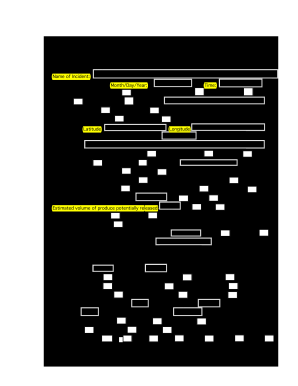
Cre Other G. Total amount of dispersant to be used: H. gals. Time of dispersant application: Start time Day Finish time I. Day Estimated percentage of spill area to be treated: 1-5% 6-20% 21-40% 41-70% Signature of Requester: Printed Name of Requester: Title of Requester: Requester Affiliation: Requester Representing: Time & Date Request Submitted to FOSC: ARRT Approved 04/15/92 Dispersant Use: Zones 2 & 3 2 of 6 71-99% 100% View Example IV. WEATHER AND WATER CONDITION FOREC.

How it works
  • Open form

    Open form follow the instructions

  • Easily sign form

    Easily sign the form with your finger

  • Share form

    Send filled & signed form or save

How to use or fill out the AK Oil Spill Response Checklist online

Filling out the AK Oil Spill Response Checklist online is a crucial step in effectively documenting and responding to oil spills in Alaska. This guide provides clear, step-by-step instructions to help you complete the form with confidence and accuracy.

Follow the steps to complete the AK Oil Spill Response Checklist online:

  1. Click the ‘Get Form’ button to obtain the form and open it in the editor.
  2. Begin with Section I, 'Spill Data.' Enter the name of the incident, date and time in the specified format (Month/Day/Year), and mark the type of incident by checking the relevant box. Specify if the source has burned and whether it is still burning.
  3. Continue by providing the spill location details, including latitude and longitude, and the distance and direction to the nearest land or town. Also, indicate the product released and whether it is easily emulsified or already emulsified.
  4. Estimate the volume of the product released and the volume potentially released. Indicate the release status—whether continuous, intermittent, or one time only—and specify the estimated rate of release if applicable.
  5. In Section II, 'Weather and Water Conditions at the Time and Location of the Spill,' fill in the air and water temperature, tidal state, weather conditions, wind speed and direction, and sea state.
  6. Indicate whether ice is present and describe other relevant observations, such as low visibility or water depth.
  7. In Section III, 'Proposed Dispersant Use Plan,' explain the reason for requesting dispersant use and select the dispersant zone. Provide the name of the dispersant intended for use and confirm if a safety plan is in place.
  8. Specify dispersant dosage goals and total amount to be used. Record the estimated time of application and percentage of the spill area to be treated.
  9. Continue filling out subsequent sections, ensuring all required information is completed. Review your inputs for accuracy and completeness.
  10. Finally, check the document for any errors, then save changes, download, print, or share the form as necessary.

Complete the AK Oil Spill Response Checklist online to ensure a thorough and efficient response to oil spills.

Get form

Experience a faster way to fill out and sign forms on the web. Access the most extensive library of templates available.

Related content

Oil Spill Response Exercise Manual

Feb 5, 2023 — DEC is pleased to provide the updated Oil Spill Response Exercise Manual:...

Learn more
Overview | Oil and Hazardous Spills and Wildlife...

If you find/see oil on the beach, in the water, on marine debris, or on wildlife, report...

Learn more
DEC Regulations 18 AAC 75, Oil and Other Hazardous...

by M Dunleavy — Oil Spill Primary Response Action Contractors and Streamlined Plan...

Learn more
Questions & Answers

Get answers to your most pressing questions about US Legal Forms API.

Contact support

What are the response measures for oil spills?

Response measures for oil spills can include physical containment, chemical dispersal, and biological remediation strategies. These measures aim to limit the spread of oil and facilitate cleanup. It's essential to choose appropriate measures based on the severity and location of the spill. The AK Oil Spill Response Checklist assists in selecting the right measures for effective response.

The oil spill response action plan is a strategic roadmap designed to respond to oil spills effectively. It usually contains key information on procedures, personnel responsibilities, and equipment needed. This plan is critical for coordinating efforts among various agencies and stakeholders. Make sure to integrate the AK Oil Spill Response Checklist into your action plan for optimal effectiveness.

The 7 steps of spill response typically include detection, notification, assessment, containment, recovery, disposal, and cleanup. Each step plays an essential role in managing the incident effectively. By following each step meticulously, you can significantly reduce the environmental impact of the spill. Refer to the AK Oil Spill Response Checklist for detailed guidance on each of these steps.

The response to an oil spill involves a series of actions aimed at minimizing the impact on the environment. This includes immediate reporting, containment, cleanup, and monitoring. Each of these actions is vital for effective spill management and environmental protection. The AK Oil Spill Response Checklist serves as a valuable tool to guide you through these responses.

To respond to an oil spill, start with immediate assessment and reporting. Next, implement containment measures to prevent the oil from spreading. Engage response teams to recover and clean up the spill efficiently. The AK Oil Spill Response Checklist helps ensure that you follow the best practices during this critical process.

The emergency oil spill response plan is a comprehensive document that outlines procedures for managing oil spills. This plan typically involves hazard assessment, resource allocation, and communication strategies. It's important to have a well-defined response plan to mitigate environmental damage. Utilizing the AK Oil Spill Response Checklist can streamline your emergency preparedness.

Response actions for oil spills include assessment, containment, recovery, and cleanup. Initially, experts assess the situation to understand the extent of the spill and then deploy resources to contain the oil. Following containment, teams work on recovery and cleaning up the affected area. The AK Oil Spill Response Checklist provides a detailed framework for these crucial steps.

An oil spill must be reported to the National Response Center (NRC) as soon as it is discovered. This step is crucial for ensuring a quick and effective response. In Alaska, you will also need to contact the Alaska Department of Environmental Conservation (DEC). Following the AK Oil Spill Response Checklist can guide you through the necessary reporting procedures.

The 4 C's of spill response refer to Command, Control, Communication, and Coordination. Each aspect plays a vital role in ensuring a successful oil spill response, as stated in the AK Oil Spill Response Checklist. Effective command and control enhance decision-making, while strong communication and coordination facilitate teamwork among responders. Together, these four elements create a robust framework for managing oil spills.

A reportable oil spill typically involves discharges exceeding 1,000 gallons into navigable waters or smaller spills if they can harm the environment or public safety. Regulations may vary based on regulations and locations, so always check local guidelines. The AK Oil Spill Response Checklist offers valuable insights into determining reportable spill sizes according to specific scenarios.

Get This Form Now!

Use professional pre-built templates to fill in and sign documents online faster. Get access to thousands of forms.

If you believe that this page should be taken down, please follow our DMCA take down process here.

Get AK Oil Spill Response Checklist