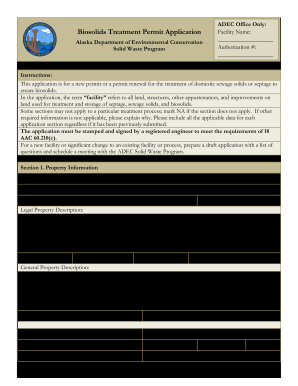
Biosolids Treatment Permit Application Alaska Department of Environmental Conservation Solid Waste ProgramADEC Office Only: Facility Name: Authorization #: Instructions: This application is for a.
Open form follow the instructions
Easily sign the form with your finger
Send filled & signed form or save
How to fill out the AK Biosolids Treatment Permit Application online
This guide provides a comprehensive overview of how to complete the AK Biosolids Treatment Permit Application online. By following these instructions, users will be able to navigate through each section of the application efficiently and accurately.
Follow the steps to complete your application effectively.
- Press the ‘Get Form’ button to access the application form and open it in your preferred editor.
- In Section 1, enter the property information, including the facility name, address, city, and zip code. Provide the legal property description and general property description along with latitude and longitude.
- In Section 2, fill out the contact information for the permit applicant, including the type of entity, email, and phone number. If the owner or operator differs from the applicant, provide their contact details as well.
- In Section 3, indicate whether you are applying for a new permit or a permit renewal. Ensure appropriate fees are included.
- In Section 4, draft a cover letter addressing all required points, including your desire for a permit and a brief description of the facility's operational specifics.
- In Section 5, list the expected quantities of sewage solids or septage to be received each year and the projected amounts of biosolids to be used or sold.
- In Section 6, provide location information, specifically related to property ownership and any water body proximity.
- In Section 7, attach a complete set of facility design documents, indicating all necessary structures and operational areas.
- In Section 8, prepare a comprehensive operations plan detailing access control, waste handling, processing, storage, and managing any odors or nuisances.
- In Section 9, outline the monitoring plan, ensuring compliance with applicable regulations.
- In Section 10, detail the closure plan and the associated cost estimates.
- Finally, review the application thoroughly before saving your changes. Download, print, or share as required to submit your application.
Complete your AK Biosolids Treatment Permit Application online today.
Experience a faster way to fill out and sign forms on the web. Access the most extensive library of templates available.
Related content
Solid waste permit applications and forms. ... Asbestos Waste Landfill (PDF) · Biosolids...
A person must apply for a permit covering biosolids use or disposal standards if they own...
PFAS Assessment of Biosolids and Agricultural Fields . ... as contracted by the Michigan...
Get answers to your most pressing questions about US Legal Forms API.
What is the difference between Class A and B biosolids?
Class A biosolids can be sold to the public or land applied without further restrictions because of the level of treatment they received. Class B biosolids are not treated to the same level and as such may be land applied with site restrictions on place.
What is required for a biosolids to be classified as Class A biosolids?
The EPA claims that Class A biosolids must "contain no detectible levels of pathogens" but the only pathogens actually measured and regulated in the law are fecal coliform and salmonella.
What is a Class A biosolid?
Class A biosolids are essentially free of pathogens prior to land application. The metal contents requirements under the Part 503 Rule are the same for Class A and Class B biosolids. (Regulation Example: Riverside County, Chapter 13.24).
What can Class A biosolids be used for that Class B biosolids Cannot?
Class A systems must meet more stringent requirements, enabling Class A biosolids to be applied not only to agricultural land but also to public access areas, such as private lawns and home gardens. Class B biosolids are almost exclusively applied to agricultural land and are prohibited from public access areas.
What are the categories of biosolids?
Biosolids are divided into “Class A” and “Class B” designations based on treatment methods. The different classes have specified treatment requirements for pollutants, pathogens and vector attraction reduction, as well as general requirements and management practices.
What are Class B biosolids?
Class B biosolids have undergone treatment that has reduced but not eliminated pathogens. By definition, Class B biosolids may contain pathogens.
What are Class A biosolids?
Class A Biosolids is a designation for dewatered and heated sewage sludge that meets U.S. EPA guidelines for land application with no restrictions. Thus, class A biosolids can be legally used as fertilizer on farms, vegetable gardens, and can be sold to home gardeners as compost or fertilizer.
What are the options for biosolids?
Biosolids landfilling options include disposal in a monofill (a landfill that accepts only wastewater treatment plant biosolids), or in a co-disposal landfill (a landfill that combines biosolids with municipal solid waste (MSW)).
Use professional pre-built templates to fill in and sign documents online faster. Get access to thousands of forms.
If you believe that this page should be taken down, please follow our DMCA take down process here.