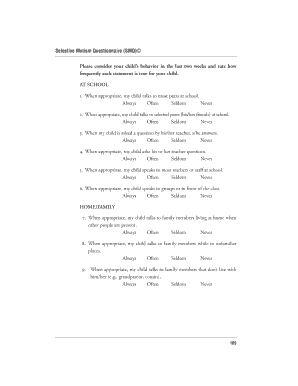
Selective Mutism Questionnaire (SMQ) Please consider your childs behavior in the last two weeks and rate how frequently each statement is true for your child. AT SCHOOL 1. When appropriate, my child.
Open form follow the instructions
Easily sign the form with your finger
Send filled & signed form or save
How to fill out the Selective Mutism Questionnaire online
The Selective Mutism Questionnaire is an essential tool for assessing a child's communication behavior in different settings. This guide will walk you through the online process of filling out the questionnaire, ensuring that you provide accurate and helpful responses.
Follow the steps to complete the questionnaire effectively.
- Press the ‘Get Form’ button to access the Selective Mutism Questionnaire and open it in your preferred online editor.
- Begin by reviewing the introduction and instructions provided in the questionnaire to understand its purpose and how to respond accurately.
- In the ‘At School’ section, rate your child's communication behavior with peers, teachers, and in group settings. Choose from options such as 'Always', 'Often', 'Seldom', or 'Never' for each statement.
- Move to the ‘Home/Family’ section, where you will evaluate your child's communication interactions with family members in various contexts. Again, select the appropriate frequency for each statement.
- Proceed to the ‘In Social Situations (Outside of School)’ section. Rate how often your child communicates with others outside of a school environment based on the provided statements.
- In the ‘Interference/Distress’ section, assess the impact of your child's selective mutism on different aspects of their life by selecting a level of interference ranging from 'Not at all' to 'Extremely'.
- After completing all sections of the questionnaire, review your responses to ensure accuracy. Make any necessary adjustments.
- Finally, save your changes, and choose to download, print, or share the completed questionnaire as needed.
Complete the Selective Mutism Questionnaire online today to gain valuable insights into your child's communication behaviors.
Experience a faster way to fill out and sign forms on the web. Access the most extensive library of templates available.
Related content
by AM Letamendi · 2008 · Cited by 55 — The Selective Mutism Questionnaire (SMQ) is the...
by ML Ortega · 2011 · Cited by 1 — DescriptionSelective Mutism (SM) is a childhood...
Anxiety disorders are a cluster of mental disorders characterized by significant and...
Get answers to your most pressing questions about US Legal Forms API.
How to score selective mutism questionnaire?
Parents are asked to rate the frequency of each item, using a 4-point scale (1=Always; 2= Often; 3=Seldom; and 4=Never for speaking situations). A separate scale is used for the interference/distress items (1=Not at all, 2=Slightly, 3=Moderately, 4=Extremely).
Is there an assessment for selective mutism?
The SMart Center takes a comprehensive approach with assessments for individuals of all ages who suffer from a wide array of disorders/concerns including but not limited to Selective Mutism, social/general anxiety, depression, behavioral concerns, learning concerns, dyslexia, speech and language, developmental ...
What is the DSM 5 criteria for selective mutism?
Selective mutism is defined in the Diagnostic and Statistical Manual of Mental Disorders, Fifth Edition (DSM-5), as an anxiety disorder, “characterized by a consistent failure to speak in social situations in which there is an expectation to speak (e.g., school) even though the individual speaks in other situations.
What is the selective mutism questionnaire for speech therapy?
Developed by R. Lindsey Bergman and colleagues, the Selective Mutism Questionnaire (SMQ) is a caregiver-report questionnaire that assesses the frequency of selective mutism symptoms over the preceding two weeks, in three domains: at school, speech in home/family environments, and in community/social settings.
How do you get diagnosed with selective mutism?
Diagnosis of selective mutism is mostly on the basis of the patient's clinical history. A speech-language pathologist (SLP) plays a key role in the diagnosis of the condition. A child who shows signs of selective mutism should be taken to an SLP, apart from a pediatrician and a child psychologist.
What is selective mutism 312.23 f94 0?
Introduction. ing to the DSM-V, Selective Mutism is a childhood disorder typified by an inability to speak in certain circumstances. Specifically, it is a consistent failure to speak in certain social situations where there is a natural expectation of speaking (American Psychiatric Association, 2013).
What is the SMQ rating scale?
The SMQ is a parent rating scale, measuring the severity of SM rated speaking behavior in different contexts (17 items) and impediment associated with nonspeaking behavior (six additional items). Items are scored on a 4-point Likert scale ranging from 0 (never speaking) to 3 (always speaking).
Use professional pre-built templates to fill in and sign documents online faster. Get access to thousands of forms.
If you believe that this page should be taken down, please follow our DMCA take down process here.