Loading
Form preview
  • US Legal Forms
  • Form Library
  • More Forms
  • More Multi-State Forms
  • Open-ended Functional Assessment Interview

Get Open-ended Functional Assessment Interview

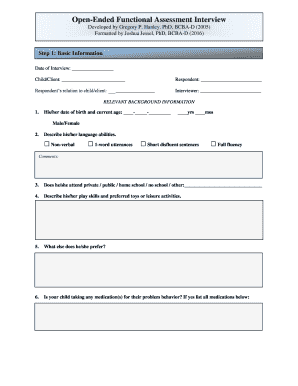
OpenEnded Functional Assessment Interview Developed by Gregory P. Hanley, PhD, BCBAD (2005) Formatted by Joshua Jessel, PhD, BCBAD (2016)Step 1: Basic Information Date of Interview: Child/Client:.

How it works

  1. Open form

    Open form follow the instructions

  2. Easily sign form

    Easily sign the form with your finger

  3. Share form

    Send filled & signed form or save

How to fill out the Open-Ended Functional Assessment Interview online

Filling out the Open-Ended Functional Assessment Interview is a critical step in understanding and addressing the needs of individuals with problem behaviors. This guide provides a comprehensive walkthrough of each section, ensuring that users can complete the form online with confidence and clarity.

Follow the steps to effectively complete the Open-Ended Functional Assessment Interview online.

  1. Press the ‘Get Form’ button to access the interview document and open it in your preferred online editor.
  2. Begin with Step 1: Basic Information. Fill in the date of the interview, the name of the child or client, the respondent's name, their relation to the child/client, and the interviewer's name. This foundational information is crucial for the evaluation process.
  3. Continue to the Relevant Background Information section. Provide the child’s date of birth, current age, and gender. Next, describe their language abilities by selecting from the provided options and offering additional comments if needed.
  4. Indicate the educational setting of the child by specifying whether they attend private, public, home school, or no school.
  5. Document the child’s play skills and preferred toys or leisure activities. This section helps in understanding the child’s interests and strengths.
  6. Note any other preferences the child may have, which can provide insights into their behavior and interaction.
  7. If applicable, list any medications that the child is taking for their problem behavior. This information is vital for the assessment process.
  8. Move to Step 2: Questions to Inform the Design of the Functional Analysis. Start by listing the observable problem behaviors the child exhibits. Check any that apply and add comments for clarification.
  9. Identify the single-most concerning problem behavior, followed by listing the top three most concerning problem behaviors.
  10. Describe the intensity of the problem behaviors and potential risks of injury to themselves or others.
  11. Indicate whether the problem behaviors occur in bursts or clusters, and if there are any preceding behaviors.
  12. Explore the antecedent conditions by detailing situations where problem behaviors are likely to occur and any specific activities that seem to trigger these behaviors.
  13. Answer questions regarding routine interruptions and whether the problem behavior occurs when the child does not get their way.
  14. Detail how you and others respond to the problem behaviors, including strategies for calming down the child and diverting attention. This information can guide further interventions.
  15. Finally, answer the final questions about the communication behind the problem behavior, considering motives and possible self-stimulation.
  16. Review all responses for clarity and completeness. Once satisfied, save changes, download, print, or share the completed form as necessary.

Complete your Open-Ended Functional Assessment Interview online now to ensure thorough documentation of your child's needs.

Get form

Experience a faster way to fill out and sign forms on the web. Access the most extensive library of templates available.
Get form

Related content

The Practical Importance of the Distinction...
Indirect Assessments · by MJ Fryling · 2016 · Cited by 12 — Open-Ended Functional...
Learn more
Open-Ended Functional Assessment Interview
Open-Ended Functional Assessment Interview ... TO DETERMINE WHICH PROBLEM BEHAVIOR(s) WILL...
Learn more
Focus group - Wikipedia
A focus group is a group interview involving a small number of demographically similar...
Learn more

Related links form

Download - University Of South Carolina Beaufort - Uscb SUSTAINABLE UNIVERSITIES INITIATIVE APPLICATION COVER ... South Carolina HOPE Scholarship - University Of South Carolina ... - Uscb Application To Take Comps When Not Enrolled - Utm

Questions & Answers

Get answers to your most pressing questions about US Legal Forms API.

Contact support

INTERVIEW QUESTIONS – TEACHER/PARAPROFESSIONAL /STAFF What behavior(s) gets in the way of you teaching/working with the child? Pick only one or two. What behavior(s) get in the way of student learning? How do you feel when the student exhibits problem behaviors (your gut reactions)?

The steps are: Identify the problem and defining the behaviour. Gather information about the antecedents and consequences that are triggering and maintaining the behaviour. Form a hypothesis by analysing the data to determine why the young person is demonstrating the behaviour.

Overview. The Functional Assessment Interview Form (FAI; O'Neill et al., 1997) is a semi-structured interview designed to gather information about a behavior and the circumstances under which it occurs.

When planning for and implementing a functional behavior assessment (FBA) with children and youth with ASD, the following steps are recommended. Establishing a Team. ... Identifying the Interfering Behavior. ... Collecting Baseline Data. ... Developing a Hypothesis Statement. ... Testing the Hypothesis. ... Developing Interventions.

They go on to define functional behavior assessment and how to utilize it through 6 steps: Collect Data, Develop Hypothesis, Direct Observation, Behavior Support Plan, Implement Scripts, and Evaluate/Redesign.

The steps are: Identify the problem and defining the behaviour. Gather information about the antecedents and consequences that are triggering and maintaining the behaviour. Form a hypothesis by analysing the data to determine why the young person is demonstrating the behaviour.

Open-Ended Functional Assessment Interview In particular, questions ask about the topography of the target behavior(s), which target behaviors are most concerning (i.e., setting priority), the intensity of the behavior, potential precursors, antecedent events, and consequences, among other variables.

In a functional assessment, the purpose of an individual's behaviours is explored by collecting data specific to the individual, their relationships and their environments. Using this information, the specialist is able to develop appropriate teaching and/or intervention strategies that are specific to the individual.

Get This Form Now!

Use professional pre-built templates to fill in and sign documents online faster. Get access to thousands of forms.
Get form
If you believe that this page should be taken down, please follow our DMCA take down processhere.

Industry-leading security and compliance

US Legal Forms protects your data by complying with industry-specific security standards.
  • In businnes since 1997
    25+ years providing professional legal documents.
  • Accredited business
    Guarantees that a business meets BBB accreditation standards in the US and Canada.
  • Secured by Braintree
    Validated Level 1 PCI DSS compliant payment gateway that accepts most major credit and debit card brands from across the globe.
Get Open-Ended Functional Assessment Interview
Get form
  • Adoption
  • Bankruptcy
  • Contractors
  • Divorce
  • Home Sales
  • Employment
  • Identity Theft
  • Incorporation
  • Landlord Tenant
  • Living Trust
  • Name Change
  • Personal Planning
  • Small Business
  • Wills & Estates
  • Packages A-Z
  • Affidavits
  • Bankruptcy
  • Bill of Sale
  • Corporate - LLC
  • Divorce
  • Employment
  • Identity Theft
  • Internet Technology
  • Landlord Tenant
  • Living Wills
  • Name Change
  • Power of Attorney
  • Real Estate
  • Small Estates
  • Wills
  • All Forms
  • Forms A-Z
  • Form Library
  • Legal Hub
  • About Us
  • Help Portal
  • Legal Resources
  • Blog
  • Affiliates
  • Contact Us
  • Delete My Account
  • Site Map
  • Industries
  • Forms in Spanish
  • Localized Forms
  • State-specific Forms
  • Forms Kit
  • Real Estate Handbook
  • All Guides
  • Notarize
  • Incorporation services
  • For Consumers
  • For Small Business
  • For Attorneys
  • USLegal
  • FormsPass
  • pdfFiller
  • signNow
  • altaFlow
  • DocHub
  • Instapage
Form Packages
  • Adoption
  • Bankruptcy
  • Contractors
  • Divorce
  • Home Sales
  • Employment
  • Identity Theft
  • Incorporation
  • Landlord Tenant
  • Living Trust
  • Name Change
  • Personal Planning
  • Small Business
  • Wills & Estates
  • Packages A-Z
Form Categories
  • Affidavits
  • Bankruptcy
  • Bill of Sale
  • Corporate - LLC
  • Divorce
  • Employment
  • Identity Theft
  • Internet Technology
  • Landlord Tenant
  • Living Wills
  • Name Change
  • Power of Attorney
  • Real Estate
  • Small Estates
  • Wills
  • All Forms
  • Forms A-Z
  • Form Library
Customer Service
  • Legal Hub
  • About Us
  • Help Portal
  • Legal Resources
  • Blog
  • Affiliates
  • Contact Us
  • Delete My Account
  • Site Map
  • Industries
  • Forms in Spanish
  • Localized Forms
  • State-specific Forms
  • Forms Kit
Legal Guides
  • Real Estate Handbook
  • All Guides
Prepared for you
  • Notarize
  • Incorporation services
Our Customers
  • For Consumers
  • For Small Business
  • For Attorneys
Our Sites
  • USLegal
  • FormsPass
  • pdfFiller
  • signNow
  • altaFlow
  • DocHub
  • Instapage
Social Media
Call us now toll free:
+1 833 426 79 33
As seen in:
© Copyright 1999-2026 airSlate Legal Forms, Inc. 3720 Flowood Dr, Flowood, Mississippi 39232
  • Your Privacy Choices
  • Terms of Service
  • Privacy Notice
  • Content Takedown Policy
  • Bug Bounty Program