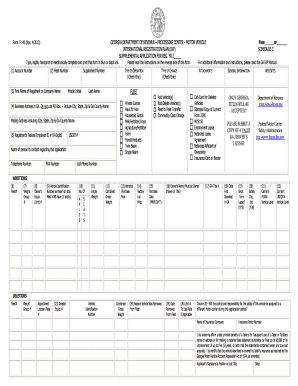
Georgia Motor Vehicle Accident Reparation Act of 1974, as amended. Applicant’s Signature & Position or Job Title: Date: Form T-140 – Instructions (Rev. 4/2013) Instructions for Completing Schedule C, Form T-140 Use Schedule C, Form T-140, when adding or deleting vehicles to a fleet after an original application has been filed. You must also use Schedule C, Form T-140, when transferring vehicles between fleets. Please do not use Schedule C, Form T-140, to change weights or to change the .
Open form follow the instructions
Easily sign the form with your finger
Send filled & signed form or save
How to fill out the GA T-140 Schedule C online
Filling out the GA T-140 Schedule C online is a crucial step for users looking to manage their fleet registration effectively. This guide provides clear, step-by-step instructions on how to complete the form accurately and efficiently.
Follow the steps to complete the GA T-140 Schedule C.
- Click ‘Get Form’ button to obtain the form and open it in the editor.
- Enter your account number in the designated field. This is the number assigned to you during your initial application.
- Fill in the fleet number. A fleet consists of one or more vehicles that travel the same states.
- Input the registrant's name, which can be an individual, business, or corporation, as shown on your original application.
- Provide the business address in Georgia, ensuring you do not use a P.O. Box. Include the city, state, zip code, and county name.
- If applicable, type in the registrant’s Federal Employer ID number (nine digits).
- Complete the vehicle details including owner’s equipment number, vehicle identification number (VIN), number of axles, empty weight, and combined gross weight.
- Specify the vehicle purchase price and the factory list price, ensuring there are no cents noted.
- Indicate the date of purchase using the MM/DD/YY format and provide the owner's name as shown on the vehicle title.
- Fill out the date the vehicle first operated in Georgia and indicate whether it is under a short-term lease.
- If relevant, answer whether the safety control will be assigned to a different carrier during this registration period.
- Complete the section for deletions if any vehicles are being removed, stating the reason for removal and the date.
- Review all entries for accuracy and completeness.
- Once finished, save your changes, download, print, or share the form as needed.
Begin filing the GA T-140 Schedule C online today to manage your fleet registration efficiently.
Experience a faster way to fill out and sign forms on the web. Access the most extensive library of templates available.
Related content
T-140 IRP Supplemental Application Schedule C Form T-140 IRP Supplemental Application...
Dec 31, 2021 — Georgia DOR was calendar year (CY) 2019. Therefore, even in cases in...
Table C of Part IV to this document, indicates the States that had not ... schedule and...
Get answers to your most pressing questions about US Legal Forms API.
What is the Schedule C on the 1040 form?
The Schedule C on the 1040 form details the profit or loss from a business operated as a sole proprietorship. It allows you to report your revenue and expenses, paving the way for an accurate net income figure on your tax return. The GA T-140 Schedule C is instrumental in ensuring you capture all eligible deductions and maintain compliance with tax laws. Utilizing this form effectively can help optimize your tax outcomes.
Does everyone have a 1040 Schedule C?
Not everyone needs a 1040 Schedule C; it is required only for those who are self-employed or operate a business. If you earn income solely through traditional employment and receive a W-2, you won't be dealing with this form. However, if your income comes from a business venture, the GA T-140 Schedule C becomes vital for reporting your earnings. Always assess your situation to determine if this form applies to you.
Where is Schedule C reported on 1040?
Schedule C is reported directly on the 1040 form, specifically on the front page under the section for income. Your net profit or loss calculated from the GA T-140 Schedule C will flow to your 1040, impacting your overall tax calculations. It's important to ensure that these numbers align correctly to avoid discrepancies with the IRS. Properly indicating your business income helps streamline the tax filing process.
Who should not file a Schedule C?
Individuals who earn income solely from wages or salaries, as recorded on a W-2, should not file a Schedule C. Moreover, if you are not actively engaged in a trade or business, it is not appropriate to use the GA T-140 Schedule C. Remember, this form is specifically for those who run a business or are self-employed. Always consult with a tax professional if you're uncertain about your filing requirements.
What qualifies as Schedule C income?
Schedule C income includes any earnings from self-employment activities or a business you operate as a sole proprietor. This can encompass profits from selling goods, providing services, or any other revenue-generating activities. When you report your income using the GA T-140 Schedule C, it helps clarify your earnings and establish your tax obligations. Accurate reporting ensures you comply with tax requirements and maximize your allowable deductions.
What is the net income on Schedule C?
The net income on GA T-140 Schedule C refers to the profit your business earns after subtracting all allowable business expenses from your total revenue. This figure is essential for determining your tax obligations and can influence your overall financial health. Accurately calculating net income ensures compliance with IRS regulations. To ease the process and ensure accuracy, you may opt for resources available on US Legal Forms to assist you.
Who fills out Schedule C form 1040?
The IRS Schedule C form 1040 is typically filled out by sole proprietors and individuals who conduct business as self-employed. This includes freelancers, independent contractors, and those who operate a business under their name. By completing this form, you report your business income and expenses, which is crucial for accurate tax calculations. Utilizing platforms like US Legal Forms can simplify the completion process for you.
How is Schedule C income calculated?
Schedule C income is calculated by first determining your total income from sales and services. Once you have that figure, deduct your business expenses, which may include costs like rent, utilities, and supplies. This calculation gives you the net profit or loss from your business, as reflected on the GA T-140 Schedule C. Remember to keep detailed financial records to support your calculations.
How do I prove my Schedule C income?
Proving your Schedule C income requires maintaining accurate records of all transactions related to your business. This includes invoices, receipts, and bank statements that detail your income and expenses. Additionally, you can use tools like the US Legal Forms platform to help organize your documents and generate reports that substantiate your claims. This organized approach can streamline your tax filing process.
Use professional pre-built templates to fill in and sign documents online faster. Get access to thousands of forms.
If you believe that this page should be taken down, please follow our DMCA take down process here.
This form is available in several versions. Select the version you need from the drop-down list below.