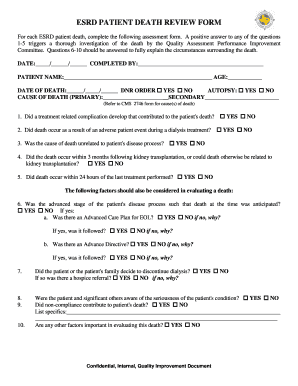
the Quality Assessment Performance Improvement Committee. Questions 6-10 should be answered to fully explain the circumstances surrounding the death. DATE:_____/______/______ COMPLETED BY:____________________________________________ PATIENT NAME:____________________________________________________ AGE:____________ DATE OF DEATH:______/_____/______ DNR ORDER YES NO AUTOPSY: YES NO CAUSE OF DEATH (PRIMARY):_______________________SECONDARY__________________________ (Refer to CMS 27.
Open form follow the instructions
Easily sign the form with your finger
Send filled & signed form or save
How to fill out the TX ESRD Patient Death Review Form online
Filling out the TX ESRD Patient Death Review Form online requires careful attention to detail, as each section is crucial for understanding the circumstances surrounding a patient's death. This guide provides clear and supportive instructions to help users navigate the form's components effectively.
Follow the steps to complete the form accurately
- Click ‘Get Form’ button to access the TX ESRD Patient Death Review Form and open it in your preferred editing tool.
- Begin by entering the date, your name, the patient's name, age, and the date of death in the designated fields.
- Indicate whether a Do Not Resuscitate (DNR) order was present by checking 'YES' or 'NO'.
- Specify if an autopsy was conducted by selecting 'YES' or 'NO'.
- Provide the primary and secondary causes of death, referring to the CMS 2746 form for accurate descriptions.
- Answer questions 1-5 by selecting 'YES' or 'NO', as a positive response triggers further investigation.
- In section 6, evaluate whether the advanced stage of the patient's disease was anticipated and respond accordingly, following up with the Advanced Care Plan and Advance Directive questions.
- Continue to section 7, documenting any decisions made by the patient or family regarding the discontinuation of dialysis.
- For section 8, confirm if the patient and significant others understood the seriousness of the condition, and address any non-compliance issues noted.
- Finally, review any other significant factors related to the death and confirm your responses.
- Once all sections are completed, save your changes, then download, print, or share the completed form as necessary.
Complete the TX ESRD Patient Death Review Form online today to ensure careful documentation.
Experience a faster way to fill out and sign forms on the web. Access the most extensive library of templates available.
Related content
Form 6103 is used to notify Texas Health and Human Services Commission (HHSC) of an...
You will be graded on the correctness, completeness, and presentation of your layouts, on...
51% of patients receiving . Treatment-related deaths occurred in one patient in the...
Get answers to your most pressing questions about US Legal Forms API.
What is a 2746 form?
A 2746 form, often referred to as the 'End Stage Renal Disease Medical Evidence Report,' is used to collect patient information regarding kidney disease. It plays a crucial role in establishing a patient's eligibility for Medicare coverage. If you are navigating the complexities of ESRD and require support, uslegalforms can offer valuable resources to help with this documentation.
Do ESRD patients automatically get Medicare?
Yes, most ESRD patients receive Medicare coverage automatically, typically after they start dialysis or have a transplant. This process provides critical support for managing healthcare costs associated with kidney disease. To ensure all paperwork is completed correctly, consider using the TX ESRD Patient Death Review Form if needed in your situation.
Does ESRD automatically qualify for Medicare?
Patients with End Stage Renal Disease generally automatically qualify for Medicare after a certain period of dialysis or following a kidney transplant. This provision provides significant health coverage, including hospital care and outpatient services. Understanding your eligibility can be simplified through resources like uslegalforms, which can help you manage the necessary documentation.
Do all dialysis patients qualify for Medicaid?
Not all dialysis patients automatically qualify for Medicaid, as eligibility depends on various factors including income and state guidelines. It is important for patients to evaluate their individual circumstances and apply if they meet the requirements. Consulting resources like uslegalforms can assist you in understanding how to navigate Medicaid applications effectively.
What is the most common cause of death in end-stage renal failure?
The most common cause of death in end-stage renal failure often results from complications such as cardiovascular disease. Due to the imbalance in body function caused by kidney failure, these complications can arise more frequently. Families may need to prepare relevant documentation, including the TX ESRD Patient Death Review Form, to facilitate necessary processes.
What is ESRD on a death certificate?
ESRD, or End Stage Renal Disease, appears on a death certificate to indicate the underlying cause of death related to kidney failure. This designation is crucial for accurate statistical reporting and for processing necessary documents like the TX ESRD Patient Death Review Form. Understanding this can help families navigate the complexities of loss and ensure proper follow-up.
What is required when a patient is in end stage kidney disease?
When a patient is in end stage kidney disease, they typically require regular dialysis treatment or a kidney transplant. Proper documentation, such as a TX ESRD Patient Death Review Form, may also be necessary for healthcare providers and family members. It is essential for patients to work closely with their healthcare team to manage symptoms and ensure they receive the support they need.
What is the life expectancy of someone with ESRD?
The life expectancy of someone with end-stage renal disease varies greatly depending on several factors, including age, overall health, and the effectiveness of their treatment. Generally, with proper management, patients can live for several years after diagnosis. Timely use of resources like the TX ESRD Patient Death Review Form can help track patient outcomes and enhance care, potentially extending life expectancy.
What do patients with ESRD require?
Patients with end-stage renal disease need comprehensive care, including dialysis or a kidney transplant to maintain their health. They also require ongoing monitoring and support to manage complications and improve their quality of life. Proper documentation through the TX ESRD Patient Death Review Form can significantly aid healthcare providers in tailoring treatment plans that meet these complex needs.
What does ESRD mean on a death certificate?
On a death certificate, ESRD stands for end-stage renal disease, which indicates that the individual experienced severe kidney dysfunction before passing. This classification highlights the critical nature of their condition and helps inform medical and legal considerations. Utilizing the TX ESRD Patient Death Review Form can provide essential documentation for understanding these cases more thoroughly.
Use professional pre-built templates to fill in and sign documents online faster. Get access to thousands of forms.
If you believe that this page should be taken down, please follow our DMCA take down process here.