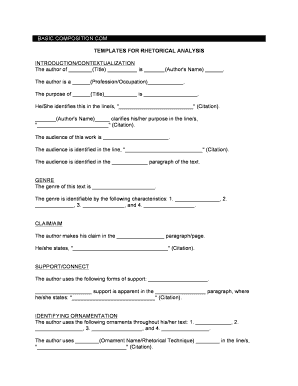
BASIC COMPOSITION.COM TEMPLATES FOR RHETORICAL ANALYSIS INTRODUCTION/CONTEXTUALIZATION The author of (Title) is (Author 's Name) . The author is a (Profession/Occupation) . The purpose of (Title).
Open form follow the instructions
Easily sign the form with your finger
Send filled & signed form or save
How to fill out the Rhetorical Analysis Template online
This guide provides step-by-step instructions for completing the Rhetorical Analysis Template online. By following these clear and concise directions, users can easily navigate the form and ensure all necessary information is accurately submitted.
Follow the steps to complete your Rhetorical Analysis Template.
- Press the ‘Get Form’ button to access the template and open it in your chosen online format.
- Begin by filling in the introduction/contextualization section. Enter the title of the work in the first blank, followed by the author's name in the second blank. Specify the author's profession or occupation in the third blank.
- Describe the purpose of the work in the fourth blank, including a citation to support your statement in the provided space.
- Indicate the audience of the work in the blank that follows. You can identify this from the relevant section of the text and include a citation to validate your choice.
- In the genre section, state the genre of the text and detail its characteristics in the subsequent blanks. You may list up to four identifying traits.
- Moving to the claim/aim section, articulate the main claim made by the author, specifying its location within the text along with a proper citation.
- In the support/connect section, outline the forms of support the author utilizes. Provide an example quote from the relevant paragraph along with a citation.
- Lastly, in the identifying ornamentation section, list various rhetorical techniques applied throughout the text. Ensure to offer a specific citation for each technique mentioned.
- Once all fields are complete, make sure to save your changes. You can also choose to download, print, or share the form as needed.
Start completing your Rhetorical Analysis Template online today for a comprehensive understanding.
Experience a faster way to fill out and sign forms on the web. Access the most extensive library of templates available.
Related content
In this speech, the author uses a unique progression of ideas, point of view, and a...
Then, click the image below to open a PDF of the sample paper. The strategies and...
Parallelism is a rhetorical device that compounds words or phrases that have equivalent...
Get answers to your most pressing questions about US Legal Forms API.
What are the 5 parts of a letter rhetoric?
In this early manual, the five parts of a letter are explained: “the Salutation, the Securing of Goodwill, the Narration, the Petition, and the Conclusion” (Bizzell & Herzberg, 2001, p. 497).
What are the key points of rhetorical analysis?
A rhetorical analysis considers all elements of the rhetorical situation--the audience, purpose, medium, and context--within which a communication was generated and delivered in order to make an argument about that communication.
What are the 3 main parts of a rhetorical analysis?
Aristotle taught that a speaker's ability to persuade an audience is based on how well the speaker appeals to that audience in three different areas: logos, ethos, and pathos. Considered together, these appeals form what later rhetoricians have called the rhetorical triangle.
How do you write a rhetorical analysis?
In writing an effective rhetorical analysis, you should discuss the goal or purpose of the piece; the appeals, evidence, and techniques used and why; examples of those appeals, evidence, and techniques; and your explanation of why they did or didn't work.
What are the 5 points of rhetorical analysis?
The rhetorical situation can be described in five parts: purpose, audience, topic, writer, and context. These parts work together to better describe the circumstances and contexts of a piece of writing, which if understood properly, can help you make smart writing choices in your work.
How do you start a rhetorical analysis essay?
The introductory paragraph to an analysis essay is usually brief. However, it must contain some essential information. (Writer's credentials), (writer's first and last name), in his/her (type of text), (title of text), (strong verb – see list at end of this handout) (writer's subject).
What are the basic steps of rhetorical analysis?
A rhetorical analysis is structured similarly to other essays: an introduction presenting the thesis, a body analyzing the text directly, and a conclusion to wrap up. This article defines some key rhetorical concepts and provides tips on how to write a rhetorical analysis.
Use professional pre-built templates to fill in and sign documents online faster. Get access to thousands of forms.
If you believe that this page should be taken down, please follow our DMCA take down process here.