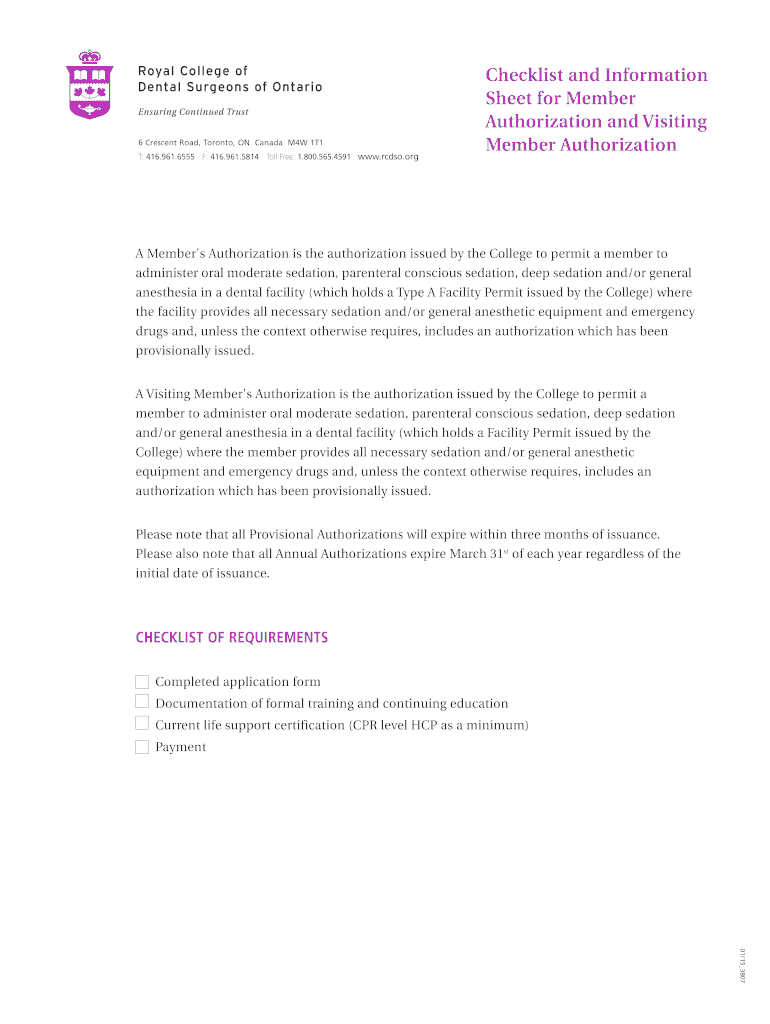
6 Crescent Road, Toronto, ON Canada M4W 1T1 T: 416.961.6555 F: 416.961.5814 Toll Free: 1.800.565.4591 www.rcdso.orgChecklist and Information Sheet for Member Authorization and Visiting Member AuthorizationA.
Loading

Open form follow the instructions

Easily sign the form with your finger

Send filled & signed form or save
How to fill out the Canada RCDSO Checklist And Information Sheet For Member Authorization And Visiting Member online
The Canada RCDSO Checklist and Information Sheet for Member Authorization and Visiting Member provides essential guidelines for dental professionals seeking authorization to administer sedation and anesthesia. This comprehensive guide will walk you through the process of completing the form online, ensuring a smooth and efficient submission experience.
Follow the steps to complete the checklist and information sheet effectively.
- Click ‘Get Form’ button to obtain the form and open it in your preferred online editing platform.
- Begin by selecting the type of authorization you are seeking: either 'Member authorization' or 'Visiting member authorization.' Make sure to provide accurate information as this determines the necessary requirements for your application.
- Fill in your personal information, including your name, street address, suite number, city, province, postal code, telephone number, fax number, and email address. Ensure all details are correct to avoid processing delays.
- Indicate which modalities of sedation and/or general anesthesia you intend to administer by checking 'Yes' or 'No' for each option listed: oral moderate sedation, parenteral conscious sedation, deep sedation, and general anesthesia.
- List all drugs you plan to administer to achieve the sedation and anesthesia modalities. Include any additional drugs not listed in the provided options.
- Provide details of your formal training and competencies in sedation and general anesthesia. Include the name and location of the institution where you received your training and attach a copy of the certificate of completion.
- Fill in your continuing education details if applicable, indicating whether you have participated in any related programs in the past year. Provide the course name, date, and location.
- Review the attestation section carefully, as it outlines your understanding of the regulations and responsibilities. Sign and date the form along with a witness.
- Complete the payment section by selecting your preferred payment method (certified cheque, money order, or credit card). Fill out the required payment details accurately.
- Finally, save your changes, download the completed form, and print or share it as required. Ensure that you keep a copy for your records before submission.
Complete your documents online to ensure timely processing and compliance with professional standards.
Experience a faster way to fill out and sign forms on the web. Access the most extensive library of templates available.
Related content
What are the requirements for a dental license? A complete list of requirements is...
carefully and provide all of the requested information as quickly as possible....
Confidentiality of Member Health Information and HIPPA Transactions ... form and send it...
Get answers to your most pressing questions about US Legal Forms API.
What is the difference between minimal and moderate sedation?
Minimal: also called anxiolysis; the patient remains awake but relaxed, able to interact. Moderate: also called conscious sedation, the patient has depressed consciousness but will respond to verbal requests or react to touch. Breathing remains intact, and no support is needed.
What is the use of sedation and general anesthesia in dental practice?
At the most basic level a local anesthetic is used to prevent pain. Applied directly to the treatment site, used on its own it will not alter consciousness. Sedation in conjunction with anesthetic medications is used to relieve pain or to relax and calm a patient in preparation for a dental procedure.
What parameter must be monitored continuously during sedation?
Routine monitoring during procedural sedation should include continuous pulse oximetry and ECG monitoring as well as intermittent recordings of respiratory rate and blood pressure at a frequency of at least every 5 minutes during the procedure.
What are the levels of sedation?
What are the levels of sedation? Minimal – Minimal sedation will help you relax, but you will likely be awake. ... Moderate – You will feel drowsy and may even fall asleep during the procedure. ... Deep – You won't actually be unconscious, but you'll sleep through the procedure and probably will have little or no memory of it.
What drugs are used for minimal sedation?
Among these are phenothiazines, butyrophenones, barbiturate and non-barbiturate hypnotics, benzodiazepines, and the hypno-analgesic, . As benzodiazepines offer both sedative and profound amnesic and anxiolytic effects, these drugs are used for conscious sedation worldwide.
What is the difference between minimal and deep sedation?
Minimal sedation is given only to relieve anxiety, with very little effect on patient awareness, while moderate sedation depresses consciousness, but leaves the patient capable of responding to external stimuli (tactile or verbal). In deep sedation, the patient only responds to painful or repeated stimuli.
What is considered minimal sedation?
Minimal Sedation (Anxiolysis) is a drug-induced state during which patients respond normally to verbal commands. Although cognitive function and physical coordination may be impaired, airway reflexes, and ventilatory and cardiovascular functions are unaffected.
Use professional pre-built templates to fill in and sign documents online faster. Get access to thousands of forms.
If you believe that this page should be taken down, please follow our DMCA take down process here.