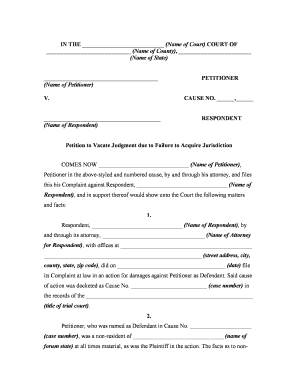
IN THE (Name of Court) COURT OF (Name of County), (Name of State) (Name of Petitioner) V.PETITIONER CAUSE NO. , (Name of Respondent)RESPONDENTPetition to Vacate Judgment due to Failure to Acquire.
Open form follow the instructions
Easily sign the form with your finger
Send filled & signed form or save
How to fill out the Jurisdiction Over Defendant online
Filling out the Jurisdiction Over Defendant form is an important step for users seeking to challenge a judgment entered against them due to a lack of jurisdiction. This guide will provide a detailed overview of how to competently and confidently complete the form online.
Follow the steps to successfully complete the form online:
- Click ‘Get Form’ button to obtain the form and open it in the editor.
- Begin by filling in the name of the court, the county, and the state at the top of the form. Make sure to provide accurate and complete information to avoid potential issues.
- In the section for the petitioner, enter the name of the person who is filing the petition. This should be the same individual named as the defendant in the original case.
- For the respondent section, input the name of the opposing party involved in the lawsuit, along with their attorney's name and address if available.
- Fill in the cause number as assigned to the original judgment case to ensure the document is accurately identified.
- Detail the events surrounding the original judgment. Start by stating the date on which the original complaint was filed and include the docketing information.
- Explain the reasons for filing the petition, emphasizing any lack of jurisdiction that may have occurred during the original case. Be clear and specific in this section.
- Address any specific failures by the plaintiff in the previous case regarding service of notice or jurisdiction. This may include noting any proof of service that was not filed.
- If applicable, provide details about when you first became aware of the judgment and the circumstances surrounding that notification.
- Attach any supporting documents or affidavits that reinforce your claims, labeled appropriately as 'Exhibit A' or similar.
- Conclude the form by signing and dating it. Ensure that the name and signature of the petitioner's attorney are included along with their state bar number.
- Finally, save your completed form, ensuring that you download, print, or share it as needed.
Take the next step in managing your legal matters by filling out your documents online today.
Experience a faster way to fill out and sign forms on the web. Access the most extensive library of templates available.
Related content
Jurisdiction over the legal issue or dispute you are suing about, called “subject-matter...
Typically for a court to have personal jurisdiction over a defendant, the plaintiff needs...
Personal jurisdiction is a court's jurisdiction over the parties, as determined by the...
Get answers to your most pressing questions about US Legal Forms API.
What is the difference between jurisdiction and venue?
While jurisdiction says in what state and what court you file your lawsuit, venue is the county where you file your action.
Who has personal jurisdiction?
Personal jurisdiction In general, all California superior courts have jurisdiction over a person that lives in California or can be found in California, and businesses or organizations that do business in California.
What is jurisdiction over the person?
Jurisdiction over the person (also sometimes simply referred to as personal jurisdiction) is jurisdiction over the persons or entities, such as corporations or partnerships, involved in the lawsuit. In rem jurisdiction is implicated when an object or piece of land is the subject of the legal action.
Why is it important for the court to have personal jurisdiction over the defendant?
Personal jurisdiction means the judge has the power or authority to make decisions that affect a person. For a judge to be able to make decisions in a court case, the court must have personal jurisdiction over all of the parties to that court case.
Court System Basics: What is personal jurisdiction? Why is it ...
The jurisdiction of a legal case depends on both personal jurisdiction and subject matter jurisdiction. A court must have both subject matter jurisdiction and personal jurisdiction over the matter to hear a case. Subject matter comes first.
How do you determine jurisdiction?
The jurisdiction of a legal case depends on both personal jurisdiction and subject matter jurisdiction. A court must have both subject matter jurisdiction and personal jurisdiction over the matter to hear a case. Subject matter comes first.
What are Jurisdiction and Venue Requirements? | Justia
The court must have power over the defendant that you are suing, which is known as personal jurisdiction, and it must have the power to resolve the legal issues in the case, which is known as subject matter jurisdiction. ... This involves choosing which court in a certain state should hear your case.
Use professional pre-built templates to fill in and sign documents online faster. Get access to thousands of forms.
If you believe that this page should be taken down, please follow our DMCA take down process here.