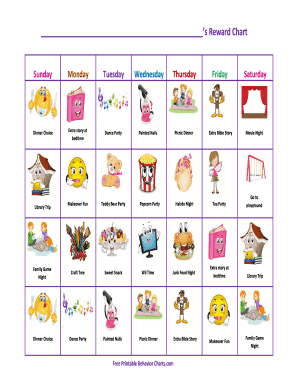
SRewardChart Sunday Monday Tuesday ThursdayWednesday Friday Saturday Extrastoryat bedtimeDinnerChoiceDancePartyMakeoverFunLibraryTripFamilyGame NightTeddyBearPartyCraftTmePaintedNailsSweetSnackHairdoNightWiiTimeExtraBibleStoryPopcornPartyPicnicDinner.
Open form follow the instructions
Easily sign the form with your finger
Send filled & signed form or save
How to fill out the Reward Chart - Free Printable Behavior Charts online
This guide provides clear instructions on how to effectively fill out the Reward Chart - Free Printable Behavior Charts. By following these steps, users can easily personalize and utilize the chart to encourage positive behavior.
Follow the steps to fill out your reward chart with ease.
- Click ‘Get Form’ button to access the chart and open it in the editor.
- Identify the days of the week listed on the top of the chart. Each day provides a space for tracking behaviors and rewards.
- Fill in the desired rewards for each day. Consider options such as 'Dance Party' or 'Library Trip' that might motivate the individual.
- As behaviors are exhibited, mark them accordingly on the designated days. Use check marks or other indicators to represent accomplishments.
- Review the chart periodically to assess progress and make adjustments to rewards as necessary for continued motivation.
- Once completed, save changes to the document. You can then download, print, or share the filled-out reward chart with others.
Start filling out your Reward Chart online today to track and encourage positive behavior effectively!
Experience a faster way to fill out and sign forms on the web. Access the most extensive library of templates available.
Related content
But, sometimes you may want to use a sticker or check mark for things like using the...
The theory behind such methods stems from a branch of psychology called 'behaviourism'...
A bubble chart is a type of chart that displays three dimensions of data. ... Bubble...
Get answers to your most pressing questions about US Legal Forms API.
How do you make a homemade behavior chart?
How to create a behavior chart Set your goal. You'll want to be as specific as possible when setting a goal. ... Choose a reward. Try to choose a reward that you know will truly motivate your child. ... Make your chart. ... Set up the ground rules. ... Use your chart. ... Work toward life without a chart.
What can I do instead of reward charts?
Here are my top five alternatives to using a reward chart in early years settings: Develop strong bonds and attachments with children. ... Use encouragement. ... Use labelled praise. ... Providing a stimulating environment. ... Promote a growth mindset.
What can I use instead of a behavior chart?
Feelings Charts, cozy corners, and other types of emotionally responsive invitations are alternatives to behavioral management programs. Feelings charts give children the opportunity to think about how they feel, and to communicate those feelings to the adults in the classroom.
What can I use instead of a behavior chart at home?
Sticker or incentive charts might be used to track positive choices in order to earn a reward or a positive consequence. Color-coded charts track both desired and undesired behaviors and therefore assign positive and/or negative consequences.
Why not to use behavior charts?
While behavior charts may be effective in achieving the short-term goal of obedience, this approach to discipline misses the goal of building the executive functioning part of the brain where life-long skills such as personal awareness, empathy, impulse control, and problem-solving are cultivated.
How do you make a reward chart for behaviour?
Setting up reward charts that work well: steps Clearly and positively describe the behaviour you want to encourage. ... Choose a chart. ... Choose short-term rewards. ... Give your child stickers straight after the behaviour. ... Try to stay positive. ... Move on from the reward chart. ... Optional step: measure the behaviour.
Why not to use behavior charts in the classroom?
Behavior charts can reinforce students who are already sociable and well behaved, but negatively affect those students who aren't. Using charts in your classroom can affect students with a history of trauma, shame your students, and enforce strict obedience instead of actual change.
Why I don't use behavior charts?
While behavior charts may be effective in achieving the short-term goal of obedience, this approach to discipline misses the goal of building the executive functioning part of the brain where life-long skills such as personal awareness, empathy, impulse control, and problem-solving are cultivated.
Use professional pre-built templates to fill in and sign documents online faster. Get access to thousands of forms.
If you believe that this page should be taken down, please follow our DMCA take down process here.