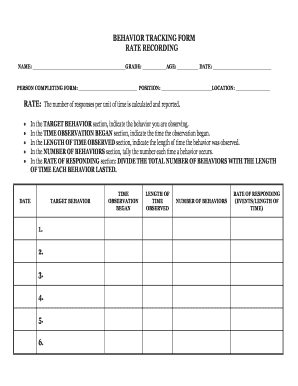
LOCATION: RATE: The number of responses per unit of time is calculated and reported. In the TARGET BEHAVIOR section, indicate the behavior you are observing. In the TIME OBSERVATION BEGAN section, indicate the time the observation began. In the LENGTH OF TIME OBSERVED section, indicate the length of time the behavior was observed. In the NUMBER OF BEHAVIORS section, tally the number each time a behavior occurs. In the RATE OF RESPONDING section: DIV.

How it works
  • Open form

    Open form follow the instructions

  • Easily sign form

    Easily sign the form with your finger

  • Share form

    Send filled & signed form or save

How to fill out the BEHAVIOR TRACKING FORM - Gulfportschoolsorg online

Filling out the Behavior Tracking Form is essential for effectively documenting and analyzing behavioral observations. This guide will provide clear, step-by-step instructions to assist users in completing the form accurately and efficiently.

Follow the steps to fill out the Behavior Tracking Form effectively.

  1. Press the ‘Get Form’ button to access the Behavior Tracking Form and open it in your preferred editor.
  2. In the 'Name' field, enter the name of the individual being observed, followed by their grade and age. This information is crucial for identifying the person involved.
  3. In the 'Date' field, indicate the date when the observation is taking place. Ensure accuracy to maintain proper records.
  4. Identify yourself in the 'Person Completing Form' section, including your name, position, and location, to provide context for the observation.
  5. In the 'Target Behavior' section, list the specific behaviors you are observing. Clearly stating these behaviors allows for better tracking and analysis.
  6. Document the 'Time Observation Began' by noting the exact time you started observing the behaviors. This helps in creating a timeline.
  7. Indicate the 'Length of Time Observed' by writing how long the observation lasted. This is important for calculating the frequency of behaviors.
  8. In the 'Number of Behaviors' section, keep a tally of each time the observed behavior occurs during the observation period.
  9. Calculate the 'Rate of Responding' by dividing the total number of behaviors recorded by the length of time the observation lasted. This provides a clear metric for analyzing behavior.
  10. After completing the form, you can save your changes, download a copy for records, print it for physical documentation, or share it as required.

Begin filling out the Behavior Tracking Form online today!

Get form

Experience a faster way to fill out and sign forms on the web. Access the most extensive library of templates available.

Related content

U.S. Department of Education 2019 National Blue...

The original signed cover sheet only should be converted to a PDF file and ... Department...

Learn more
Bayou View Middle School - US Department of...

U.S. Department of Education monitoring report that apply to the school or school ... Our...

Learn more
Questions & Answers

Get answers to your most pressing questions about US Legal Forms API.

Contact support

How do you make a behavior tracker?

The chart itself is simply a piece of paper that has rows and columns on it. You then write down the behaviors you would like your child to engage in. For example, “complete all homework” or “hang up clothes after you shower.” Then you and your child keep track of how often they complete the behavior on the chart.

In most simple terms, it is a way of gaining information about users' browsing habits. The data collected from their Internet and social media searches helps brands process data more efficiently and create more effective campaigns.

By tracking the behavior, you will find clues that help you begin to identify the reasons behind the specific behaviors in your classroom. Once you know the reasons, you will no longer need to pick random strategies and hope they work.

The forms were created so teachers or other professionals could rate a child's behavior 2-4 times per day over a one month period of time. A simple behavior contract that can be used in conjunction with the tracker is also included. Classroom Management, School Psychology, Special Education.

Behaviour charts are simple documents that track behaviours of concern which may impact daily routines for a person with an intellectual and/or developmental disability. Behaviour charts are important when discussing past behaviours of concern with any medical teams.

Get This Form Now!

Use professional pre-built templates to fill in and sign documents online faster. Get access to thousands of forms.

If you believe that this page should be taken down, please follow our DMCA take down process here.

Get BEHAVIOR TRACKING FORM - Gulfportschoolsorg