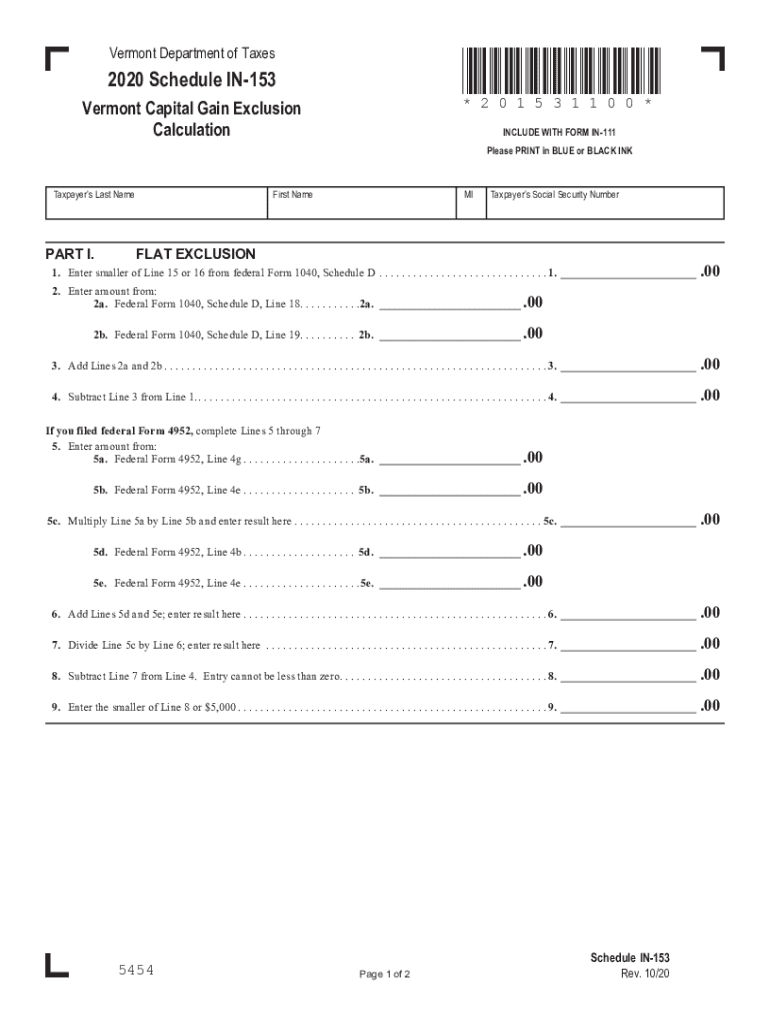
Vermont Department of Taxes*201531100*2020 Schedule IN153* 2 0 1 5 3 1 1 0 0 *Vermont Capital Gain Exclusion CalculationINCLUDE WITH FORM IN111 Please PRINT in BLUE or BLACK INKTaxpayers Last NamePART.
Loading

Open form follow the instructions

Easily sign the form with your finger

Send filled & signed form or save
How to fill out the VT Schedule IN-153 online
Completing the VT Schedule IN-153 is a crucial step in claiming your capital gain exclusion. This guide provides straightforward instructions to help you successfully fill out the form online.
Follow the steps to effectively complete the VT Schedule IN-153.
- Press the ‘Get Form’ button to obtain the form and open it in your preferred editor.
- Fill in your last name, first name, middle initial, and Social Security number in the designated fields at the top of the form.
- In Part I, start with Line 1 by entering the smaller amount from Line 15 or 16 of your federal Form 1040, Schedule D.
- For Line 2a, input the amount from federal Form 1040, Schedule D, Line 18, and for Line 2b, the amount from federal Form 1040, Schedule D, Line 19.
- Add the amounts in Lines 2a and 2b, and enter the total in Line 3.
- Subtract the amount in Line 3 from Line 1 and enter the result in Line 4.
- If you filed a federal Form 4952, move to Lines 5 through 8 for additional calculations relevant to your situation, entering the required amounts as instructed.
- In Part II, if eligible gains apply, complete Lines 10 to 18, following similar instructions to calculate your capital gain exclusion percentage.
- In Part III, determine your final capital gain exclusion by comparing values from previous sections and entering the required amounts in Lines 19 to 21.
- Once you have completed the form, save your changes, then download, print, or share the completed form as necessary.
Complete your forms online today for a more efficient filing experience.
Experience a faster way to fill out and sign forms on the web. Access the most extensive library of templates available.
Related content
Feb 8, 2021 — Tax Year 2020 Schedule IN-153, Capital Gain Exclusion Calculation. File...
Please fill out the IN-113 form if you received any of the following from a different...
Vermont Route 153 (VT 153) is a state highway in southwestern Vermont in the United...
Get answers to your most pressing questions about US Legal Forms API.
What is the standard deduction for VT income tax?
Standard Deduction For tax year 2022, it is $13,050 for Married/CU Filing Jointly or Qualifying Widow(er), $6,500 for Single or Married/CU Filing Separately, $9,800 for Head of Household, and an additional $1,050 for individuals 65 and older and/or blind.
What is exempt from sales tax in Vermont?
Product-based Exemption An item is exempt from tax based on the product type or category. Tangible personal property in this category is exempt from sales tax regardless of who purchases the product or how it will be used. For example, drugs intended for human consumption is a product-based exemption.
What are the exclusions for capital gains tax?
Use the Internal Revenue Service (IRS) primary residence exclusion, if you qualify. For single taxpayers, you may exclude up to $250,000 of the capital gains, and for married taxpayers filing jointly, you may exclude up to $500,000 of the capital gains (certain restrictions apply).1.
Is there a standard deduction for Vermont in 2023?
$6,500 for single and married separate filers; $9,800 for head-of-household filers; and. $13,050 for joint filers and surviving spouses.
What is the capital gains tax on real estate in Vermont?
When real estate is sold in Vermont, state income tax is due on the gain from the sale, whether the seller is a resident, part-year resident, or nonresident. If the seller is a nonresident, the buyer is required to withhold 2.5% of the sale price and remit it to the Vermont Department of Taxes.
What is property gains tax in Vermont?
Land Gains Withholding of 10% of the value attributable to the land must be withheld from the sale proceeds by the buyer at the closing.
What is the 40 capital gain exclusion in Vermont?
The Flat Exclusion is the general exclusion amount allowed for a particular tax year or the actual amount of net adjusted capital gains, whichever is less. A Percentage Exclusion allows you to you exclude up to 40% of your adjusted net capital gain from the sale of assets held for more than three years.
Use professional pre-built templates to fill in and sign documents online faster. Get access to thousands of forms.
If you believe that this page should be taken down, please follow our DMCA take down process here.