Loading
Form preview
  • US Legal Forms
  • Form Library
  • More Forms
  • More Multi-State Forms
  • 12+24-item Version, Interviewer-administered - Who - Who

Get 12+24-item Version, Interviewer-administered - Who - Who

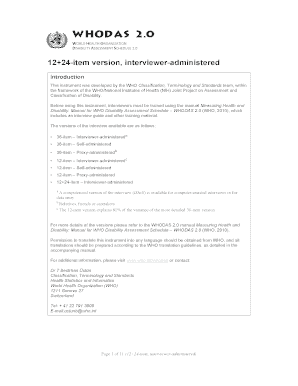
WHODAS-03(23Nov09).book Page 1 Tuesday, November 24, 2009 1:30 PM WHODAS 2.0 WORLD HEALTH ORGANIZATION DISABILITY ASSESSMENT SCHEDULE 2.0 12+24-item version, interviewer-administered Introduction.

How it works

  1. Open form

    Open form follow the instructions

  2. Easily sign form

    Easily sign the form with your finger

  3. Share form

    Send filled & signed form or save

How to fill out the 12+24-item Version, Interviewer-administered - WHO - Who online

This guide provides a comprehensive overview on how to accurately fill out the 12+24-item Version of the Interviewer-administered WHO Disability Assessment Schedule 2.0. It is designed to support users at all levels of experience in completing the form efficiently and correctly.

Follow the steps to successfully complete the form.

  1. Press the ‘Get Form’ button to access the form and open it in the editing interface.
  2. Begin with the face sheet (Section 1). Fill in items F1 to F5, including the respondent's identity number, interviewer's identification, assessment time point, interview date, and living situation.
  3. Move to Section 2 to collect demographic and background information. Record the respondent's gender, age, years of education, marital status, and main work status. Ensure to select the most accurate options provided.
  4. In Section 3, familiarize the respondent with the content of the interview. Use flashcard #1 to explain health conditions and the concept of difficulty with an activity. Then, present flashcard #2 to the respondent, detailing the scale they will use during the interview.
  5. Administer the core questions listed in Section 4. For each question (S1–S12), ask the respondent to rate the difficulty experienced over the past 30 days. Continue if any responses indicate difficulty beyond 'none'.
  6. If applicable, follow up with additional domains as specified, based on responses to the core questions. Proceed through questions about cognition, mobility, self-care, getting along, life activities, work or school activities, and participation.
  7. After completing all relevant sections, ensure all responses are accurately recorded. The final queries (H1, H2, H3) will assess the frequency of difficulties the respondent has faced.
  8. Conclude the interview by thanking the respondent for their participation. Save any changes if required, and ensure you have the option to download, print, or share the completed document.

Start filling out your 12+24-item Version, Interviewer-administered - WHO - Who form online today.

Get form

Experience a faster way to fill out and sign forms on the web. Access the most extensive library of templates available.
Get form

Related content

NCI Thesaurus - NIH
Preferred Name: CDISC Questionnaire WHODAS 2.0 12+24-item Version Interviewer-administered...
Learn more
Related - U-Connect
9.1 Interviewer-administered version specifications . ... The 12+24-item version of WHODAS...
Learn more
Food frequency questionnaire - Wikipedia
Length and administration format[edit] ... A FFQ that aims to capture total dietary intake...
Learn more

Related links form

AU Parramatta City Council Parking Penalty Notice Review Form 2011 Canada AH-109A 2009 Canada Workers Compensation Board Of PEI Sample Letter Of Representation 2007 AU Girl Guides Junior BP Workbook 2014

Questions & Answers

Get answers to your most pressing questions about US Legal Forms API.

Contact support

The EDSS scale ranges from 0 to 10 in 0.5 unit increments that represent higher levels of disability. Scoring is based on an examination by a neurologist. EDSS steps 1.0 to 4.5 refer to people with MS who are able to walk without any aid and is based on measures of impairment in eight functional systems (FS):

The scoring has three steps: Step 1 – Summing of recoded item scores within each domain. Step 2 – Summing of all six domain scores. Step 3 – Converting the summary score into a metric ranging from 0 to 100 (where 0 = no disability; 100 = full disability).

The Disability Assessment Scale (DAS) evaluates upper-limb functional disability in patients with spasticity. It is characterized by exaggerated deep tendon reflexes that interfere with muscular activity, gait, movement, or speech.

The World Health Organization Disability Assessment Schedule (WHODAS 2.0) is a generic assess- ment instrument developed by WHO to provide a standardized method for measuring health and disabil- ity across cultures.

The average scores are comparable to the WHODAS 5-point scale, which allows the clinician to think of the individual's disability in terms of none (0-0.49), mild (0.5-1.49), moderate (1.5-2.49), severe (2.5-3.49), or extreme (3.5-4).

The average scores are comparable to the WHODAS 5-point scale, which allows the clinician to think of the individual's disability in terms of none (1), mild (2), moderate (3), severe (4), or extreme (5).

The WHODAS 2.0 measures average functioning in everyday situations for the last 30 days, and surveys six domains of functioning: (1) cognition (understanding and communicating), (2) mobility (ability to move and get around), (3) self-care (eg, with regard to hygiene, dressing, and eating) (4) getting along with others, ...

Get This Form Now!

Use professional pre-built templates to fill in and sign documents online faster. Get access to thousands of forms.
Get form
If you believe that this page should be taken down, please follow our DMCA take down processhere.
Get 12+24-item Version, Interviewer-administered - WHO - Who
Get form
  • Adoption
  • Bankruptcy
  • Contractors
  • Divorce
  • Home Sales
  • Employment
  • Identity Theft
  • Incorporation
  • Landlord Tenant
  • Living Trust
  • Name Change
  • Personal Planning
  • Small Business
  • Wills & Estates
  • Packages A-Z
  • Affidavits
  • Bankruptcy
  • Bill of Sale
  • Corporate - LLC
  • Divorce
  • Employment
  • Identity Theft
  • Internet Technology
  • Landlord Tenant
  • Living Wills
  • Name Change
  • Power of Attorney
  • Real Estate
  • Small Estates
  • Wills
  • All Forms
  • Forms A-Z
  • Form Library
  • Legal Hub
  • About Us
  • Help Portal
  • Legal Resources
  • Blog
  • Affiliates
  • Contact Us
  • Delete My Account
  • Site Map
  • Industries
  • Forms in Spanish
  • Localized Forms
  • State-specific Forms
  • Forms Kit
  • Real Estate Handbook
  • All Guides
  • Notarize
  • Incorporation services
  • For Consumers
  • For Small Business
  • For Attorneys
  • USLegal
  • FormsPass
  • pdfFiller
  • signNow
  • altaFlow
  • DocHub
  • Instapage
Form Packages
  • Adoption
  • Bankruptcy
  • Contractors
  • Divorce
  • Home Sales
  • Employment
  • Identity Theft
  • Incorporation
  • Landlord Tenant
  • Living Trust
  • Name Change
  • Personal Planning
  • Small Business
  • Wills & Estates
  • Packages A-Z
Form Categories
  • Affidavits
  • Bankruptcy
  • Bill of Sale
  • Corporate - LLC
  • Divorce
  • Employment
  • Identity Theft
  • Internet Technology
  • Landlord Tenant
  • Living Wills
  • Name Change
  • Power of Attorney
  • Real Estate
  • Small Estates
  • Wills
  • All Forms
  • Forms A-Z
  • Form Library
Customer Service
  • Legal Hub
  • About Us
  • Help Portal
  • Legal Resources
  • Blog
  • Affiliates
  • Contact Us
  • Delete My Account
  • Site Map
  • Industries
  • Forms in Spanish
  • Localized Forms
  • State-specific Forms
  • Forms Kit
Legal Guides
  • Real Estate Handbook
  • All Guides
Prepared for you
  • Notarize
  • Incorporation services
Our Customers
  • For Consumers
  • For Small Business
  • For Attorneys
Our Sites
  • USLegal
  • FormsPass
  • pdfFiller
  • signNow
  • altaFlow
  • DocHub
  • Instapage
Social Media
Call us now toll free:
+1 833 426 79 33
As seen in:
© Copyright 1999-2026 airSlate Legal Forms, Inc. 3720 Flowood Dr, Flowood, Mississippi 39232
  • Your Privacy Choices
  • Terms of Service
  • Privacy Notice
  • Content Takedown Policy
  • Bug Bounty Program