Loading
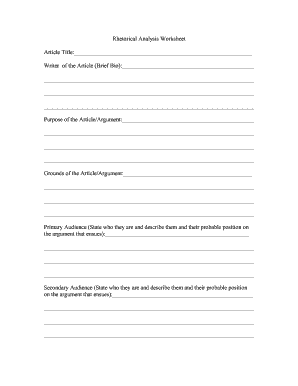
Get Rhetorical Analysis Worksheet
How it works
-

Open form follow the instructions
-

Easily sign the form with your finger
-

Send filled & signed form or save
How to fill out the Rhetorical Analysis Worksheet online
This guide provides clear instructions on how to fill out the Rhetorical Analysis Worksheet online. Whether you are new to digital document management or looking to refine your skills, this comprehensive approach will help you navigate each section with ease.
Follow the steps to successfully complete the Rhetorical Analysis Worksheet.
- Press the ‘Get Form’ button to access the worksheet and open it in your preferred online editor.
- Begin by entering the article title in the designated field labeled 'Article Title.' Ensure it is accurately spelled and formatted.
- In the 'Writer of the Article (Brief Bio)' section, provide a concise biography of the author that highlights their qualifications and relevance to the topic being discussed.
- For 'Purpose of the Article/Argument,' articulate the main goal of the article. Why did the author write it, and what are they trying to accomplish?
- In the 'Grounds of the Article/Argument' section, identify the key points the author uses to support their argument. List these grounds clearly.
- Fill in details about the primary audience by describing who they are and their likely stance on the argument presented in the article.
- Repeat the process for both the secondary and tertiary audiences, outlining their probable positions regarding the author's argument.
- Assess the author's stance on the issue based on the language and evidence presented throughout the article, and document your findings.
- Identify any biases that may influence the author's perspective. Consider their background and societal position.
- Analyze the rhetorical appeals utilized in the article. Clearly state examples of logos, ethos, and pathos, and paraphrase where needed.
- For each claim made in the article, provide a detailed answer for the claim, supporting data, warrant, and backing.
- Document any qualifiers that the author uses to limit claims or assertions.
- Identify any logical fallacies present in the author's arguments, explaining how they impact the overall discussion.
- Engage with the author's claims by providing rebuttals, and articulate counter-arguments based on their stance and bias.
- Lastly, draft a summary analysis that encapsulates your findings. Reflect on whether the author successfully argued their points, remained neutral, or failed to make a convincing case.
- Once you have completed the worksheet, be sure to save your changes. You can then download, print, or share the form as needed.
Start filling out the Rhetorical Analysis Worksheet online now to enhance your analytical skills and understanding.
The rhetorical situation identifies the relationship among the elements of any communication--audience, author (rhetor), purpose, medium, context, and content. Audience. ... Author/Rhetor/Speaker/Writer. ... Purpose of the Author. ... Medium. ... Claim. ... Support. ... Warrant. ... Ethos.