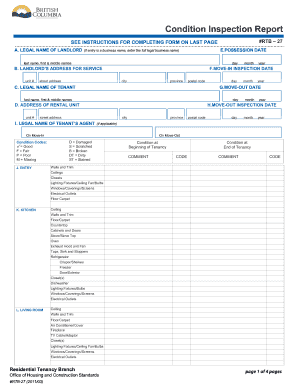
S name) last name, first & middle names day B. LANDLORD’S ADDRESS FOR SERVICE unit # street address city province postal code C. LEGAL NAME OF TENANT last name, first & middle names day city province month year month year postal code day month year (if applicable) On Move-In On Move-Out D = Damaged S = Scratched B = Broken DT = Dirty ST = Stained Condition Codes: P= Good F = Fair P = Poor M = Missing J. ENTRY day H.MOVE-OUT INSPECTION DATE street address I. LEGAL NA.

How it works
  • Open form

    Open form follow the instructions

  • Easily sign form

    Easily sign the form with your finger

  • Share form

    Send filled & signed form or save

How to fill out the Canada RTB-27 online

The Canada RTB-27 is a critical document for recording the condition of a rental unit at the start and end of a tenancy. This guide will provide clear, step-by-step instructions to assist users in filling out this form online, ensuring that all information is accurately captured.

Follow the steps to successfully complete the Canada RTB-27 online.

  1. Click ‘Get Form’ button to obtain the form and open it in the editor.
  2. In box A, enter the legal name of the landlord, ensuring it matches the name on any official documentation.
  3. Fill out box B with the landlord’s address for service, including unit number, street address, city, province, and postal code.
  4. Input the legal name of the tenant in box C, providing the last name, first, and middle names as applicable.
  5. Indicate the rental unit address in box D, including any suite or apartment number.
  6. Record the possession date in box E, specifying the day the tenant is entitled to move in.
  7. Enter the date of the move-in inspection in box F.
  8. If applicable, enter the name of the tenant’s agent in box I.
  9. For boxes J through V, use the comment and code columns to document the condition of each room or area at the beginning of the tenancy, following the provided codes and detail any significant issues.
  10. In box W, record the number of keys or controls provided at the start of the tenancy.
  11. List any necessary repairs in box X, specifying key details.
  12. In box Y, indicate if the tenant agrees with the report and provide reasons if disagreeing, along with their signature.
  13. Make sure the landlord also signs the report in box 3, confirming completion.
  14. Complete the equivalent boxes for the end of the tenancy, including move-out date in box G and move-out inspection date in box H.
  15. Document the condition of the unit at the end of the tenancy in boxes J through V, as per the same procedures.
  16. Finalize by ensuring all parties have signed the report and the tenant’s forwarding address is recorded in box 5.

Start filing the Canada RTB-27 form online today to ensure a smooth renting experience.

Get form

Experience a faster way to fill out and sign forms on the web. Access the most extensive library of templates available.

Related content

Tuberculosis recurrence in a priority city in the...

by AA Vieira · 2017 · Cited by 16 — This was an analytical retrospective observational...

Learn more
The Royal Canadian Air Force Journal

THE ROYAL CANADIAN AIR FORCE JOURNAL is an official publication of the Commander. Royal...

Learn more
ControlLogix Remote I/O Communication Module

The 1756-RIO module components include a 4-character display, status indicators, an RTB...

Learn more
Questions & Answers

Get answers to your most pressing questions about US Legal Forms API.

Contact support

Do tenants have to clean when moving out in BC?

Yes, tenants in British Columbia are generally required to leave the rental unit in a clean condition when moving out. This often means cleaning floors, kitchens, bathrooms, and any other areas used during their tenancy. However, the exact cleaning standards can depend on the rental agreement. For a clear understanding of cleaning obligations, consulting Canada RTB-27 can provide useful insights.

In British Columbia, landlords can hold a damage deposit at the beginning of a tenancy, but there are strict regulations about its return. Landlords can only keep the deposit to cover actual damages or unpaid rent, and they must provide evidence to the tenant. Understanding the rules surrounding damage deposits is crucial for both parties. For more insights on this subject, Canada RTB-27 provides helpful information.

To rent a property in British Columbia, tenants typically need to present several important documents. These include valid identification, proof of income, and references from previous landlords. Having these documents ready can streamline the rental process and enhance your chances of securing your ideal apartment. For a full checklist of requirements, Canada RTB-27 offers detailed guidance.

Recent changes in tenancy laws in British Columbia focus on enhancing tenant rights and ensuring fair rental practices. Key changes include stricter regulations on rent increases and additional protections against eviction. Staying informed about these updates is important for both current and prospective tenants. For a thorough overview of the latest laws, resources like Canada RTB-27 can be invaluable.

A notice of rent increase form in British Columbia is a standard document that landlords use to inform tenants about an upcoming rent increase. This notice must comply with the regulations set out by the Residential Tenancy Act, including providing appropriate notice periods. Understanding the legalities surrounding this process is essential for both landlords and tenants. For further details on this topic, Canada RTB-27 is an excellent reference.

The RTB 26 form, often referred to as the 'Notice of Intent to End Tenancy,' is a crucial document in the British Columbia residential tenancy process. This form allows landlords to formally notify tenants of their intention to terminate a rental agreement under specific grounds. Ensuring proper use of this form can help avoid disputes. For a comprehensive understanding of its implications, consulting Canada RTB-27 can be helpful.

In British Columbia, landlords are generally expected to provide a clean and habitable rental unit. This includes addressing any issues relating to cleanliness before a tenant moves in. However, specific expectations can vary from one rental agreement to another. For clarity on tenant rights and landlord responsibilities regarding cleanliness, consider reviewing Canada RTB-27.

Evicting a tenant in British Columbia can be a detailed process, influenced by several factors. Typically, a landlord must first serve a written notice, which varies depending on the reasons for eviction. Generally, if the reasons are valid and follow the guidelines, the process can take a few weeks. For more specifics on timelines and requirements, Canada RTB-27 is a valuable resource.

In British Columbia, a tenant can refuse entry to a landlord under certain circumstances. According to the Residential Tenancy Act, a landlord must provide 24 hours' written notice before entering the rental unit, except in emergencies. If the landlord fails to give notice or if the entry is unreasonable, a tenant can refuse access. Understanding these rights is fundamental, and resources like Canada RTB-27 can provide further guidance.

In BC, responsibility for a clogged drain generally lies with the landlord unless the tenant caused the blockage. Canada RTB-27 specifies that landlords must maintain plumbing systems. Tenants should report issues immediately and document the situation. Clear communication can help clarify responsibilities.

Get This Form Now!

Use professional pre-built templates to fill in and sign documents online faster. Get access to thousands of forms.

If you believe that this page should be taken down, please follow our DMCA take down process here.

Get Canada RTB-27