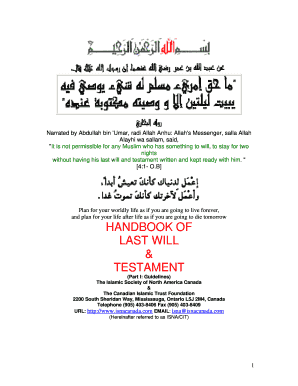
Islam in their sayings and doings. Abdul Razzaq reported Anas (through an authentic chain) to have said: "'They (the Companions) used to write at the beginning of their Wills: In the name of Allah, the Beneficent, the Merciful. This is what son of (so and so) testated, that he testifies that there is no god but Allah, the One, Who has no partner. He also testifies that Muhammad (salla Allahu alayhi wa sallam) is Allah's servant and messenger, that the Last Hour will no doubt come, that Allah re.

How it works
  • Open form

    Open form follow the instructions

  • Easily sign form

    Easily sign the form with your finger

  • Share form

    Send filled & signed form or save

How to fill out the Canada Handbook of Last Will & Testament online

Creating a last will and testament is an essential process for ensuring that your wishes are honored after your passing. The Canada Handbook of Last Will & Testament provides a structured approach to drafting a legally binding document that aligns with your beliefs and intentions. This guide will outline step-by-step instructions for filling out this handbook online, making the process user-friendly and accessible to all.

Follow the steps to fill out the form effectively.

  1. Click ‘Get Form’ button to obtain the form and open it in the editor for editing and completion.
  2. Read the introductory sections carefully to understand the significance of the last will and the Islamic principles surrounding it. Familiarize yourself with the context and requirements outlined in the guide.
  3. Begin filling out the preamble section, where you declare your faith and intentions. This serves as important advice for your surviving relatives and friends.
  4. Complete Article I by specifying authentic rites for funeral and burial. Provide detailed instructions as required, ensuring they conform to religious practices.
  5. In Article II, appoint an executor who is a trustworthy individual. This person should ideally be a practicing Muslim to ensure your wishes are adhered to.
  6. In Article III, list any debts and expenses that need to be accounted for. Ensure all obligations are clearly documented.
  7. Complete Article IV, where you outline your charitable contributions and testamentary transfers. Make sure this does not exceed one-third of your net estate after debt deduction.
  8. Proceed to Article V, which covers the distribution of your estate among heirs. Follow the Islamic inheritance rules carefully.
  9. Finalize by reviewing all entered information, ensuring all sections are complete and accurate. Initial each page if required.
  10. Save your changes, download a copy for your records, print the document for signing, or share it as necessary.

Start filling out your last will and testament online today to secure your legacy.

Get form

Experience a faster way to fill out and sign forms on the web. Access the most extensive library of templates available.

Related content

L-603 - Probate Law (Wills

Feb 21, 1982 — In a number of Canadian and foreign jurisdictions, a testator can make a...

Learn more
Family Estate Planning Guide

A will is a legal document that outlines how you want your assets distributed after your...

Learn more
report to

Apr 15, 2013 — The New Testament, the second context, builds on this Old Testament...

Learn more
Questions & Answers

Get answers to your most pressing questions about US Legal Forms API.

Contact support

What is the biggest mistake in a will?

One of the biggest mistakes in a will is failing to update it after major life changes, such as marriage, divorce, or the birth of a child. Another common error is excluding specific details about asset distribution, which can lead to disputes among beneficiaries. Following guidance from the Canada Handbook of Last Will & Testament can help you avoid these pitfalls. Utilizing platforms like uslegalforms can also provide valuable resources to ensure your will is comprehensive and reflects your current wishes.

Registration of a will in Canada is not mandatory, but it is strongly recommended for security and ease of access. While some provinces have registry services, others do not require any formal registration. By adhering to the practices in the Canada Handbook of Last Will & Testament, you can ensure your loved ones can easily locate your will after your passing. Consider utilizing services like uslegalforms to aid in this process.

You can create a will in Canada without a lawyer by following guidelines in the Canada Handbook of Last Will & Testament. Start by clearly outlining your assets and how you want them distributed. Use templates available from trusted sources to ensure you meet all legal requirements. Ensure to sign the will in front of two witnesses, who should not be beneficiaries, to validate your document.

A will may raise suspicion if there are inconsistencies with earlier versions or if its creation coincides with significant life events. Unusual provisions that favor one beneficiary disproportionately can also make a will appear questionable. Consulting the Canada Handbook of Last Will & Testament can help you better understand what constitutes a valid will and avoid such pitfalls. Engaging professionals can add a layer of security in drafting a will.

The most common grounds for contesting a will include claims of lack of capacity, undue influence, and improper execution. If you believe the testator did not understand what they were signing or was pressured into signing, these may be valid reasons. Additionally, if the will was not signed correctly according to the Canada Handbook of Last Will & Testament, it may be deemed invalid. Consulting with legal experts can provide clarity on this complex issue.

To file a will in Canada, you must first ensure it meets the legal requirements outlined in the Canada Handbook of Last Will & Testament. Typically, this involves signing the will in the presence of two witnesses who are not beneficiaries. Once signed, some provinces may require you to file the will with a local probate court. You should check your province's regulations for specific filing procedures.

No, a will in Canada does not need to be notarized to be valid. The requirements for a valid will, as outlined in the Canada Handbook of Last Will & Testament, primarily focus on the signature and witnesses. However, notarizing a will might simplify the probate process in some cases. Explore options through USLegalForms for additional help in preparing your will.

A will does not need notarization in Canada to be legally valid, as highlighted in the Canada Handbook of Last Will & Testament. The key is to ensure that it is properly signed and witnessed according to provincial laws. While notarization may provide an extra layer of authenticity, it is not a requirement for the will's validity.

Do-it-yourself wills are legal in Canada as long as they adhere to the legal requirements outlined in the Canada Handbook of Last Will & Testament. Individuals may choose to create their own wills using templates or online platforms. However, it is crucial to ensure that the will meets all the criteria to avoid future disputes or complications with probate.

Wills become part of the public record only after going through probate. Once filed, the will is accessible to the public, as mentioned in the Canada Handbook of Last Will & Testament. This transparency allows interested parties to verify the contents of the will and its validity. If privacy is a concern, you may want to explore alternative estate planning methods.

Get This Form Now!

Use professional pre-built templates to fill in and sign documents online faster. Get access to thousands of forms.

If you believe that this page should be taken down, please follow our DMCA take down process here.

Get Canada Handbook of Last Will & Testament