Loading
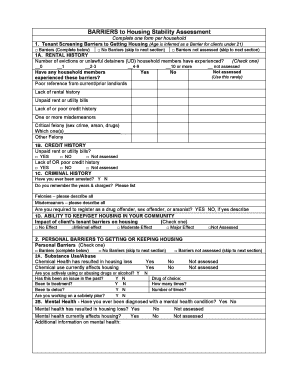
Get Barriers To Housing Stability Assessment Form - Homebase
How it works
-

Open form follow the instructions
-

Easily sign the form with your finger
-

Send filled & signed form or save
How to fill out the Barriers To Housing Stability Assessment Form - HomeBase online
Filling out the Barriers To Housing Stability Assessment Form - HomeBase online can be an essential step in addressing housing stability issues. This guide provides a comprehensive overview of each section of the form, ensuring you complete it accurately and effectively.
Follow the steps to successfully complete your assessment form.
- Click ‘Get Form’ button to obtain the form and open it in the editor.
- Begin with the 'Tenant Screening Barriers to Getting Housing' section. Indicate if there are any barriers by checking the appropriate box: 'Barriers,' 'No Barriers,' or 'Barriers not assessed.' If you selected 'Barriers,' proceed to fill out the specific barriers listed below.
- In section 1A, 'Rental History,' provide the number of evictions or unlawful detainers experienced by household members by checking the corresponding box for '0,' '1,' '2-3,' '4-9,' or '10 or more.' Then indicate whether any household members have faced issues such as poor references, lack of rental history, or unpaid bills.
- Move to section 1B, 'Credit History,' and respond to the questions about unpaid rent or utility bills and your credit history. Check 'Yes,' 'No,' or 'Not assessed' for each.
- In section 1C, 'Criminal History,' answer whether you have ever been arrested and list any felonies or misdemeanors. Indicate if you need to register as a drug offender, sex offender, or arsonist, and provide necessary details.
- For section 1D, assess the impact of tenant barriers on housing stability by selecting one of the options ranging from 'No Effect' to 'Major Effect.'
- Next, proceed to 'Personal Barriers to Getting or Keeping Housing.' Similar to earlier sections, indicate if there are personal barriers and elaborate further, if necessary.
- In 2A, address substance use/abuse by answering the relevant questions regarding your current status, past issues, and engagement with treatment.
- Continue to section 2B, 'Mental Health,' and provide answers about any diagnoses and their effects on housing. Complete the questions regarding mental health status.
- Follow with sections 2C and 2D, which cover domestic violence/abuse and medical/physical conditions. Provide responses where applicable.
- In the income barriers section (3), indicate if there are barriers related to income, including employment and educational factors. Complete details on your financial situation.
- Finally, assess the impact of income barriers on housing stability, selecting an appropriate level of effect from 'No Effect' to 'Major Effect.'
- Once all sections are completed, make sure to review your answers thoroughly. You can then save changes, download, print, or share the completed form as needed.
Complete your Barriers To Housing Stability Assessment Form online today to take the first step towards securing stable housing.
Stable (or secure) housing means that you aren't living in uncertainty about your housing situation and generally have a choice over when to move.