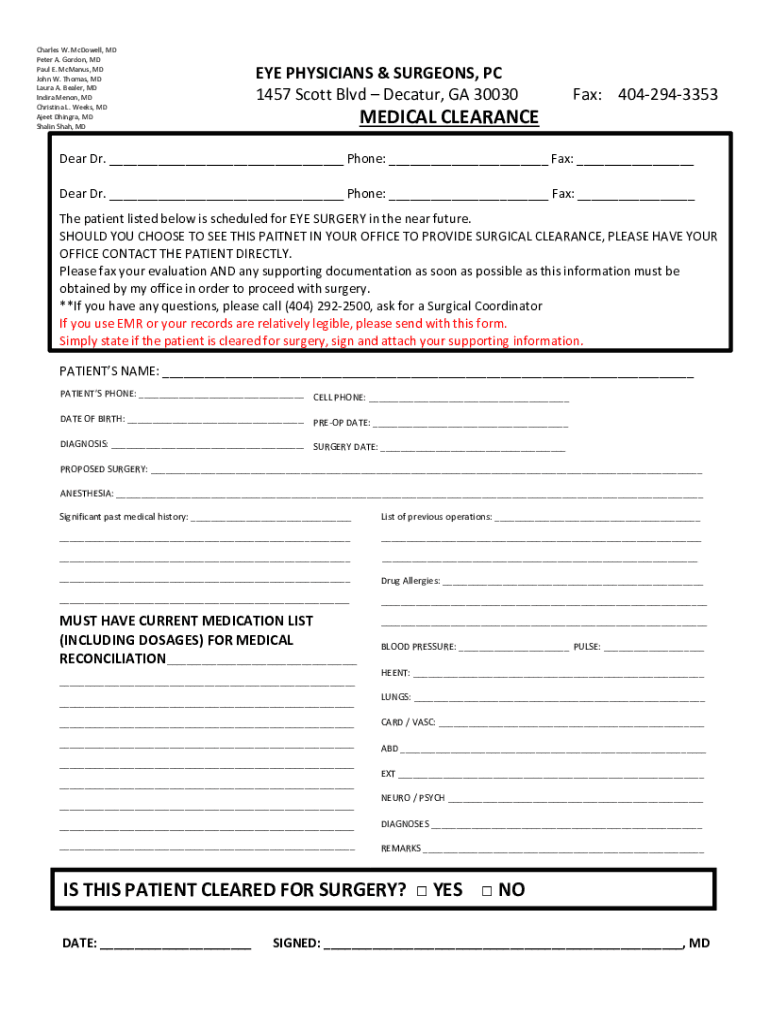
EPS Surgical Medical Clearance Form Medical clearance is needed from your primary care physician before your date of surgery. Your primary care physician should complete the attached form. Please.
Loading

Open form follow the instructions

Easily sign the form with your finger

Send filled & signed form or save
How to fill out the Eye Physicians & Surgeons EPS Surgical Medical Clearance Form online
Filling out the Eye Physicians & Surgeons EPS Surgical Medical Clearance Form is an important step in ensuring your upcoming eye surgery proceeds smoothly. This guide provides clear instructions to help you navigate the form effectively, ensuring you provide all necessary information for your primary care physician's review.
Follow the steps to complete the form accurately and efficiently.
- Click ‘Get Form’ button to access the form. This will open the document in your preferred editing tool.
- Begin by entering the patient's basic information in the designated fields. This includes the patient's name, phone number, cell phone number, date of birth, and pre-operative date.
- Fill in the diagnosis and surgery date, ensuring these details are accurate to avoid any delays.
- Specify the proposed surgery and the type of anesthesia to be used during the procedure.
- Document any significant past medical history and list any previous operations the patient has undergone.
- Indicate any drug allergies the patient may have, if applicable.
- Include a current medication list, noting dosages for medical reconciliation.
- Record the patient’s blood pressure and pulse readings in the appropriate sections.
- Complete the physical examination findings for the HEENT, lungs, cardiovascular, abdomen, extremities, and neuro/psych assessments.
- Indicate if the patient is cleared for surgery by checking the appropriate box and include the date.
- The form must be signed by the physician, along with their printed name and medical title.
- Upon completing the form, save changes, download, print, or share it as necessary.
Complete your surgical medical clearance form online for a seamless preparation for your surgery.
Experience a faster way to fill out and sign forms on the web. Access the most extensive library of templates available.
Related content
but based on symptoms or risk factors identified in the preoperative evaluation, the...
Cataract surgery puts very little strain on the heart. In the absence of symptoms of heart...
Airway Clearance System (2AJKO-PMACS1WI) User Manual_G details for FCC ... Rib fractures...
Get answers to your most pressing questions about US Legal Forms API.
What is the difference between an ophthalmologist and Opthamologist?
Optometrists are the first line of care for your eye health. They perform routine eye exams, prescribe corrective lenses, and know when a person needs to see an ophthalmologist. Ophthalmologists are medical doctors that specialize in the care of more complex eye disorders and perform eye surgery if required.
What is a physician who treats diseases of the eye?
Ophthalmologists are physicians who specialize in medical and surgical eye care. They diagnose and treat all eye diseases. Many ophthalmologists conduct scientific research to improve treatment options and to find cures for eye diseases and vision disorders.
What is the difference between an eye doctor and an ophthalmologist?
Optometrists are the first line of care for your eye health. They perform routine eye exams, prescribe corrective lenses, and know when a person needs to see an ophthalmologist. Ophthalmologists are medical doctors that specialize in the care of more complex eye disorders and perform eye surgery if required.
What is the best eye doctor called?
An ophthalmologist — Eye M.D. — is a medical or osteopathic doctor who specializes in eye and vision care. Ophthalmologists differ from optometrists and opticians in their levels of training and in what they can diagnose and treat.
What is the difference between OD and MD eye doctor?
Because ophthalmologists are medical doctors (MDs), they are trained to diagnose all eye diseases as well as to surgically treat patients dealing with an ocular disorder or disease. Optometrists, on the other hand, primarily focus on vision care and correction to a vision change diagnosis.
Which doctor is best for eyesight?
Ophthalmologists and optometrists are eye doctors who diagnose and treat issues that affect your eyes....An ophthalmologist will perform surgery needed to treat some eye issues, including: Glaucoma. Cataracts. Retinal detachment. Eye injuries.
Can an optometrist diagnose macular degeneration?
Macular degeneration is a significant risk to your eye health and vision, but your optometrist can help manage this disease. They can diagnose this disease as early as possible, recommend ways to lower your risk and provide a customized treatment plan to protect your vision.
What is the difference between optometrist and ophthalmology PA?
Visit your medical optometrist for primary medical eye care, including eye medication prescriptions, monitoring and managing eye diseases, or emergency eye care services. Visit an ophthalmologist for interventions like surgical treatments for serious eye diseases, advanced ocular problems, or refractive eye surgery.
Use professional pre-built templates to fill in and sign documents online faster. Get access to thousands of forms.
If you believe that this page should be taken down, please follow our DMCA take down process here.