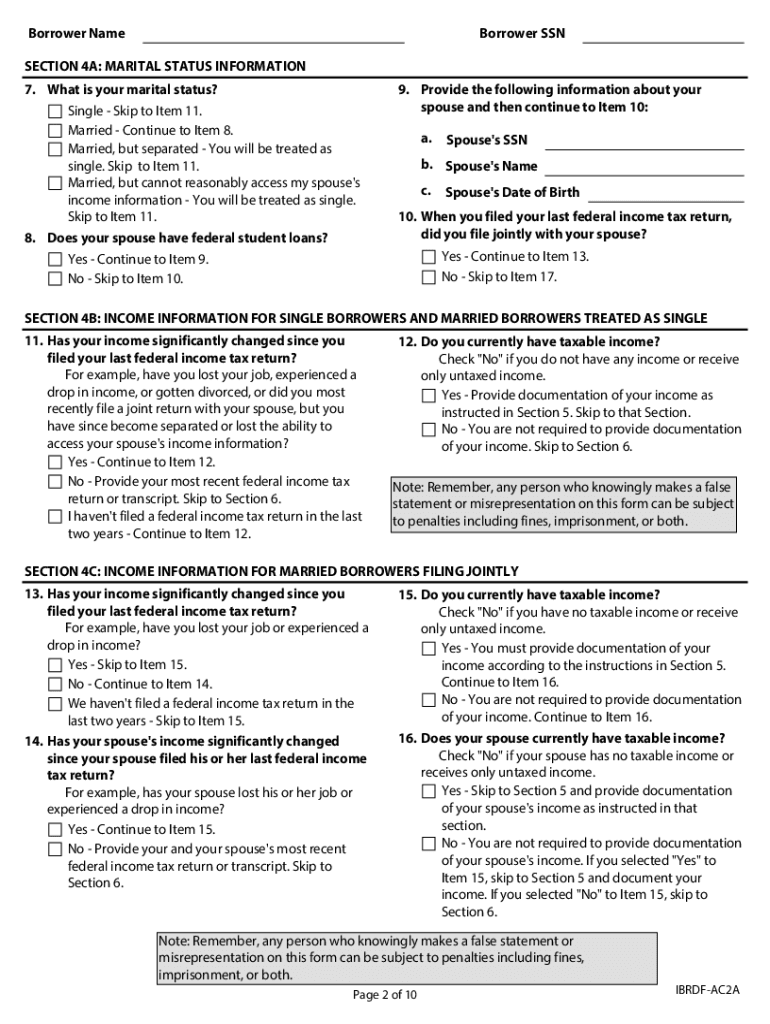
and are requesting the IBR plan, complete the IBR-Request to End Deferment/Forbearance form. Failure to provide any of the required documentation may result in your request being denied. REQUIRED DOCUMENTATION IF YOU… Are currently employed and your income has not recently changed Are currently employed but your income has changed since filing your most recent federal income tax return Currently receive no income or only untaxed income (SSI/Child Support) but filed a federal income tax retur.
Loading

Open form follow the instructions

Easily sign the form with your finger

Send filled & signed form or save
How to fill out the ED IBR/PAYE/ICR online
The Income-Based Repayment (IBR), Pay As You Earn (PAYE), and Income-Contingent Repayment (ICR) plans provide flexible repayment options for borrowers based on their income. This guide will walk you through each section of the ED IBR/PAYE/ICR form, ensuring you have a clear understanding of the requirements and steps needed to complete it online.
Follow the steps to successfully complete the form online.
- Press the ‘Get Form’ button to access the form, which will open in your preferred online editing tool.
- Begin with Section 1, where you will enter your personal information, including Social Security Number, name, address, and contact information. Make sure to check the box if any of your details have changed.
- In Section 2, select the reason for your repayment request. You will need to check the appropriate box for either requesting a new repayment plan, submitting annual documentation, or requesting a recalculation of your payment amount due to changed circumstances.
- Proceed to Section 3 if you are married and filing jointly, enter your spouse’s details, including Social Security Number, name, and date of birth.
- In Section 4, specify your family size and answer whether you filed a federal income tax return for the previous two years. Proceed to provide any necessary tax information.
- If applicable, complete Section 5 by providing alternative documentation of income if your current income does not match the amount reported on your tax return. Include necessary proofs.
- In Section 6, confirm your understanding and agreement by signing the form. Your spouse's signature is necessary if you completed Section 3.
- Double-check your entries for accuracy and completeness before finalizing your submission. Ensure all required documents are attached.
- Finally, submit your completed form and documentation to your loan holder as per the instructions in Section 10. You may also choose to save changes, download, print, or share your completed form.
Start filling out your IBR/PAYE/ICR form online today to take control of your student loan repayments.
Experience a faster way to fill out and sign forms on the web. Access the most extensive library of templates available.
Related content
An income-driven repayment (IDR) plan bases your monthly student loan payment amount on...
The ICR statute gives substantial discretion to the Department of Education in defining...
Get answers to your most pressing questions about US Legal Forms API.
Is ICR a good payment plan?
The ICR plan can be advantageous for borrowers experiencing variable incomes or financial challenges. It allows for manageable payment options based on your income and family size, which can relieve financial stress. If you're unsure about your eligibility or how the ICR plan works, uslegalforms can provide useful guidance to help you navigate this decision.
How is IBR calculated?
IBR is calculated based on your income, family size, and the federal poverty line. First, determine your discretionary income, which is your adjusted gross income minus 150% of the poverty line for your household size. This calculated discretionary income is then applied to the percentage rate applicable to you, giving you a clearer picture of your monthly repayments under the ED IBR/PAYE/ICR plans. Utilizing USLegalForms can help facilitate this process with templates and resources.
What is the formula for IBR?
To find your IBR payment, take your discretionary income, multiply it by 10% or 15% depending on when you took out your loans, and then divide that by 12 to determine your monthly payment. Discretionary income is your income above 150% of the poverty level for your household size. This straightforward formula allows for flexible payments under the ED IBR/PAYE/ICR guidelines, promoting financial relief.
Is IBR 15% or 10%?
The Income-Based Repayment (IBR) plan typically uses 10% of your discretionary income if you borrowed your loans after July 1, 2014. If your loans were disbursed on or before that date, the percentage is 15%. It's important to understand these rates, as they directly affect your monthly payments under the ED IBR/PAYE/ICR plans, helping you navigate your financial obligations more easily.
Is PAYE better than IBR?
Many borrowers find PAYE to be more beneficial than IBR due to its generally lower payment caps and faster path to forgiveness. However, IBR may suit some individuals better, depending on their specific income and repayment history. It’s valuable to evaluate both options to find which aligns best with your financial goals.
What is the PAYE for student loans?
The PAYE plan for student loans is designed to ease the financial burden on borrowers by tying monthly payments to income. This plan caps payments at 10% of discretionary income, making it more affordable for those with fluctuating earnings. If you need help navigating this plan, consider using the resources available on US Legal Forms.
Is PAYE or ICR better?
Whether PAYE or ICR is better for you depends on your financial situation. PAYE generally offers lower payments, making it a preferred choice for many. However, if you expect a significant income increase, ICR may allow for more manageable payments while considering your eventual financial prospects.
What are the cons of PAYE?
Some cons of PAYE include the potential for interest accumulation due to a longer repayment period. Additionally, your tax returns will determine your payments, so changes in income can lead to payment fluctuations. Moreover, if your income increases, you may end up paying more than anticipated.
What is the difference between PAYE and IBR?
PAYE and IBR are both income-driven repayment plans, but they have some distinct features. PAYE generally offers a lower payment cap of 10% of discretionary income, while IBR can go higher depending on when you took out your loans. Understanding these differences can help you select the best plan for your situation.
What is the difference between IBR and PAYE?
IBR is easier to qualify for than PAYE While PAYE may further reduce your student loan bills and get you out of debt faster than IBR, it imposes stricter eligibility requirements. To get on the PAYE plan, you can't have had any unpaid Direct or FFEL student loans as of Oct.
Use professional pre-built templates to fill in and sign documents online faster. Get access to thousands of forms.
If you believe that this page should be taken down, please follow our DMCA take down process here.