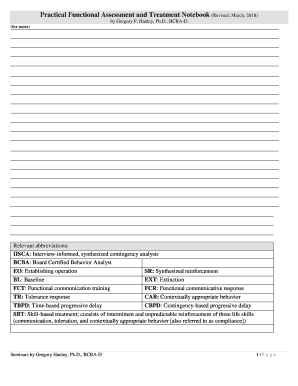
Practical Functional Assessment and Treatment Notebook (Revised: March, 2018) by Gregory P. Hanley, Ph.D., BCBAD (for notes)Relevant abbreviations: IISCA: Interviewinformed, synthesized contingency.
Open form follow the instructions
Easily sign the form with your finger
Send filled & signed form or save
How to fill out the Practical Functional Assessment online
Completing the Practical Functional Assessment is an essential step in understanding and addressing behavioral needs effectively. This guide offers a clear, step-by-step approach to filling out the assessment online, ensuring you provide all necessary information accurately.
Follow the steps to complete the Practical Functional Assessment successfully.
- Press the ‘Get Form’ button to access the Practical Functional Assessment document and open it in your document editor.
- In the first section, enter the relevant background information, including the date of the interview, the child or client’s pseudonym, and the respondent's relation to the child or client. Ensure to provide accurate details to properly understand the context.
- Next, describe the language abilities, play skills, and preferred activities of the child or client. This information helps assess their current functional level.
- Identify and define the problem behaviors in the designated field, including a brief description of the most concerning behaviors to be targeted.
- Moving forward, articulate the triggers and conditions under which these problem behaviors occur, as well as the responses from caregivers or therapists in such situations.
- Document the perceived objectives behind each problem behavior and denote any reinforcement strategies previously used to mitigate these behaviors.
- Review the completed fields for accuracy. Adjust any information if necessary to ensure clarity and conciseness.
- Finally, save your changes. Choose to download, print, or share the form electronically as required to ensure it is accessible for future reference.
Start completing the Practical Functional Assessment online today to better support the needs of individuals under your care.
Experience a faster way to fill out and sign forms on the web. Access the most extensive library of templates available.
Related content
by KC Fleming · 1995 · Cited by 195 — Use of the assessment tools presented herein can...
A practical functional assessment (PFA) is used to inform a skill-based treatment (SBT). A...
The most robust form of functional assessment is functional analysis, which involves the...
Get answers to your most pressing questions about US Legal Forms API.
Occupational Therapy functional assessments | Youth Living Skills
There are three main categories of functional assessment approaches indirect (e.g., questionnaires, rating scales), observational, and experimental/functional analysis. Gathering information about the conditions surrounding the behavior, asking relevant individuals questions about the behavior are initial steps.
FBA - FUNCTIONAL BEHAVIORAL ASSESSMENT - PaTTAN
A functional behavioral assessment (or FBA) is a process that identifies a specific or target behavior that interferes with a student's education. The assessment attempts to designate the particular behavior, identify the factors that support the behavior, and determine the purpose of the behavior.
What is included in a functional assessment?
Functional assessment is a continuous collaborative process that combines observing, asking meaningful questions, listening to family stories, and analyzing individual child skills and behaviors within naturally occurring everyday routines and activities across multiple situations and settings.
Practical Functional Assessment (PFA) and Skill-Based Treatment ...
The interview-informed synthesized contingency analysis (IISCA; Hanley et al. 2014) is a type of functional analysis (FA) that alternates a single test and a single control condition, both comprehensively informed by an open-ended interview with relevant caregivers.
What is an FBA assessment?
FUNCTIONAL BEHAVIORAL ASSESSMENT (FBA) PROCESS. Functional Behavioral Assessment (FBA)is a process. for identifying problem behaviors and developing interventions to improve or eliminate those behaviors.
Functional Status Assessment
Define the challenging behavior. An FBA starts by defining the student's behavior in a specific and objective way. ... Gather and analyze information. Next, the team pulls together information and data about the behavior. ... Find out the reason for the behavior. ... Make a plan.
What Is Functional Behavioral Assessment (FBA ...
The purpose of the OT functional assessment is to determine the person's current functioning (involving identifying areas of strengths and weaknesses) in all aspects of daily life and develop recommendations to alleviate identified difficulties so that the person is as independent as possible.
Virtual Workshop: PFA and SBT of Severe Problem Behavior: A ...
Practical Functional Assessment (PFA) and Skill-Based Treatment (SBT) of Severe Problem Behavior (Beginner Course) ... The course is designed to give you an introduction to the assessment and treatment process from the ground up and prepare you to run your first (or second or third) application of the process.
Definition of Functional Assessment Functional assessment is a ...
In this presentation, Dr Hanley introduces the attendees to the latest iteration of the practical functional assessment process (PFA) that allows for the development of skill-based treatments (SBTs) capable of producing socially valid outcomes.
What are the components of a functional assessment?
Components of functional assessment - Vision and hearing, mobility, continence, nutrition, mental status (cognition and affect), affect, home environment, social support, ADL-IADL. ADL's (activities of daily living) are basic activities such as transferring, ambulating, bathing, etc.
Use professional pre-built templates to fill in and sign documents online faster. Get access to thousands of forms.
If you believe that this page should be taken down, please follow our DMCA take down process here.