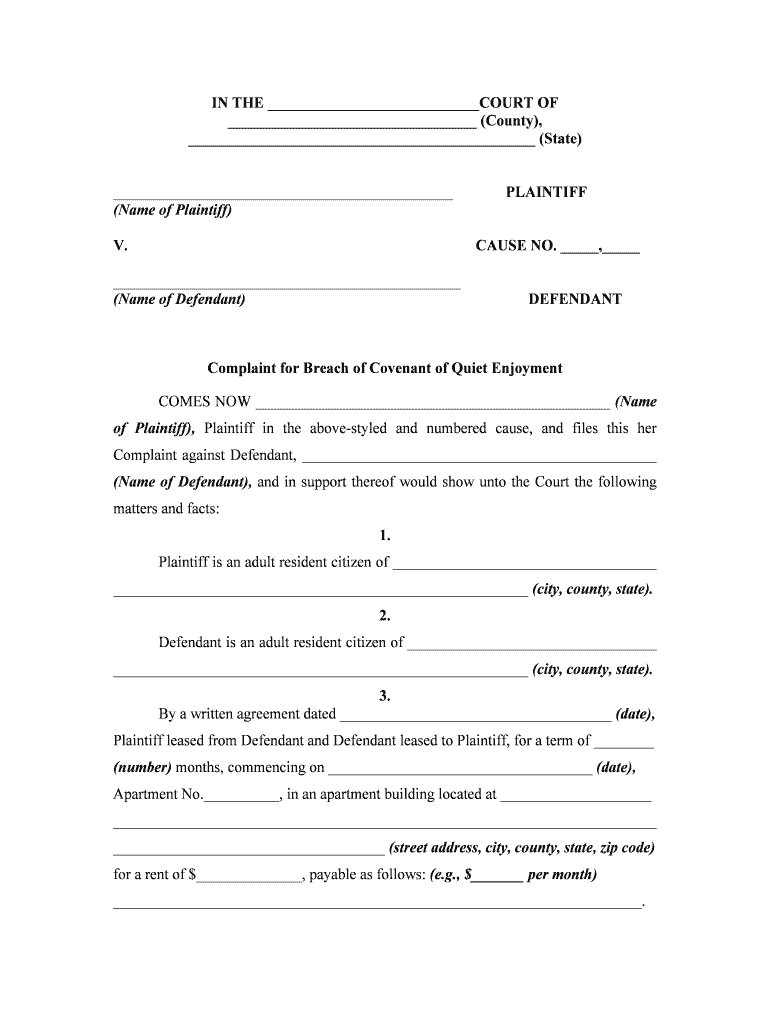
IN THE COURT OF (County), (State) (Name of Plaintiff) V.PLAINTIFFCAUSE NO. , (Name of Defendant)DEFENDANTComplaint for Breach of Covenant of Quiet Enjoyment COMES NOW (Name of Plaintiff), Plaintiff.
Loading

Open form follow the instructions

Easily sign the form with your finger

Send filled & signed form or save
How to fill out the Right To Quiet Enjoyment California online
This guide provides a comprehensive overview of how to fill out the Right To Quiet Enjoyment California form. It will walk you through each section, ensuring you understand what information is needed and how to effectively complete the form online.
Follow the steps to complete the form accurately.
- Press the ‘Get Form’ button to access the Right To Quiet Enjoyment California form and open it in your online editor.
- Begin by entering the name of the court in which you are filing. This should include the county and state where the case will be heard.
- Fill in your name as the plaintiff in the designated field. Ensure it reflects your full legal name.
- In the next section, enter the name of the defendant, again using their full legal name.
- Specify the cause number assigned to your case. If unsure, leave this blank for now, as you will receive it upon filing your case.
- Complete the details about your lease agreement, including the date it was signed, the duration in months, the starting date, and the apartment number along with its full address.
- Indicate the total amount of rent and how it is payable, providing clear terms such as the monthly amount.
- Refer to the attachment of the Lease Agreement as Exhibit A, making sure to indicate its inclusion in the complaint.
- Highlight the covenant of quiet enjoyment as stated in your lease and cite the specific paragraph number relevant to your agreement.
- Detail how the defendant breached their covenant of quiet enjoyment, specifying dates and instances of disturbance or interference.
- Conclude your complaint by outlining your requests for relief, including the kind of damages and costs you aim to recover.
- Finalize the document by signing and typing your name at the end of the complaint, ensuring you also provide space for notarization.
- Once completed, review all information for accuracy. You can then save changes, download, print, or share the completed form as required.
Start filing your Right To Quiet Enjoyment California form online today!
Experience a faster way to fill out and sign forms on the web. Access the most extensive library of templates available.
Related content
tenant can exercise the same remedy available for breach of the covenant of quiet...
A covenant of quiet enjoyment insures an owner or tenant against a disturbance of his or...
The lessor is the legal owner of the asset, while the lessee obtains the right to use...
Get answers to your most pressing questions about US Legal Forms API.
What is a breach of quiet enjoyment?
The covenant of quiet enjoyment can be breached by a landlord. A landlord is violating the covenant if they're letting anything happen that: Prevents a tenant from accessing their unit. Damages the property. Disturbs a tenant's ability to use all of their unit in any way.
How do you prove breach of quiet enjoyment?
To establish a breach of the warranty of habitability, a tenant must be able to prove that the interference was substantial. Mild annoyances and inconveniences do not count. The activity must also be caused by the landlord or by someone under the landlord's control, which may include other tenants.
What is a quiet enjoyment in property law?
According to Nolo, quiet enjoyment is The right of a property owner or tenant to enjoy his or her property without interference. Disruption of quiet enjoyment may constitute a legal nuisance.
What is reasonable enjoyment of a rental property?
reasonable privacy. freedom from unreasonable disturbances. exclusive use of their rental unit (unless the landlord is allowed to enter by law), and. use of common areas for reasonable and lawful purposes.
Can you sue for quiet enjoyment?
Sue the landlord and whoever for up to $10,000 in small claims court for trespassing, breach of contract, invasion of privacy, and breach of quiet enjoyment; if you are two or more tenants, each can separately sue them for up to $10,000, and a joint action is not required.
What constitutes a breach of quiet enjoyment California?
For a tenant to claim that a landlord violated their right to quiet enjoyment, the interference must be substantial and not just an inconvenience or annoyance. Examples of interferences that may violate the covenant of quiet enjoyment include the landlord: Not letting the tenant onto the property.
Do I have a right to peace and quiet?
A Covenant that promises that the grantee or tenant of an estate in real property will be able to possess the premises in peace, without disturbance by hostile claimants. Quiet enjoyment is a right to the undisturbed use and enjoyment of real property by a tenant or landowner.
What does quiet enjoyment mean in legal terms?
According to Nolo, quiet enjoyment is The right of a property owner or tenant to enjoy his or her property without interference. Disruption of quiet enjoyment may constitute a legal nuisance.
What is peaceful enjoyment of property?
A Covenant that promises that the grantee or tenant of an estate in real property will be able to possess the premises in peace, without disturbance by hostile claimants. Quiet enjoyment is a right to the undisturbed use and enjoyment of real property by a tenant or landowner.
Use professional pre-built templates to fill in and sign documents online faster. Get access to thousands of forms.
If you believe that this page should be taken down, please follow our DMCA take down process here.