Loading
Form preview
  • US Legal Forms
  • Form Library
  • More Forms
  • More Multi-State Forms
  • Ionic Bonding Worksheet Date

Get Ionic Bonding Worksheet Date

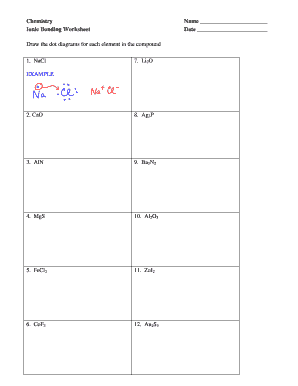
Chemistry Ionic Bonding WorksheetName Date Draw the dot diagrams for each element in the compound 1. NaCl7. Li2OEXAMPLE2. CaO8. Ag3P3. AlN9. Ba3N24. MgS10. Al2O35. FeCl211. ZnI26. CoF312. Au2S3Chemistry.

How it works

  1. Open form

    Open form follow the instructions

  2. Easily sign form

    Easily sign the form with your finger

  3. Share form

    Send filled & signed form or save

How to fill out the Ionic Bonding Worksheet Date online

Filling out the Ionic Bonding Worksheet Date can be a straightforward process when approached step by step. This guide will help you navigate through the necessary fields and sections, ensuring your completion is efficient and accurate.

Follow the steps to complete your Ionic Bonding Worksheet Date online.

  1. Click ‘Get Form’ button to obtain the form and open it in the editor.
  2. Begin by entering your name in the designated field at the top of the worksheet. This helps identify your work.
  3. Next, record the date in the appropriate space right below your name, ensuring it is accurate and current.
  4. Proceed to the section where you will draw the dot diagrams for the compounds listed. Use appropriate tools in the online interface to illustrate the dot diagrams for NaCl, Li2O, and the other compounds up to Au2S3.
  5. Move on to the next section asking which compounds would result from combining certain ions. Carefully examine the pairs provided in the list and write your answers in the spaces next to each.
  6. Review all your entries to ensure accuracy and completeness, making any necessary adjustments.
  7. Finally, save your changes, then download, print, or share the completed Ionic Bonding Worksheet Date as needed.

Start filling out your Ionic Bonding Worksheet Date online today to enhance your understanding of ionic bonding.

Get form

Experience a faster way to fill out and sign forms on the web. Access the most extensive library of templates available.
Get form

Related content

Ionic-Covalent-Namin.. - Chemistry 301
Covalent bonding occurs when two or more nonmetals share electrons, ... Classify the...
Learn more

Related links form

University Of Denver FVF-D Verification Worksheet 2020 MJC Regional Fire Training Center RS1 Registration Form 2019 University Of Denver FVF-D Verification Worksheet 2021 Halifax Community College Foundation Scholarship Application 2022

Questions & Answers

Get answers to your most pressing questions about US Legal Forms API.

Contact support

An ionic bond can be formed after two or more atoms loss or gain electrons to form an ion. Ionic bonds occur between metals, losing electrons, and nonmetals, gaining electrons. Ions with opposite charges will attract one another creating an ionic bond.

First, Lewis proposed that ionic bonds are formed by the complete transfer of electrons from the valence shell of one atom into the valence shell of another atom and that the transfer proceeds until the valence shells of both have reached the electronic composition characteristic of the nearest noble gas atom in the ...

An ionic bond can be formed after two or more atoms loss or gain electrons to form an ion. Ionic bonds occur between metals, losing electrons, and nonmetals, gaining electrons. Ions with opposite charges will attract one another creating an ionic bond.

The idea of ionic bonding developed gradually over the years. Around 1830, Michael Faraday's experiments on electrolysis showed that certain substances would conduct an electric current when dissolved in water. He thought that the electricity caused the substances to break up into charged particles.

The idea of ionic bonding developed gradually over the years. Around 1830, Michael Faraday's experiments on electrolysis showed that certain substances would conduct an electric current when dissolved in water. He thought that the electricity caused the substances to break up into charged particles.

Ionic solids are composed of cations and anions held together by electrostatic forces. Due to the strength of these interactions, ionic solids tend to be hard, brittle and have high melting points.

Ionic bonds result from the attraction between oppositely charged ions. For example, sodium cations (positively charged ions) and chlorine anions (negatively charged ions) are connected via ionic bonds in sodium chloride, or table salt.

In this theory, he reaveled many conditions for the formation of chemical bonds specially the covalent and ionic bonds. Though, Faraday and others did gave their contribution in this regard, still the actual discoveror of ionic bond was G. N. Lewis and W. Kossel.

Get This Form Now!

Use professional pre-built templates to fill in and sign documents online faster. Get access to thousands of forms.
Get form
If you believe that this page should be taken down, please follow our DMCA take down processhere.

Industry-leading security and compliance

US Legal Forms protects your data by complying with industry-specific security standards.
  • In businnes since 1997
    25+ years providing professional legal documents.
  • Accredited business
    Guarantees that a business meets BBB accreditation standards in the US and Canada.
  • Secured by Braintree
    Validated Level 1 PCI DSS compliant payment gateway that accepts most major credit and debit card brands from across the globe.
Get Ionic Bonding Worksheet Date
Get form
  • Adoption
  • Bankruptcy
  • Contractors
  • Divorce
  • Home Sales
  • Employment
  • Identity Theft
  • Incorporation
  • Landlord Tenant
  • Living Trust
  • Name Change
  • Personal Planning
  • Small Business
  • Wills & Estates
  • Packages A-Z
  • Affidavits
  • Bankruptcy
  • Bill of Sale
  • Corporate - LLC
  • Divorce
  • Employment
  • Identity Theft
  • Internet Technology
  • Landlord Tenant
  • Living Wills
  • Name Change
  • Power of Attorney
  • Real Estate
  • Small Estates
  • Wills
  • All Forms
  • Forms A-Z
  • Form Library
  • Legal Hub
  • About Us
  • Help Portal
  • Legal Resources
  • Blog
  • Affiliates
  • Contact Us
  • Delete My Account
  • Site Map
  • Industries
  • Forms in Spanish
  • Localized Forms
  • State-specific Forms
  • Forms Kit
  • Real Estate Handbook
  • All Guides
  • Notarize
  • Incorporation services
  • For Consumers
  • For Small Business
  • For Attorneys
  • USLegal
  • FormsPass
  • pdfFiller
  • signNow
  • altaFlow
  • DocHub
  • Instapage
Form Packages
  • Adoption
  • Bankruptcy
  • Contractors
  • Divorce
  • Home Sales
  • Employment
  • Identity Theft
  • Incorporation
  • Landlord Tenant
  • Living Trust
  • Name Change
  • Personal Planning
  • Small Business
  • Wills & Estates
  • Packages A-Z
Form Categories
  • Affidavits
  • Bankruptcy
  • Bill of Sale
  • Corporate - LLC
  • Divorce
  • Employment
  • Identity Theft
  • Internet Technology
  • Landlord Tenant
  • Living Wills
  • Name Change
  • Power of Attorney
  • Real Estate
  • Small Estates
  • Wills
  • All Forms
  • Forms A-Z
  • Form Library
Customer Service
  • Legal Hub
  • About Us
  • Help Portal
  • Legal Resources
  • Blog
  • Affiliates
  • Contact Us
  • Delete My Account
  • Site Map
  • Industries
  • Forms in Spanish
  • Localized Forms
  • State-specific Forms
  • Forms Kit
Legal Guides
  • Real Estate Handbook
  • All Guides
Prepared for you
  • Notarize
  • Incorporation services
Our Customers
  • For Consumers
  • For Small Business
  • For Attorneys
Our Sites
  • USLegal
  • FormsPass
  • pdfFiller
  • signNow
  • altaFlow
  • DocHub
  • Instapage
Social Media
Call us now toll free:
+1 833 426 79 33
As seen in:
© Copyright 1999-2026 airSlate Legal Forms, Inc. 3720 Flowood Dr, Flowood, Mississippi 39232
  • Your Privacy Choices
  • Terms of Service
  • Privacy Notice
  • Content Takedown Policy
  • Bug Bounty Program