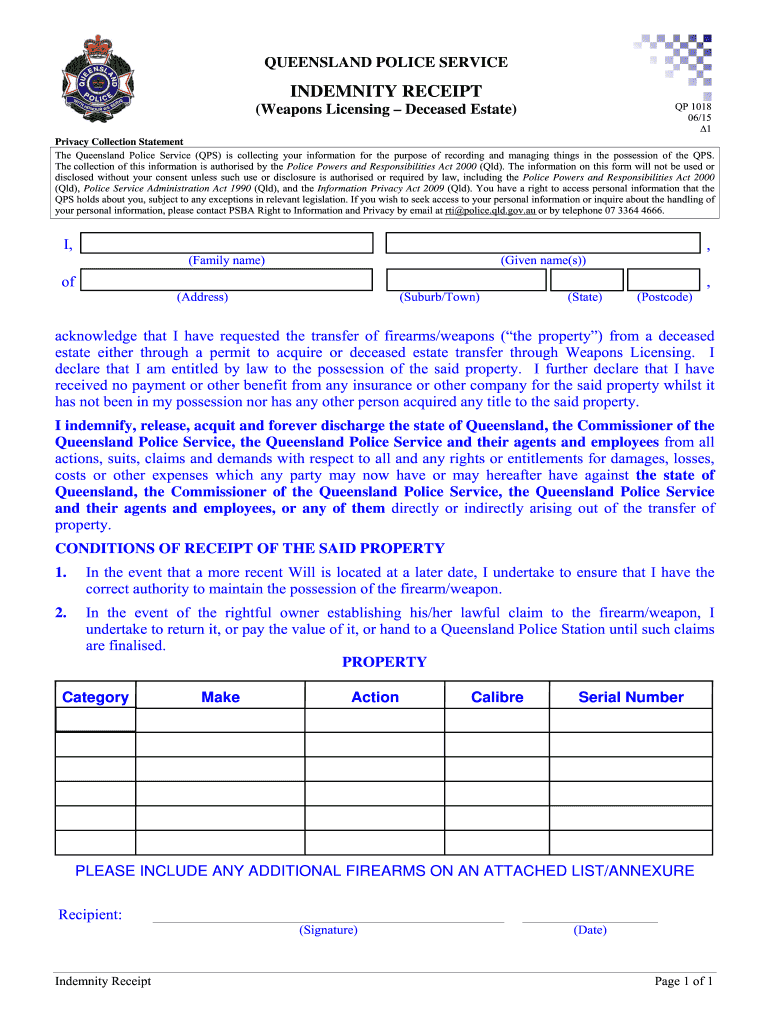
QUEENSLAND POLICE SERVICEINDEMNITY RECEIPT QP 1018 06/15 1(Weapons Licensing Deceased Estate)Privacy Collection Statement The Queensland Police Service (QPS) is collecting your information for the.

Open form follow the instructions

Easily sign the form with your finger

Send filled & signed form or save
How to fill out the INDEMNITY RECEIPT online
Filling out the Indemnity Receipt online is a critical step for individuals managing firearms or weapons from a deceased estate. This guide provides clear, easy-to-follow instructions to help you complete the form accurately and effectively.
Follow the steps to complete your Indemnity Receipt online
- Click the ‘Get Form’ button to obtain the Indemnity Receipt and open it in your preferred online editor.
- Fill in your family name and given name(s) in the designated fields. Ensure that the names are accurate and mirror those on your identification.
- Provide your address, including suburb/town, state, and postcode. Double-check each component for accuracy to avoid processing delays.
- Acknowledgment: Confirm that you have requested the transfer of firearms or weapons from a deceased estate. This may involve obtaining a permit or engaging in a deceased estate transfer through Weapons Licensing.
- Make a declaration regarding your entitlement to possess the property, stating that you have not received payment or benefits related to the property.
- Indemnify the state of Queensland and the Queensland Police Service by acknowledging the conditions outlined in the receipt. Read this section carefully to understand your responsibilities.
- Complete the property section, detailing the category, make, action, calibre, and serial number of the firearms or weapons being transferred. If you have additional firearms, make sure to list them on an attached annexure.
- Sign and date the form to finalize it. Ensure that your signature matches the name you provided earlier.
- Once completed, save your changes. You may choose to download, print, or share the completed form as needed.
Begin filling out your Indemnity Receipt online today to ensure a smooth transfer process.
Experience a faster way to fill out and sign forms on the web. Access the most extensive library of templates available.
Related content
NOW THEREFORE, in consideration of the sum of $1.00 now paid by MT to each of the...
The demo equipment must be returned within 5 business days from receipt of ... Liability...
Get answers to your most pressing questions about US Legal Forms API.
What is indemnity example?
Indemnity is compensation paid by one party to another to cover damages, injury or losses. ... An example of an indemnity would be an insurance contract, where the insurer agrees to compensate for any damages that the entity protected by the insurer experiences.
What are the types of indemnity?
Broad Indemnification. The Promisor promises to indemnify the Promisee against the negligence of all parties, including third parties, even if the third party is solely at fault. Intermediate Indemnification. ... Limited Indemnification.
What is an indemnity document?
What is an indemnity? An indemnity is generally some form of notice that is in writing and excludes the liability on the part of the person or company presenting such a notice. An indemnity form also limits the person's contractual and delictual liability.
What is meant by indemnity?
Definition: Indemnity means making compensation payments to one party by the other for the loss occurred. Description: Indemnity is based on a mutual contract between two parties (one insured and the other insurer) where one promises the other to compensate for the loss against payment of premiums.
What does indemnity mean in legal terms?
An indemnity is a promise by one party to compensate another for the loss suffered as a consequence of a specific event, called the 'trigger event'. The trigger event can be anything defined by the parties, including: a breach of contract. a party's fault or negligence. a specific action.
Which is an example of contract of indemnity?
A typical example is an insurance company wherein the insurer or indemnitor agrees to compensate the insured or indemnitee for any damages or losses he/she may incur during a period of time.
What is the purpose of an indemnity?
Indemnity is a comprehensive form of insurance compensation for damages or loss. In this type of arrangement, one party agrees to pay for potential losses or damages caused by another party.
What is the purpose of an indemnity agreement?
An indemnity agreement is a contract that 'holds a business or company harmless' for any burden, loss, or damage. An indemnity agreement also ensures proper compensation is available for such loss or damage.
What is the concept of indemnity?
Definition: Indemnity means making compensation payments to one party by the other for the loss occurred. Description: Indemnity is based on a mutual contract between two parties (one insured and the other insurer) where one promises the other to compensate for the loss against payment of premiums.
What does signing an indemnity mean?
If you've signed a contract, chances are you've seen an indemnity clause. ... In its simplest form, indemnity means that one party in the contract is responsible for compensating another for loss, damages, and/or injury incurred as a result of that party's actions.
Use professional pre-built templates to fill in and sign documents online faster. Get access to thousands of forms.
If you believe that this page should be taken down, please follow our DMCA take down process here.