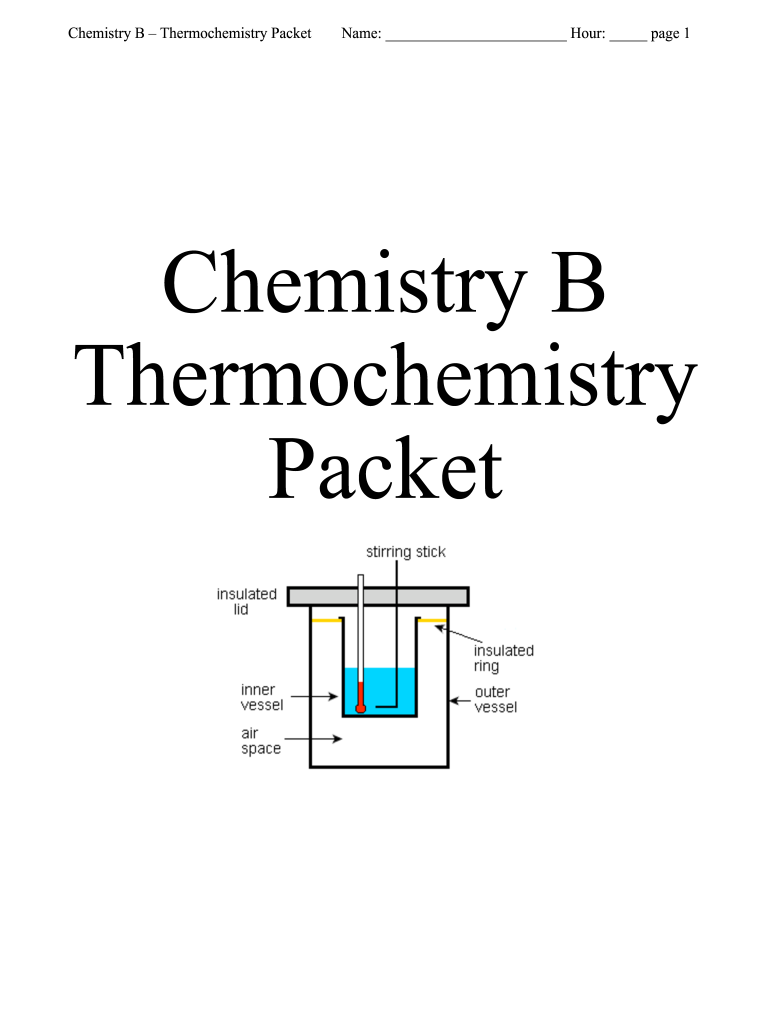
Chemistry B Thermochemistry Packet Name: Hour: page 1 Chemistry B Thermochemistry Packet Chemistry B Thermochemistry Packet Name: Hour: page 2 Desired Understandings Worksheet 1 P3.p2 Energy Transfer:.
Loading

Open form follow the instructions

Easily sign the form with your finger

Send filled & signed form or save
How to fill out the Chemistry B Thermochemistry Packet online
This guide provides a thorough overview of how to effectively complete the Chemistry B Thermochemistry Packet online. The step-by-step instructions ensure clarity and ease of understanding for all users, regardless of their prior experience.
Follow the steps to successfully complete the Chemistry B Thermochemistry Packet.
- Press the ‘Get Form’ button to retrieve the Chemistry B Thermochemistry Packet and open it in the designated digital editor.
- Begin by entering your name and hour number in the designated fields at the top of the packet. This information is essential for identifying your submission.
- Proceed to the 'Desired Understandings' section. Here, you will summarize key concepts you aim to master through this packet. Carefully reflect on each worksheet to formulate your responses.
- Fill out Worksheet 1 on Types of Energy. Complete the table for potential and kinetic energy with appropriate examples and descriptions based on your course materials.
- Continue to Worksheet 2, where you will answer the essential questions regarding energy conservation and crises. Provide thoughtful explanations based on your understanding of thermochemistry.
- For Worksheets 3 to 8, complete each calculation and question as instructed. Ensure to show all necessary work to validate your answers, especially in the calculations involving enthalpy and calorimetry.
- After finishing all worksheets, review the entire packet for completeness and accuracy. Make sure all questions are answered and all calculations are confirmed.
- Finally, you can choose to save changes, download or print the completed Chemistry B Thermochemistry Packet for your records, or share it with your instructor as required.
Start filling out the Chemistry B Thermochemistry Packet online today and enhance your understanding of thermochemistry!
Experience a faster way to fill out and sign forms on the web. Access the most extensive library of templates available.
Related content
Thermochemistry, Chapter 05, Ap chemistry unit 5. Thermochemistry With ... Review and...
Chemistry B – Thermochemistry Packet Name: ... We classify all forms of energy into two...
Organic chemistry is a branch of chemistry that studies the structure, properties and...
Get answers to your most pressing questions about US Legal Forms API.
What is thermochemistry used for in everyday life?
Outline of Thermochemistry We use this energy to produce electricity (38%); to transport food, raw materials, manufactured goods, and people (27%); for industrial production (21%); and to heat and power our homes and businesses (10%).
How is thermochemistry used in medicine?
Thermochemistry is also important in the field of medicine and pharmacology. The study of thermochemistry is used to determine the enthalpy change of a drug reaction. This is vital in determining the dosage and effectiveness of various drugs, as well as their potential side effects.
What is thermochemistry used for?
Thermochemistry is useful in predicting reactant and product quantities throughout the course of a given reaction. In combination with entropy determinations, it is also used to predict whether a reaction is spontaneous or non-spontaneous, favorable or unfavorable.
What are some examples of thermochemistry?
The changes could be physical such as melting, and evaporation or could also be chemical such as burning, acid-base neutralisation etc.
What is thermochemistry pdf?
• Thermochemistry. –The study of the transfer of heat (thermal energy) in chemical reactions. –Exothermic - transfer of heat from the. system to the surroundings.
Why is the study of thermochemistry useful?
Flexi Says: Chemists study thermochemistry to understand the energy changes that occur during chemical reactions. This knowledge is crucial in predicting whether a reaction will occur spontaneously, and it helps in the design of energy-efficient chemical processes and the development of new energy sources.
What are the three 3 basic rules of thermochemistry?
The three laws of thermochemistry are the law of conservation of energy, the law of conservation of mass, and Hess's law. The law of conservation of energy states that the total energy of a system is conserved.
What is ∆H in chemistry?
We define the enthalpy change (ΔH) as the heat of a process when pressure is held constant: The letter H stands for “enthalpy,” a kind of energy, while the Δ implies a change in the quantity. We will always be interested in the change in H, rather than the absolute value of H itself.
Use professional pre-built templates to fill in and sign documents online faster. Get access to thousands of forms.
If you believe that this page should be taken down, please follow our DMCA take down process here.