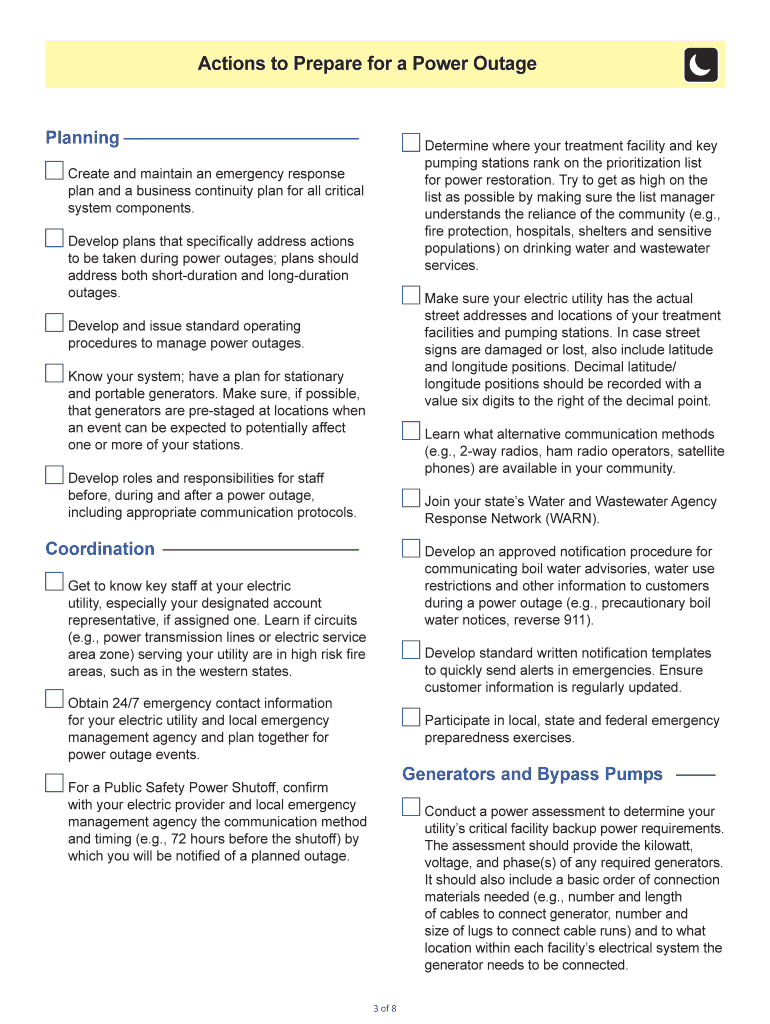
Incident Action Checklist Power Outages For onthego convenience, the actions in this checklist are divided into three rip & run sections and are examples of activities that drinking water and.
Loading

Open form follow the instructions

Easily sign the form with your finger

Send filled & signed form or save
How to fill out the EPA 817-F-19-005 online
The EPA 817-F-19-005 form is designed to assist users in documenting incidents and actions related to power outages affecting drinking water and wastewater utilities. This guide provides a clear, step-by-step approach for effectively completing this form online.
Follow the steps to fill out the EPA 817-F-19-005 online.
- Click ‘Get Form’ button to obtain the EPA 817-F-19-005 and open it for online editing.
- Begin by reviewing the introduction section to understand the purpose of the form and the importance of accurate documentation.
- Populate the 'My Contacts' section with critical contact information for your utility, including emergency contacts and service providers.
- Move to the 'Preparing for the Loss of Power During Hurricanes' section. Enter details about your utility's preparedness plans, including actions taken and resources available.
- In the 'Coordination' section, document the established notification procedures for communicating with the community during outages.
- Detail your utility’s response plan, focusing on notifications, generators readiness, and maintenance schedules in the relevant sections.
- Capture any additional notes or observations that might help with future incident planning in the designated notes section.
- After completing the form, verify that all fields are filled correctly before proceeding to save your changes, download, print, or share the form.
Complete your EPA forms online to ensure effective documentation and preparedness.
Experience a faster way to fill out and sign forms on the web. Access the most extensive library of templates available.
Related content
WARN Chair. Local Health Department. State Primacy Agency. State emergency management...
The following definitions apply to OAR Chapter 817, Divisions 5 through 120. ... (13)...
duplicates (from Faucher et al. Ch 5 in Jenkins et al. 2008). Figure 21. Dispersion of NG...
Get answers to your most pressing questions about US Legal Forms API.
How much lead is OK in drinking water?
EPA has set the maximum contaminant level goal for lead in drinking water at zero because lead can be harmful to human health even at low exposure levels. Lead is a toxic metal that is persistent in the environment and can accumulate in the body over time.
How many grams of lead is toxic?
Most pharmaceutical companies have set a limit for maximum daily intake of lead as 1.0 μg/g, however prolonged intake of even this low level of lead is hazardous to human beings. Occupational exposure also results in elevated blood lead levels.
What is the EPA action level for copper in drinking water?
These non-enforceable levels, based solely on possible health risks and exposure, are called Maximum Contaminant Level Goals. The MCLG for copper has been set at 1.3 parts per million (ppm) because EPA believes this level of protection would not cause any of the potential health problems described below.
What is the EPA standard for lead in drinking water?
EPA's action level for lead in water delivered to users of public drinking water systems is 15 µg/L. FDA has set various action levels regarding lead in food items, cosmetics and bottled water.
What are the EPA standards for TDS?
EPA recommends secondary standards to water systems but does not require systems to comply with the standard....National Secondary Drinking Water Regulations (NSDWRs) ContaminantSecondary StandardpH6.5-8.5Silver0.10 mg/LSulfate250 mg/LTotal Dissolved Solids500 mg/L11 more rows • Feb 14, 2023
How many ppm lead is safe?
There is no known safe blood lead concentration; even blood lead concentrations as low as 3.5 µg/dL may be associated with decreased intelligence in children, behavioural difficulties and learning problems (1).
What are safe levels of lead in drinking water?
EPA has set the maximum contaminant level goal for lead in drinking water at zero because lead can be harmful to human health even at low exposure levels.
What level of lead is acceptable?
OSHA set a Permissible Exposure Limit (PEL) for lead in workplace air of 50 µg/m3 (8-hour time weighted average).
Use professional pre-built templates to fill in and sign documents online faster. Get access to thousands of forms.
If you believe that this page should be taken down, please follow our DMCA take down process here.