How it works
  • Open form

    Open form follow the instructions

  • Easily sign form

    Easily sign the form with your finger

  • Share form

    Send filled & signed form or save

How to fill out the EPA 817-F-15-008 online

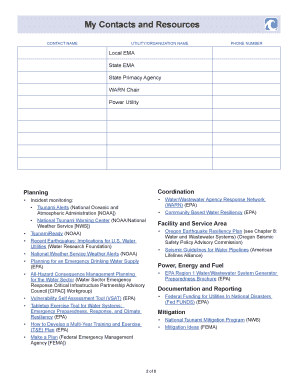
Filling out the EPA 817-F-15-008 form is an essential step for water and wastewater utilities to prepare, respond to, and recover from tsunami events. This guide provides step-by-step instructions to help users efficiently complete the form online.

Follow the steps to effectively fill out the form online.

  1. Click the ‘Get Form’ button to access the form and open it for editing.
  2. Begin by populating the 'My Contacts' section with important contact information relevant to your utility. This may include local emergency management contacts, state agency representatives, and utility partners.
  3. Proceed to the section titled 'Actions to Prepare for a Tsunami' and review the recommended actions. Select or indicate which actions your utility is planning to implement.
  4. Move to the 'Actions to Respond to a Tsunami' section. Here, document any immediate steps your utility has taken in response to a tsunami, such as inspections of facilities or operational changes.
  5. In the 'Documentation and Reporting' area, ensure you note all relevant damage assessments, mutual aid requests, and any other critical information that supports reimbursement applications or federal disaster assistance.
  6. Fill out the 'Actions to Recover from a Tsunami' section by detailing your utility's recovery plans and action items.
  7. Once all sections are completed, review the entire form for accuracy and completeness. Make any necessary adjustments.
  8. After confirming all information is correct, save your changes. You may then download, print, or share the completed form as necessary.

Start completing your EPA 817-F-15-008 form online today to ensure your utility is prepared for tsunami events.

Get form

Experience a faster way to fill out and sign forms on the web. Access the most extensive library of templates available.

Related content

Radiation Protection Document Library - US EPA

DocumentKeywordsRelated TopicEPA/SC&A Contract EP‑D‑05...NESHAPS, Subpart W...

Learn more
Questions & Answers

Get answers to your most pressing questions about US Legal Forms API.

Contact support

What is the EPA limit for arsenic in drinking water?

EPA set the arsenic standard for drinking water at 10 ppb (or 0.010 parts per million). This protects consumers from the effects of long-term, chronic exposure to arsenic.

The National Primary Drinking Water Regulations ( NPDWR) are legally enforceable primary standards and treatment techniques that apply to public water systems. Primary standards and treatment techniques protect public health by limiting the levels of contaminants in drinking water.

The CCC of 20mg/L is a minimum value except where alkalinity is naturally lower, in which case the criterion is the natural alkalinity of the water in question. Where natural alkalinity is > 20 mg/L, the criterion cannot be lower than 25% of the natural level, or 20 mg/L whichever is higher.

The recommended exposure limit set by the National Institute for Occupational Safety and Health (NIOSH) is 2 microgram per cubic meter of air for no more than a 15 minute period, based on classification of arsenic as a potential human carcinogen.

On January 22, 2001, EPA adopted a new standard for arsenic in drinking water of 0.01 mg/l or 10 parts per billion (ppb), replacing the old standard of 50 ppb.

EPA recommends secondary standards to water systems but does not require systems to comply with the standard....National Secondary Drinking Water Regulations (NSDWRs) ContaminantSecondary StandardpH6.5-8.5Silver0.10 mg/LSulfate250 mg/LTotal Dissolved Solids500 mg/L11 more rows • Feb 14, 2023

To reduce health risks associated with arsenic exposure from drinking water, the U.S. Environmental Protection Agency has set the maximum contaminant level (MCL) of arsenic in public drinking water at 10 parts per billion (ppb), and the FDA adopted this level for bottled water as well.

A geometric mean (GM) of 126 cfu per 100 mL and a statistical threshold value (STV) of 410 cfu per 100 mL measured. Recommendation 2. A GM of 100 cfu per 100 mL and an STV of 320 cfu per 100 mL measured. The GM is a statistic often used for bacterial counts in federal and state water quality standards.

Get This Form Now!

Use professional pre-built templates to fill in and sign documents online faster. Get access to thousands of forms.

If you believe that this page should be taken down, please follow our DMCA take down process here.

Get EPA 817-F-15-008