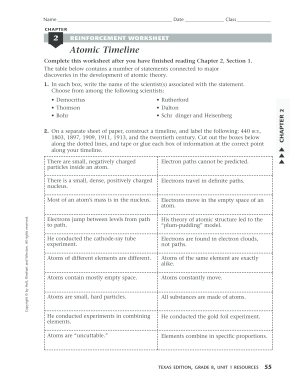
D Heisenberg) Electrons travel in definite paths. 1913 (Bohr) Copyright by Holt, Rinehart and Winston. All rights reserved. 1911 (Rutherford) Electrons move in the empty space of an atom. 1911 (Rutherford) Electrons jump between levels from path to path. 1913 (Bohr) His theory of atomic structure led to the plum-pudding model. 1897 (Thomson) He conducted the cathode-ray tube experiment. 1897 (Thomson) Electrons are found in electron clouds, not paths. twentieth century (Schr di.
Open form follow the instructions
Easily sign the form with your finger
Send filled & signed form or save
How to fill out the Atomic Timeline Answers online
Filling out the Atomic Timeline Answers is an important step in understanding atomic theory and its historical context. This guide will provide you with clear, step-by-step instructions to complete the form accurately and efficiently.
Follow the steps to successfully complete the Atomic Timeline Answers.
- Click the ‘Get Form’ button to obtain the Atomic Timeline Answers. This will allow you to access the form needed for your submission.
- In the first section, you will see boxes next to statements related to the discoveries in atomic theory. For each statement, write the name of the corresponding scientist. Utilize the list of scientists provided to ensure accurate attribution.
- Next, on a separate sheet of paper, create a timeline. Label the points 440 BCE, 1803, 1897, 1909, 1911, 1913, and the twentieth century.
- After constructing the timeline, cut out the provided boxes of information along the dotted lines. You will need to tape or glue each box at the appropriate point on your timeline.
- Once you have filled out the form and arranged your timeline, review your entries for accuracy. Make sure all information is clearly written and properly attributed.
- Finally, you can save changes to your document, download it, print it, or share it as needed for your class activities.
Get started and complete your Atomic Timeline Answers online today!
Experience a faster way to fill out and sign forms on the web. Access the most extensive library of templates available.
Related content
Sir James Chadwick, CH, FRS (20 October 1891 – 24 July 1974) was a British physicist who...
Get answers to your most pressing questions about US Legal Forms API.
What is the order of the atomic models?
Atomic model (1808) Plum-pudding model (1904) Nuclear model (1911) Planetary model (1913) Quantum mechanical model (1926-present)
What are the 5 atomic theories in order?
Ancient Greek Beliefs. Dalton's Atomic Theory. J.J. Thomson's Theory. Rutherford's Hypothesis. Bohr's Theory. Einstein, Heisenberg and Quantum Mechanics.
Which atomic theory was first?
Dalton's atomic theory was the first complete attempt to describe all matter in terms of atoms and their properties. Dalton based his theory on the law of conservation of mass and the law of constant composition. The first part of his theory states that all matter is made of atoms, which are indivisible.
What are the different atomic theory?
Atoms have protons and neutrons in the center, making the nucleus, while the electrons orbit the nucleus. The modern atomic theory states that atoms of one element are the same, while atoms of different elements are different. ... Atoms of the same element can have different numbers of neutrons, however.
What are 5 types of atoms?
Description. Atoms are made of tiny particles called protons, neutrons and electrons. ... Stable. Most atoms are stable. ... Isotopes. Every atom is a chemical element, like hydrogen, iron or chlorine. ... Radioactive. Some atoms have too many neutrons in the nucleus, which makes them unstable. ... Ions. ... Antimatter.
What is the timeline of the atomic model?
Plum-pudding model (1904) Nuclear model (1911) Planetary model (1913) Quantum mechanical model (1926-present)
How has the atomic theory changed over time?
In chemistry and physics, the atomic theory explains how our understanding of the atom has changed over time. Atoms were once thought to be the smallest pieces of matter. However, it is now known that atoms are made up of protons, neutrons, and electrons. These subatomic particles are made up of quarks.
What are the atomic theories in order?
Ancient Greek Beliefs. Leucippus and Democritus were the first to propose, in the fifth century B.C., that all matter is made of tiny units called atoms. ... Dalton's Theory. ... J.J. ... Rutherford's Hypothesis. ... Bohr's Theory. ... Einstein, Heisenberg and Quantum Mechanics. ... Quark Theory.
What are Daltons 5 Theories?
Dalton's Atomic Theory (1804) All matter is composed of extremely small particles called atoms. Atoms of a given element are identical in size, mass, and other properties. Atoms of different elements differ in size, mass, and other properties. Atoms cannot be subdivided, created, or destroyed.
What is the correct order of timeline of the history of the atom?
460 370 BC. History of the Atom - Timeline. Antoine Lavoisier. makes a substantial. ... 1766 1844. John Dalton. proposes his. ... 1743 1794. ... 1856 1940. J.J. Thomson. discovers the. ... 1871 1937. Ernest Rutherford. performs the Gold Foil. ... 1885 1962. Niels Bohr. proposes. ... 1887 1961. Erwin. Schrodinger. ... 1891 1974. James. Chadwick.
Use professional pre-built templates to fill in and sign documents online faster. Get access to thousands of forms.
If you believe that this page should be taken down, please follow our DMCA take down process here.