Loading
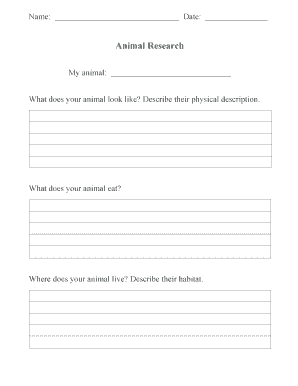
Get Animal Research Paper Template
How it works
-

Open form follow the instructions
-

Easily sign the form with your finger
-

Send filled & signed form or save
How to fill out the Animal Research Paper Template online
This guide provides a clear walkthrough for users on how to fill out the Animal Research Paper Template online. With detailed instructions for each section, you will be equipped to complete the form accurately and efficiently.
Follow the steps to complete your Animal Research Paper Template
- Click ‘Get Form’ button to access the Animal Research Paper Template and open it for editing.
- In the first section, fill in the name of your animal in the designated field. Be specific to help clarify your research focus.
- Next, describe your animal's physical appearance in detail. Consider including information about size, color, and any distinguishing features.
- Proceed to the dietary information section. Clearly state what your animal typically eats, including any special dietary needs.
- In the habitat section, describe where your animal lives. Include specifics about the environment, such as the type of ecosystem and geographical location.
- For the behavior section, write about your animal’s behaviors and habits. This may include social interactions, communication methods, and daily activities.
- Address the lifecycle of your animal, detailing its life span and the stages of development it goes through from birth to maturity.
- Mention two interesting facts about your animal that showcase its uniqueness or intrigue.
- Lastly, provide your opinion on your animal. Be sure to articulate your perspective clearly and support it with reasons.
- Once all sections are completed, review your work for accuracy. Then, you can save changes, download, print, or share the completed form as needed.
Start filling out your Animal Research Paper Template online today!
Imprecise results from animal experiments may result in clinical trials of biologically faulty or even harmful substances, thereby exposing patients to unnecessary risk and wasting scarce research resources. Animal toxicity studies are poor predictors of toxic effects of drugs in humans.