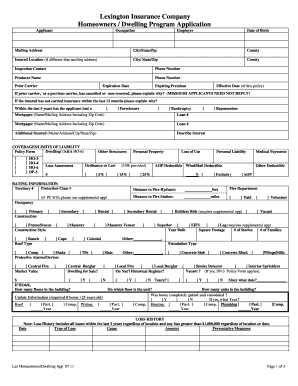
D to you or are you otherwise aware of: (i) a bending, leaning, shrinkage or expansion of any part of the dwelling or sinkhole that might affect the dwelling or other structures or (ii) any other partial or complete sinking or collapse of the dwelling or other structures? [ ]Y[ ]N other structure or (ii) any depression in the ground surface on the premises? [ ]Y [ ]N 3) At any time, has this property had any prior sinkhole claims? [ ]Y[ ]N Earthquake Coverage [ ]Y [ EQ Zone ]N If yes, [ ] .
Open form follow the instructions
Easily sign the form with your finger
Send filled & signed form or save
How to fill out the Lex Homeowners/Dwelling App online
Filling out the Lex Homeowners/Dwelling App online is a crucial step in ensuring that your dwelling is adequately insured. This guide will provide you with clear instructions on how to complete each section of the application form, empowering you to submit your information confidently and accurately.
Follow the steps to complete the application form online.
- Click the ‘Get Form’ button to access the Lex Homeowners/Dwelling App. This action opens the document in your online editing environment.
- Begin by filling in your personal details in the 'Applicant' section including your occupation, employer, date of birth, mailing address, city, state, and ZIP code.
- If your insured location differs from your mailing address, provide the details in the 'Insured Location' section along with the corresponding county.
- Enter the inspection contact name and phone number. This is the person who will be reached for any necessary follow-ups.
- Complete the 'Prior Carrier' section with information including the expiration date of your previous policy and the expiring premium.
- Next, if applicable, answer questions about any cancellations or non-renewals from prior insurance carriers.
- Complete the financial assessment by answering questions related to foreclosure, bankruptcy, or repossession over the last five years, if relevant.
- Provide details about the mortgagee, including the name, mailing address, and loan number.
- Specify any additional insured parties that should be included in the policy.
- In the 'Coverages/Limits of Liability' section, select your desired policy form and coverage limits.
- Fill in the 'Rating Information' fields including protection class number, territory number, and loss of use details.
- Detailed information on the construction type and occupancy should be completed in the respective sections.
- Address any loss history by providing the date, type of loss, cause, amount, and any preventative measures taken.
- Respond to all questions in the 'Additional Underwriting Information' section, making sure to check applicable boxes.
- Review the optional coverages and endorsements to select any additional protections you may wish to add.
- Once all sections are completed, thoroughly review your entries for accuracy.
- Finally, save your changes, download the completed form, print it, or share it as needed.
Start filling out your Lex Homeowners/Dwelling App online today to secure your insurance!
Experience a faster way to fill out and sign forms on the web. Access the most extensive library of templates available.
Related content
This program will provide qualified low- and moderate-income (LMI) first-time homebuyers...
Homeowners' Lived Experience in Developing and Using Accessory Dwelling Units” that...
by LA DeSimone — The U.S. Geological Survey (USGS) is committed to providing the Nation...
Get answers to your most pressing questions about US Legal Forms API.
What not to say when filing a home insurance claim?
When filing a home insurance claim, it's vital to avoid making statements that could confuse or mislead your insurer. Stick to the facts, and don’t offer opinions or assumptions about the cause of the loss. For accurate guidance on your claims process, you can rely on the Lex Homeowners/Dwelling App, which keeps you informed about how to communicate effectively with your insurance provider.
Which homeowners form provides broad perils coverage for both the dwelling and its personal property?
The Lex Homeowners/Dwelling App also provides a form that covers broad perils for both your dwelling and personal property. This type of coverage ensures that you are protected against a wide range of potential risks that could impact your home and belongings. Utilizing the Lex Homeowners/Dwelling App allows you to tailor your coverage to fit your specific needs, making it a smart choice for homeowners.
Which homeowners form provides broad named peril coverage for both the dwelling and personal property?
The Lex Homeowners/Dwelling App offers broad named peril coverage, which protects your home and personal belongings from specific risks. This form is designed to give you peace of mind, knowing that essential aspects of your property are safeguarded. By using the Lex Homeowners/Dwelling App, you can easily access the coverage details and see what's included in your policy.
What does dwelling mean on home insurance?
Dwelling coverage, sometimes called "dwelling insurance," is the part of your homeowners insurance policy that may help pay for the rebuilding or the repair of the physical structure of your home if it's damaged by a covered hazard.
What is not covered under a dwelling policy?
Note: Dwelling coverage on standard policies typically won't protect against damage caused by floods, earthquakes, sewer backups, or lack of maintenance. Learn how flood insurance works and what to do if your home is damaged in an earthquake.
What coverage is not included in the basic form dwelling policy?
No coverage. Damage from power failure that takes place away from the insured premises is excluded under the Dwelling forms. Damage by wind, hail, weight of ice, snow or sleet is not covered. Damage to outdoor plants by forces of nature other than lightning are so common that such damage is considered uninsurable.
How do you calculate dwelling coverage?
Calculate it yourself: You can take the square footage of your home and multiply it by your local construction costs. These costs are usually available on construction company websites.
What is not included in an unendorsed dwelling policy?
Future Assets. If you have any items in your home that are expected to mature in value, you cannot count on an unendorsed dwelling policy to cover their future value. A homeowners policy will generally cover the value of the basic, everyday belongings inside your home.
What is included in a dwelling policy?
Dwelling coverage (often called Coverage A on a homeowners or condo insurance policy) is one part of your home insurance policy that covers your house, including an attached garage, countertops, flooring, and built-in appliances.
Which of the following is not covered under Coverage A of the homeowners policy?
Most catastrophes are covered. For example, wind damage from hurricanes or tornadoes is covered as a windstorm peril. But, flood damage and earthquake damage are NOT covered by a standard homeowners policy. A separate policy is required.
Use professional pre-built templates to fill in and sign documents online faster. Get access to thousands of forms.
If you believe that this page should be taken down, please follow our DMCA take down process here.