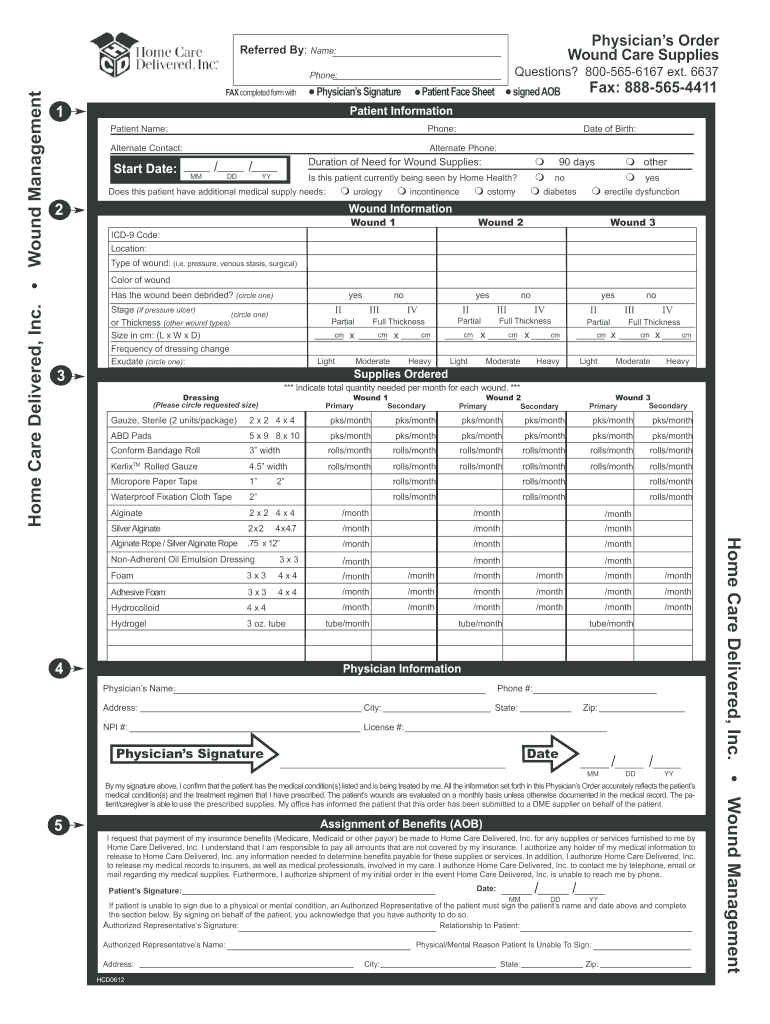
Ure 1 n Patient Face Sheet n Fax: 888-565-4411 signed aOB Patient Information Patient Name: Phone: Alternate Contact: Start Date: Date of Birth: Alternate Phone: MM / DD / Duration of Need for Wound Supplies: YY m 90 days m other m no m yes m diabetes m erectile dysfunction Is this patient currently being seen by Home Health? m urology Does this patient have additional medical supply needs: 2 m incontinence m ostomy Wound Information Wound 1 Wound 3 Wound 2 ICD-9 Code:.

Open form follow the instructions

Easily sign the form with your finger

Send filled & signed form or save
How to fill out the HCD Physician's Order Wound Care Supplies online
Filling out the HCD Physician's Order Wound Care Supplies form online ensures a streamlined process for obtaining necessary wound care supplies for patients. This guide provides step-by-step instructions to help users efficiently complete each section of the form.
Follow the steps to accurately complete the form online.
- Click ‘Get Form’ button to access the document and open it in an editable format.
- Begin by entering the patient's information. Fill in the patient's name, phone number, alternate contact, start date, and date of birth in the designated fields.
- Specify the duration of need for wound supplies by selecting '90 days' or 'other,' as applicable. Additionally, indicate if the patient has diabetes, erectile dysfunction, or is being seen by Home Health.
- Move on to the wound information section. For each wound, provide the ICD-9 code, location, type (such as pressure or surgical), color, stage or thickness, size in centimeters, frequency of dressing changes, and exudate details.
- In the supplies ordered section, indicate the total quantity needed per month for each wound. Circle the appropriate sizes for each type of dressing, gauze, or other required supplies.
- Fill in the physician's information, including their name, phone number, address, NPI number, license number, and signature. Ensure the date is accurately recorded.
- Complete the Assignment of Benefits section by signing and dating. If the patient is unable to sign, have an authorized representative sign on their behalf, citing the relationship to the patient.
- Review the completed form to ensure all information is correct and that no sections have been overlooked. Once satisfied, save your changes, download, or print the completed form for submission.
Complete your documents online for efficient processing.
Experience a faster way to fill out and sign forms on the web. Access the most extensive library of templates available.
Related content
Support, MCPs must receive and document an order from the Member's current primary care...
Demand and supply issues have complex feedback effects. A great many resources are...
Feb 1, 1989 — For an explanation of how we use these parts to make superior sounding...
Get answers to your most pressing questions about US Legal Forms API.
What is the best dressing for an open wound?
Cloth. Cloth dressings are the most commonly used dressings, often used to protect open wounds or areas of broken skin. They are suitable for minor injuries such as grazes, cuts or areas of delicate skin.
Do wounds heal faster covered or uncovered?
A handful of studies have found that when wounds are kept moist and covered, blood vessels regenerate faster and the number of cells that cause inflammation drop more rapidly than they do in wounds allowed to air out. It is best to keep a wound moist and covered for at least five days.
What is the best wound dressing to promote healing?
Hydrocolloid The gel made by hydrocolloid wound dressings keeps the wound's surface moist and promotes faster healing.
What is the best dressing for a deep wet wound?
For wet wounds, a dressing that absorbs is desired. To treat deep and wet wounds, an absorptive filler and a cover dressing should be selected. Filler dressing options include: absorptive dressing, calcium alginate (flat or rope), hydro-fiber, hydropolymer or specialty gauze.
What is the fastest way to heal an open wound?
Wounds often heal fast by keeping them clean and moist. Avoiding hydrogen peroxide or air drying is crucial. However, there is no simple answer to helping wounds heal. Most wounds other than simple cuts require medical attention and often a wound specialist.
What supplies are needed for the wound care procedure?
Medical Tape. Medical tape helps stabilize and secure the bandaging that is placed over a wound or surgical site. ... Non-Woven Sponges. Non-woven sponges are comprised of tightly pressed cotton or polyester and/or rayon fibers. ... Alcohol Pads. ... Earloop Face Masks. ... Suture Removal Kits. ... Medical Gloves. ... Gauze Rolls. ... Medical Drapes.
What is a wound specialist called?
Certified Wound Specialist Physician (CWSPⓇ) With such rigorous certification requirements, it's clear that becoming a wound specialist requires not only experience, but also deep knowledge of all aspects of wound care, from anatomy and physiology and patient assessment to treatment management and medical ethics.
What are 3 types of dressings?
5 Types of Wound Dressings and When to Use Them Gauze. Gauze, or cloth, dressings are made of woven cotton fabric in various sizes and shapes. ... Foam. Foam dressings are soft and gentle wound dressings made of polyurethane foam. ... Transparent Film. ... Hydrocolloid. ... Hydrogel.
Use professional pre-built templates to fill in and sign documents online faster. Get access to thousands of forms.
If you believe that this page should be taken down, please follow our DMCA take down process here.