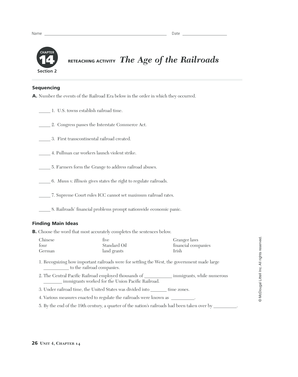
In which they occurred. 1. U.S. towns establish railroad time. 2. Congress passes the Interstate Commerce Act. 3. First transcontinental railroad created. 4. Pullman car workers launch violent strike. 5. Farmers form the Grange to address railroad abuses. 6. Munn v. Illinois gives states the right to regulate railroads. 7. Supreme Court rules ICC cannot set maximum railroad rates. 8. Railroads nancial problems prompt nationwide economic panic.

How it works
  • Open form

    Open form follow the instructions

  • Easily sign form

    Easily sign the form with your finger

  • Share form

    Send filled & signed form or save

How to fill out the Chapter 14 Section 2 The Age Of The Railroads Answer Key online

This guide provides a comprehensive overview of how to accurately fill out the Chapter 14 Section 2 The Age Of The Railroads Answer Key online. Follow these clear steps to ensure the completion of your document effectively and efficiently.

Follow the steps to complete your answer key online.

  1. Click the ‘Get Form’ button to access the answer key document and open it in your preferred online editing tool.
  2. Begin with Section A, where you will need to number the events of the Railroad Era in the correct chronological order. Review the list of events and assign a number to each based on the sequence in which they happened.
  3. Move to the 'Finding Main Ideas' section. Fill in the blanks with appropriate terms based on your understanding of the content. Ensure each blank is correctly addressed with the correct terminology.
  4. In Section B, read the options provided for each statement and select the word that most accurately completes each sentence. Take your time to analyze each choice to select the best fit.
  5. After completing all sections, review your entries for accuracy. Make sure all fields are filled out correctly to avoid any errors.
  6. Once you are satisfied with your responses, proceed to save your changes. You may have the option to download, print, or share the answer key as necessary.

Start filling out your documents online today for an efficient and organized experience.

Get form

Experience a faster way to fill out and sign forms on the web. Access the most extensive library of templates available.

Related content

The Age Discrimination in Employment Act of 1967 |...

(2) the setting of arbitrary age limits regardless of potential for job performance...

Learn more
Section 2 Guided The Northern Renaissance Answer |...

Getting the books section 2 guided the northern renaissance answer now is not type of...

Learn more
Underground Railroad - Wikipedia

The Underground Railroad was a network of secret routes and safe houses established in the...

Learn more
Questions & Answers

Get answers to your most pressing questions about US Legal Forms API.

Contact support

When did the first railroad start in America?

The first railroad track in the United States was only 13 miles long, but it caused a lot of excitement when it opened in 1830. Charles Carroll, the last surviving signer of the Declaration of Independence, laid the first stone when construction on the track began at Baltimore harbor on July 4, 1828.

The railroad opened for through traffic on May 10, 1869, when CPRR President Leland Stanford ceremonially drove the gold "Last Spike" (later often referred to as the "Golden Spike") at Promontory Summit in Utah.

Theodore Judah, a civil engineer who helped build the first railroad in California, promoted a route along the 41st parallel, running through Nebraska, Wyoming, Utah, Nevada, and California.

It would begin in Omaha, Nebraska and end up in Sacramento, California. The other route was the "southern route".

“Wedding of the Rails” Officials and workers of the Union Pacific and the Central Pacific railways held a ceremony on Promontory Summit, in Utah Territory—approximately thirty-five miles away from Promontory Point, the site where the rails were joined—to drive in the Golden Spike on May 10, 1869.

The Railroad Act of 1862 put government support behind the transcontinental railroad and helped create the Union Pacific Railroad, which subsequently joined with the Central Pacific at Promontory, Utah, on May 10, 1869, and signaled the linking of the continent.

Railways were introduced in England in the seventeenth century as a way to reduce friction in moving heavily loaded wheeled vehicles. The first North American "gravity road," as it was called, was erected in 1764 for military purposes at the Niagara portage in Lewiston, New York.

Sometimes there were problems between the railroad employees and the railroad owners and managers. Employees often worked 10, 12 and even 16 hours a day. Sometimes they did not receive extra pay for the extra hours they worked. Conditions on the job were often very dangerous.

Get This Form Now!

Use professional pre-built templates to fill in and sign documents online faster. Get access to thousands of forms.

If you believe that this page should be taken down, please follow our DMCA take down process here.

Get Chapter 14 Section 2 The Age Of The Railroads Answer Key