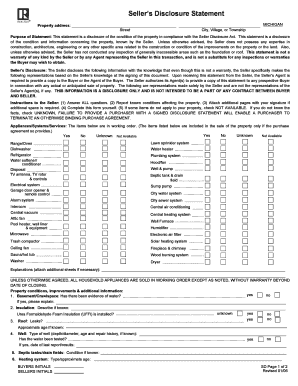
This statement is a disclosure of the condition and information concerning the property known by the Seller. THIS INFORMATION IS A DISCLOSURE ONLY AND IS NOT INTENDED TO BE A PART OF ANY CONTRACT BETWEEN BUYER AND SELLER. Instructions to the Seller 1 Answer ALL questions. Seller s Disclosure Statement Property address MICHIGAN Street City Village or Township Purpose of Statement This statement is a disclosure of the condition of the property in compliance with the Seller Disclosure Act. Upon receiving this statement from the Seller the Seller s Agent is required to provide a copy to the Buyer or the Agent of the Buyer. The Seller has owned the property since systems of this property from the date of this form to the date of closing Seller will immediately disclose the changes to Buyer. In no event shall the parties hold the Broker liable for any representations not directly made by the Broker or Broker s Agent. Seller certifies that the information in this statement is true and correct....
Open form follow the instructions
Easily sign the form with your finger
Send filled & signed form or save
How to fill out the Sellers Disclosure Michigan online
Filling out the Sellers Disclosure Michigan is an essential step for sellers who wish to provide transparent information regarding the condition of their property. This guide will provide you with detailed, step-by-step instructions to help you complete the form accurately and efficiently.
Follow the steps to complete your Sellers Disclosure Michigan online.
- Click ‘Get Form’ button to obtain the form and open it in the appropriate document editor.
- Begin with the property address section. Enter the street, city, village, or township where the property is located.
- In the purpose of the statement, understand that this document discloses the condition of the property as required by the Seller Disclosure Act.
- Answer all questions honestly. Each field must be addressed, even if you need to select 'Not Available' or 'Unknown' where applicable.
- For appliances, systems, and services, indicate whether they are in working order, checking 'Yes', 'No', 'Unknown', or 'Not Available' as required.
- Move to the property conditions section. Answer questions relating to issues such as water evidence in the basement, roof leaks, and the type of insulation.
- Proceed through questions about the heating system, plumbing, electrical systems, and any history of infestation or environmental problems.
- Document any information regarding shared features with adjacent landowners, encroachments, easements, and any alterations made without proper permits.
- Confirm the seller's living and ownership periods of the property and include any significant changes in condition between filling out the form and the closing date.
- Finally, ensure the seller certifies that the information is true and accurate by signing and dating the form. Keep a copy for your records.
- Once you have completed all sections, you can save any changes, download the finalized document, print it, or share it as needed.
Begin completing your Sellers Disclosure Michigan online to ensure a smooth transaction process.
Experience a faster way to fill out and sign forms on the web. Access the most extensive library of templates available.
Related content
The seller disclosure requirements of sections 4 to 13 apply to the transfer of any...
by LA Bernstein · 1997 · Cited by 5 — In Washington, a seller has no duty to provide a...
I AUTHORIZE THE MICHIGAN DEPARTMENT OF HEALTH AND HUMAN SERVICES (MDHHS) TO SHARE MY...
Get answers to your most pressing questions about US Legal Forms API.
Is a sellers disclosure required in Michigan?
In Michigan, seller's of owner occupied residential property up to 4 units, are required by law to complete a Seller's Disclosure Statement. ... In this statement the seller must disclose the condition of the property and any other information concerning the property that is known to the seller.
What happens when a seller fails to disclose?
If a seller fails to disclose, or actively conceals, problems that affect the value of the property; they are violating the law, and may be subject to a lawsuit for recovery of damages based on claims of fraud and deceit, misrepresentation and/or breach of contract.
Is Michigan a buyer beware state?
One Michigan court actually declared this to be the standard in a 2001 appellate case. ... This advice is perhaps well intentioned but it is wrong, at least under current Michigan law. The baseline standard is still buyer beware. The Act modifies this standard; it does not reverse it into a seller's confessional act.
Can I sue seller for non disclosure?
You can only sue a person for non-disclosure if he or she in fact had a legal obligation to disclose something to you. Usually this is not an issue since these lawsuits typically arise in the context of a purchase and sale. The seller has a legal duty to the buyer due to the existence of their contractual relationship.
What do you have to disclose when selling a house in Michigan?
Michigan disclosure laws require a seller to disclose what is personally known about the home, including any imperfections. This could include things like lead-based paint, water damage, hazardous conditions, pest damage, past repairs, past insurance claims, etc.
What is a seller disclosure law?
A seller disclosure form is a document required by State law that discloses certain physical and/or title conditions of a one- to four-unit residential property by a seller to a buyer during a title transfer. The laws regarding what sellers are required to disclose vary State-to-State.
Is Michigan a full disclosure state?
While some states have specifically addressed whether or not sellers must disclose whether a property is stigmatized (by death, murder, infectious disease, and so forth), Michigan has not. The disclosure statement instead generally limits disclosures to the physical condition of the property.
What is the seller's disclosure act?
This law requires that a disclosure form be filled out for most, but not all sales of property consisting of one to four dwelling units. ... A seller must disclose, among other things, if there are any problems with the foundation, electricity, heating, septic, drainage, or hazardous materials.
What happens if a seller does not disclose?
If a seller fails to disclose, or actively conceals, problems that affect the value of the property; they are violating the law, and may be subject to a lawsuit for recovery of damages based on claims of fraud and deceit, misrepresentation and/or breach of contract.
What does a seller have to disclose when selling a home?
Sellers should disclose anything that required a permit in their home. These are usually significant items that should be disclosed. Examples include the heating system, air conditioning, the roof, or anything related to the plumbing or electrical systems.
Use professional pre-built templates to fill in and sign documents online faster. Get access to thousands of forms.
If you believe that this page should be taken down, please follow our DMCA take down process here.