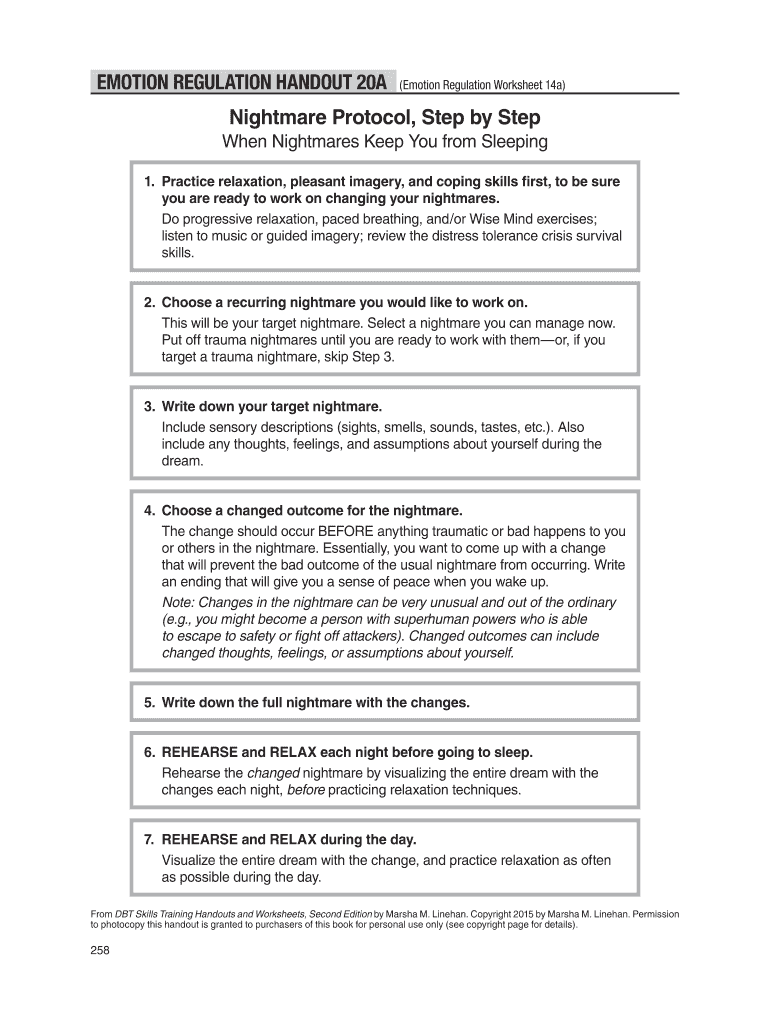
EMOTION REGULATION HANDOUT 20A(Emotion Regulation Worksheet 14a)Nightmare Protocol, Step by Step When Nightmares Keep You from Sleeping 1. Practice relaxation, pleasant imagery, and coping skills.
Loading

Open form follow the instructions

Easily sign the form with your finger

Send filled & signed form or save
How to fill out the Emotional Regulation Worksheets online
The Emotional Regulation Worksheets are designed to assist individuals in managing their emotions and reducing distress, particularly in relation to nightmares. This guide provides clear, step-by-step instructions for effectively completing these worksheets online.
Follow the steps to complete the Emotional Regulation Worksheets online.
- Click ‘Get Form’ button to access the worksheet and open it in your preferred online form editor.
- Begin by reviewing the entire worksheet to familiarize yourself with the components. This will help you understand the structure and the information required.
- Identify a recurring nightmare that you wish to address and write it down. Ensure that it is a nightmare you feel you can manage at this time.
- Detail your chosen nightmare by describing sensory elements like sights, sounds, and smells. Also include any related thoughts, feelings, and assumptions you experience during this nightmare.
- Choose an altered outcome for your nightmare. Clearly articulate this new ending that provides you with a sense of peace and prevents any distressing events from occurring.
- Incorporate your revised nightmare narrative into the worksheet, ensuring that you write out the full version with the changes you have crafted.
- Practice rehearsing your changed nightmare each night before falling asleep, utilizing relaxation techniques to reinforce the process.
- During the daytime, visualize your altered dream and continue using relaxation practices regularly to strengthen the new outcome in your mind.
- Once you have completed filling out the worksheet, you can save your changes, download your document, print it out, or share it with a trusted individual.
Start completing your Emotional Regulation Worksheets online now to take control of your emotional well-being.
Experience a faster way to fill out and sign forms on the web. Access the most extensive library of templates available.
Related content
You can then assist each one in developing skills in other channels. These modulation...
Challenging Thoughts (Client Handouts). CBT+ Triangle Worksheet ... Cognitive...
EMOTION REGULATION HANDOUT 6 (Emotion Regulation Worksheets 4, 4a) (p. 1 of 10). Ways to...
Get answers to your most pressing questions about US Legal Forms API.
How do you teach emotional regulation to adults?
Emphasize the importance of identifying the specific emotions they/others feel. ... Enhance self-regulation through goal setting. ... Encourage adaptability. ... Practice strategies for self-awareness.
What are some strategies for emotion regulation?
Mindfulness. The first emotional regulation skill is mindfulness. ... Attention-Shifting Strategies. ... Forward-Looking Strategies. ... Positive Self Talk (Reframing) ... Calling Upon our Best Self.
How can adults improve self-regulation?
Self-regulation strategies can include: Mindfulness: Many psychologists suggest practicing mindfulness when you want to improve your self-regulation. With mindfulness, you can look at your thoughts, feelings and behavior non-judgmentally to make conscious decisions.
What is an example of emotional regulation?
Examples. Here are some examples of activated goals that trigger the regulation of your emotions: ... When your child has a meltdown, you may feel angry or even amused, but instead of yelling or laughing, you regulate your emotions in order to talk to your child calmly about how she could react instead.
What are some strategies for emotional regulation?
Take a look at the impact of your emotions. Intense emotions aren't all bad. ... Aim for regulation, not repression. ... Identify what you're feeling. ... Accept your emotions all of them. ... Keep a mood journal. ... Take a deep breath. ... Know when to express yourself. ... Give yourself some space.
Which of the following are examples of emotion regulation?
Which of the following are examples of emotion regulation? Dampening one's own happiness to comfort a friend. Increasing, decreasing, or maintaining behavioral aspects of emotion. Intensifying negative emotions to help achieve a goal.
What are the emotion regulation skills in DBT?
Emotion regulation is a dialectical behavior therapy ( DBT ) skill to help us understand the function of emotions, the action urge that accompanies each emotion, and whether to heed or oppose these urges.
What is an emotional regulation technique?
Emotional regulation skills include the ability to identify, understand and accept emotional experiences; control impulsive behaviors when distressed; and flexibly manage emotional experiences as appropriate (i.e., not flying off the handle at work!)
What are emotional regulation strategies?
Emotion regulation is a term generally used to describe a person's ability to effectively manage and respond to an emotional experience. People unconsciously use emotion regulation strategies to cope with difficult situations many times throughout each day. ... Self-injury is considered an unhealthy coping strategy.
How do you teach emotional regulation?
Connect the idea that emotions drive behaviors. ... Be patient. ... Set the tone first thing in the morning. ... Help students understand emotions in real time. ... Check in all day long. ... Build a word wall. ... Designate a calm-down spot. ... Take the focus off of academic success.
Use professional pre-built templates to fill in and sign documents online faster. Get access to thousands of forms.
If you believe that this page should be taken down, please follow our DMCA take down process here.