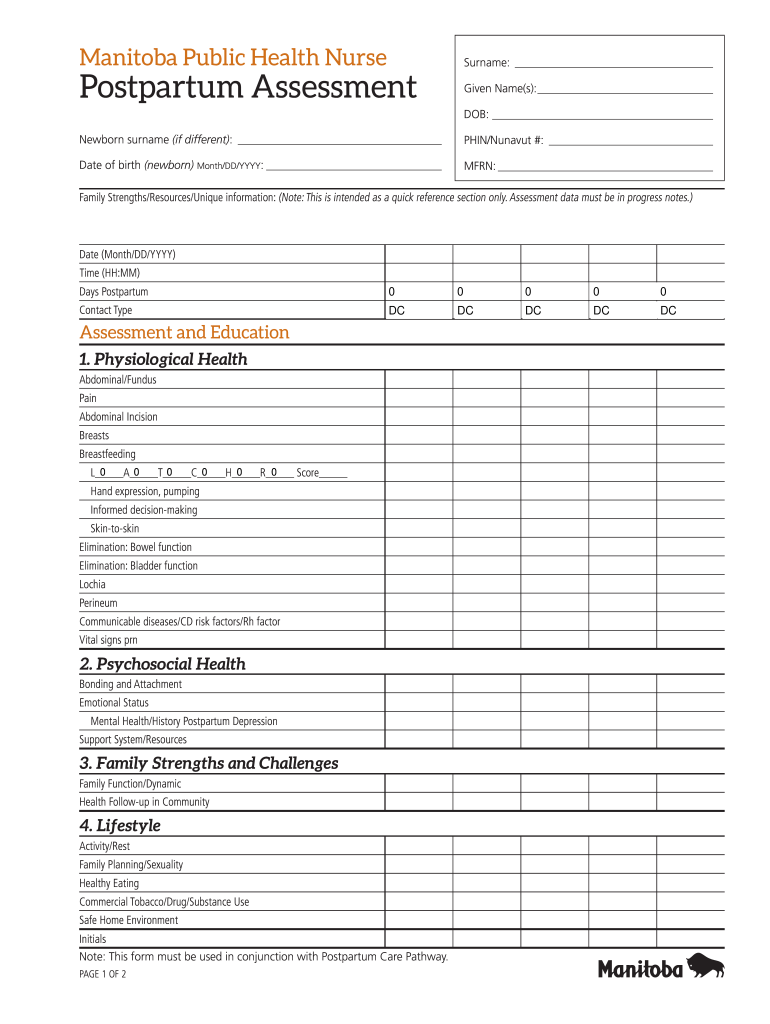
Manitoba Public Health NurseSurname: Postpartum AssessmentGiven Name(s): DOB: Newborn surname (if different): PHIN/Nunavut #: Date of birth (newborn) Month/DD/YYYY: MFRN: Family Strengths/Resources/Unique.
Loading

Open form follow the instructions

Easily sign the form with your finger

Send filled & signed form or save
How to fill out the Canada PHN Postpartum Assessment online
The Canada PHN Postpartum Assessment is a vital document designed to evaluate the health and well-being of new parents and their infants. This guide provides clear and supportive instructions on completing the assessment form online, ensuring a smooth and efficient process.
Follow the steps to complete your assessment effectively.
- Press the ‘Get Form’ button to access the assessment form and open it for completion.
- Begin by entering your surname and given name(s) in the designated fields at the top of the form. This identifies you as the person completing the assessment.
- Fill in your date of birth accurately to ensure that your health records are correctly linked. Use the format indicated: Month/DD/YYYY.
- If your newborn's surname differs from yours, provide it in the space provided. If it's the same, you may leave that field blank.
- Enter your PHIN or Nunavut number in the corresponding field for easy reference.
- Add your newborn's date of birth in the designated format. Be sure to fill this out as it is critical for newborn assessment.
- Indicate the MFRN in the given space; this number is important for continuity of care.
- In the 'Family Strengths/Resources/Unique information' section, provide any relevant information that can help in assessing the family dynamics. Remember that this section is intended for quick reference.
- Record the date, time, and number of days postpartum for your assessment. Ensure that these details are accurate as they are essential for tracking progress.
- In the assessment and education section, address each item related to physiological and psychosocial health by marking the appropriate score and providing any necessary comments.
- After completing all sections, review the information to ensure accuracy and completeness. This is crucial for effective follow-up care.
- Once you have filled out the form completely, you may choose to save your changes, download the document, print it out for your records, or share it as necessary.
Take the next step for your health and complete your postpartum assessment online today.
Experience a faster way to fill out and sign forms on the web. Access the most extensive library of templates available.
Related content
by M Aston · 2016 · Cited by 14 — Maternal, child, and newborn health is a priority...
You must also speak to your doctor, public health nurse, mental health worker or other...
Get answers to your most pressing questions about US Legal Forms API.
What assessments are vital on a postpartum patient?
BREASTS. The breasts are assessed for: ... UTERUS. The fundus is assessed for: ... BOWEL. Assessment of the bowel is important in all postpartum patients. ... BLADDER. Assessment of urination and bladder function includes: ... LOCHIA. Lochia is assessed during the postpartum period: ... EPISIOTOMY/PERINEUM. ... LOWER EXTREMITIES. ... EMOTIONS.
How often do you do postpartum assessments?
Mothers are at risk for postpartum hemorrhage, hence frequent assessment via blood pressure and heart rate every 15 minutes along with determination of fundal height and amount of lochia are recommended by AAP and ACOG (2012) and AWHONN (2010).
How often are vital signs generally taken on the newly delivered mother in the immediate postpartum period?
Definition: The number of newly-delivered mothers receiving standardized checks every 30 minutes after delivery for the first two hours. "Examined" refers to a series of standardized checks: vital signs, bleeding, and uterine status.
What is a postpartum assessment?
The postpartum nursing assessment is an important aspect of care in order to identify early signs of complications in the woman who has just given birth. Following pregnancy, the woman is at risk for infection, hemorrhage, and the development of a Deep Vein Thrombosis (DVT).
What is the purpose of a postpartum assessment?
The postpartum nursing assessment is an important aspect of care in order to identify early signs of complications in the woman who has just given birth. Following pregnancy, the woman is at risk for infection, hemorrhage, and the development of a Deep Vein Thrombosis (DVT).
How would you describe postpartum pain?
As your uterus shrinks back into its normal size and shape, you will feel pain in your abdomen (lower belly). These pains are called afterpains. Most of these pains will be dull, but some will be sharp. You may feel more of these pains as you breastfeed your baby.
What is included in postpartum care?
The comprehensive postpartum visit should include a full assessment of physical, social, and psychological well-being, including the following domains: mood and emotional well-being; infant care and feeding; sexuality, contraception, and birth spacing; sleep and fatigue; physical recovery from birth; chronic disease ...
What happens at your 2 week postpartum checkup?
What happens at a postpartum checkup? Your provider checks your blood pressure, weight, breasts and belly. If you had a cesarean birth (also called c-section), your provider may want to see you about 2 weeks after you give birth so she can check on your c-section incision (cut).
What pain is equal to childbirth?
Pain during labor is different for every woman. It varies widely from woman to woman and even from pregnancy to pregnancy. Women experience labor pain differently for some, it resembles menstrual cramps; for others, severe pressure; and for others, extremely strong waves that feel like diarrheal cramps.
How is pain assessed postpartum?
Methods: Pain assessment was performed using two subjective scales: the Verbal Numeric Scale (VNS) of 11 points and the Verbal Rating Score (VRS) of 4 points. Data collection period ran from the first postnatal day until 6 months after delivery, with two intermediate measurements at 1 and 7 weeks after birth.
Use professional pre-built templates to fill in and sign documents online faster. Get access to thousands of forms.
If you believe that this page should be taken down, please follow our DMCA take down process here.