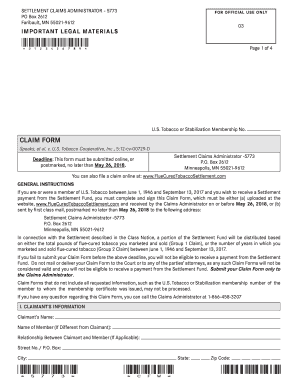
R Stabilization Membership No. CLAIM FORM Speaks, et al. v. U.S. Tobacco Cooperative, Inc., 5:12-cv-00729-D Deadline: This form must be submitted online, or postmarked, no later than May 26, 2018. Settlement Claims Administrator -5773 P.O. Box 2612 Minneapolis, MN 55021-9612 You can also file a claim online at: www.FlueCuredTobaccoSettlement.com GENERAL INSTRUCTIONS If you are or were a member of U.S. Tobacco between June 1, 1946 and September 13, 2017 and you wish to receive a Settlement pay.
Open form follow the instructions
Easily sign the form with your finger
Send filled & signed form or save
How to fill out the Flue Cured Tobacco Settlement Update 2020 online
Filling out the Flue Cured Tobacco Settlement Update 2020 can be straightforward if you follow the provided instructions carefully. This guide will help you navigate each section of the form to ensure you complete it accurately and timely.
Follow the steps to successfully complete the form
- Press the ‘Get Form’ button to obtain the form and access it for completion.
- Begin by filling in the Claimant’s Information section. Provide the Claimant's name, the name of the member if different, and their relationship. Include the street address, city, state, and zip code.
- Enter the U.S. Tobacco or Stabilization Membership Number, Taxpayer ID Number, and Social Security Number for individuals. Add daytime and evening telephone numbers, along with an email address.
- Indicate the Claimant Status by checking the appropriate box (Individual, Corporation, Partnership, Heir/Estate, or Other) and provide the name and capacity of the person completing the form if applicable.
- In the Claim Selection section, choose either Group 1 or Group 2 by checking the corresponding box. Group 1 requires information on the total pounds of tobacco marketed, while Group 2 requires the number of crop years.
- For either claim group, fill out the required details including the estimated amount of tobacco or number of years claimed, along with the specific years included.
- In the Documentation section, check all applicable options to support your claim and ensure to include relevant documents as indicated.
- Review and complete the Representations and Certification of Claimant section, providing your signature to certify the accuracy of the information provided.
- Finally, save your changes, download a copy of the form, print it, or share it as necessary.
Complete the Flue Cured Tobacco Settlement Update 2020 online to ensure your participation in the settlement.
Experience a faster way to fill out and sign forms on the web. Access the most extensive library of templates available.
Related content
Q What if I grow flue cured tobacco under a valid contract and the contract provider...
Dec 15, 2020 — The 2020 Flue-Cured Tobacco OVT Results can be used as a decision...
In the United States, this led to the Tobacco Master Settlement Agreement, which settled...
Get answers to your most pressing questions about US Legal Forms API.
What is flue-cured Virginia tobacco?
Virginia tobacco is flue-cured, which means that the leaves are hung into curing barns, where heated air is generated to dry the leaves. As they lose their moisture, they develop their distinct aroma, texture and color.
What are tobacco curing methods?
Depending on the type of the tobacco principal methods of curing can be distinguished as i) flue-curing, ii) air-curing, iii) fire-curing and iv) sun-curing.
What happened to the flue-cured tobacco settlement?
This settlement is closed! ... The proposed Flue-Cured Tobacco settlement will resolve a class action lawsuit that claims U.S. Tobacco Cooperative kept accumulating funds from Class Members after the federal Tobacco Price Support Program ended, at which point U.S. Tobacco Cooperative no longer served its purpose.
What is the status of the flue-cured tobacco settlement?
It has now reached a settlement in a recent class action that alleges (1) that the cooperative accumulated reserve funds over the years through members who should now receive a portion of those funds, (2) that the purpose for which the cooperative was formed no longer exists, so that it should be dissolved and its ...
How is Virginia tobacco cured?
Virginia tobacco is flue-cured, which means that the leaves are hung into curing barns, where heated air is generated to dry the leaves. As they lose their moisture, they develop their distinct aroma, texture and color.
What is meant by curing of tobacco?
Curing is a process by which the harvested tobacco leaf is made ready for the market. It is a well standardized process especially in FCV tobacco to achieve the desirable qualities in the cured leaf along with the removal of moisture. ... A good quality leaf from the field can be made poor by an improper curing.
What is air cured tobacco?
Air-cured tobacco is hung in well-ventilated barns and allowed to dry over a period of four to eight weeks. Air-cured tobacco is low in sugar, which gives the tobacco smoke a light, sweet flavor, and a high nicotine content. Cigar and burley tobaccos are air cured.
How do you air dry tobacco?
Curing methods vary with the type of tobacco grown. The tobacco barn design varies accordingly. Air-cured tobacco is carried out by hanging the tobacco in a well-ventilated barns, where the tobacco is allowed to dry over a period of four to eight weeks.
Can Virginia tobacco be air-cured?
From the start the Virginia tobacco was an Air-Cured tobacco, which means that the leaves were hung under a roof for drying. The period was normally 40 to 60 days before the leaves were completely dry.
How does air-cured tobacco differ from flue-cured tobacco?
Air-cured tobacco is hung in well-ventilated barns and allowed to dry over a period of weeks. ... Flue-cured tobacco was originally strung onto tobacco sticks, which were hung from tier-poles in curing barns (Aus: kilns, also traditionally called Oasts).
Use professional pre-built templates to fill in and sign documents online faster. Get access to thousands of forms.
If you believe that this page should be taken down, please follow our DMCA take down process here.