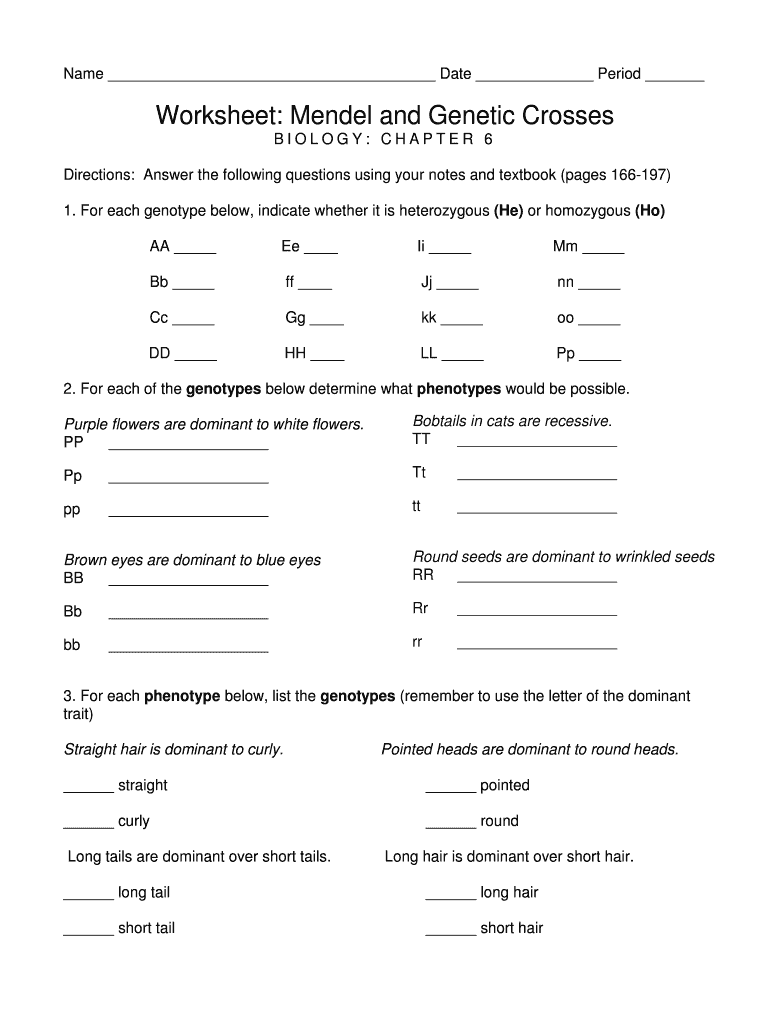
And textbook (pages 166-197) 1. For each genotype below, indicate whether it is heterozygous (He) or homozygous (Ho) AA _____ Ee ____ Ii _____ Mm _____ Bb _____ ff ____ Jj _____ nn _____ Cc _____ Gg ____ kk _____ oo _____ DD _____ HH ____ LL _____ Pp _____ 2. For each of the genotypes below determine what phenotypes would be possible. Purple flowers are dominant to white flowers. PP ___________________ Bobtails in cats are recessive. TT ___________________ Pp _________________.

Open form follow the instructions

Easily sign the form with your finger

Send filled & signed form or save
How to fill out the Worksheet: Mendel and Genetic Crosses online
This guide will assist users in effectively completing the Worksheet: Mendel and Genetic Crosses online, ensuring a thorough understanding of genetic terms and concepts. Following these clear instructions will help you accurately document your responses based on your notes and textbook.
Follow the steps to complete your worksheet online.
- Click the ‘Get Form’ button to access the worksheet and open it in your preferred editor.
- Begin by entering your name in the first blank field, followed by the date and the period in the respective sections.
- Proceed to the first question by reviewing the provided genotypes. Analyze the genotypes and indicate whether each is heterozygous (He) or homozygous (Ho) by marking the corresponding blank.
- Move to the second section. For each genotype under this prompt, determine the possible phenotypes based on the traits mentioned and fill in the blanks appropriately.
- In the third question, you will list the genotypes corresponding to the specified phenotypes. Ensure to use the letter representative of the dominant trait for your responses.
- The fourth section will require you to set up Punnett squares for each cross listed. Show your work clearly by calculating the percentages of offspring that will exhibit the dominant trait, filling in the given blanks with your results.
- Continue answering the practice questions, ensuring to show all your calculations and reasoning where requested. Fill in all blanks carefully and ensure clarity in your responses.
- Once you have completed the worksheet, review all entries for accuracy. You can then save your changes, download the document, print it, or share it as required.
Complete your Worksheet: Mendel and Genetic Crosses online today to enhance your understanding of genetic concepts.
Experience a faster way to fill out and sign forms on the web. Access the most extensive library of templates available.
Related content
These worksheets typically encompass a variety of exercises and problems that help...
This activity represents the genetic cross of two F1 plants (the plants that resulted from...
Mendelian Genetics .......................................83. Microarray Analysis...
Get answers to your most pressing questions about US Legal Forms API.
What is the diagram that shows genetic crosses?
The diagram that shows genetic crosses is commonly referred to as a Punnett square. This visual tool allows you to map out the possible genetic combinations resulting from a cross between two organisms. For anyone looking to grasp the concept of genetic inheritance, the Worksheet: Mendel and Genetic Crosses provides a detailed and practical approach to using this diagram.
How to fill in Punnett squares?
To fill in a Punnett square, first write the different alleles from each parent along the top and side of the square. Then, fill in each box by combining the alleles from both parents. This process helps determine the potential genotypes of the offspring, which is thoroughly explained in the Worksheet: Mendel and Genetic Crosses.
What is the format for representing a genetic cross?
A genetic cross is typically represented using a Punnett square, which is a grid-like diagram. It allows you to organize the alleles from each parent and visualize the potential genetic combinations for the offspring. This format is user-friendly, making it easier for anyone to understand genetic inheritance, as seen in the Worksheet: Mendel and Genetic Crosses.
How do you fill out a Monohybrid cross?
To fill out a Monohybrid cross, start by determining the parental genotypes for the trait you are studying. Then, create a Punnett square with one parent's alleles on top and the other parent's alleles on the side. Finally, fill in the squares to show the possible genotypes of the offspring, which you can analyze better through the Worksheet: Mendel and Genetic Crosses.
What is the 9-3-3-1 rule for dihybrid crosses?
The 9-3-3-1 rule illustrates the expected phenotypic ratio of offspring from a dihybrid cross. In this situation, when two organisms that are hybrids for two traits are crossed, the resulting offspring display this specific ratio. This ratio helps to predict the variety of traits in the next generation effectively, and you can explore this further in the Worksheet: Mendel and Genetic Crosses.
What is an example of a genetic cross?
An example of a genetic cross is a monohybrid cross, which examines the inheritance of a single trait. For instance, crossing a pea plant with yellow seeds (YY) with a plant that has green seeds (yy) will help you determine the traits of the offspring. You can use the Worksheet: Mendel and Genetic Crosses to map out this scenario clearly, illustrating the results effectively.
Is a Punnett square a genetic cross?
Yes, a Punnett square represents a genetic cross. It helps visualize the possible outcomes of a genetic mating between two parents. By laying out the alleles from each parent, you can easily see the probability of different traits appearing in their offspring. This tool is especially useful in the Worksheet: Mendel and Genetic Crosses for understanding inheritance patterns.
How do you write genetic crosses?
To write genetic crosses, you need to describe the parental traits, often represented as letters. For example, a dominant trait may be represented by a capital letter, while a recessive trait uses a lowercase letter. When working on a Worksheet: Mendel and Genetic Crosses, you can clearly label the alleles for each parent and their possible combinations. This method enables you to predict the genetic makeup of the offspring effectively.
How do you write probability in genetics?
In genetics, you express probability as a fraction or percentage that indicates the likelihood of a particular trait appearing in offspring. For example, when working with a Worksheet: Mendel and Genetic Crosses, you can calculate the probability of inheriting dominant or recessive traits. By analyzing genetic crosses, you can determine how often specific combinations may occur. This approach helps in understanding heredity in a clear, practical way.
How to do Punnett squares with 2 traits?
5:09 8:31 Dihybrid and Two-Trait Crosses - YouTube YouTube Start of suggested clip End of suggested clip We do it like this. First outside inside last and you get these gamete combinations. Let's placeMoreWe do it like this. First outside inside last and you get these gamete combinations. Let's place those on the top of the punnett square like. This now let's go ahead and foil the other parent.
Use professional pre-built templates to fill in and sign documents online faster. Get access to thousands of forms.
If you believe that this page should be taken down, please follow our DMCA take down process here.