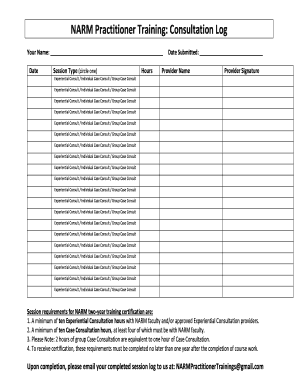
NARM Practitioner Training: Consultation Log Your Name: DateSession Type (circle one)HoursDate Submitted: Provider NameProvider SignatureExperiential Consult / Individual Case Consult / Group Case.

How it works
  • Open form

    Open form follow the instructions

  • Easily sign form

    Easily sign the form with your finger

  • Share form

    Send filled & signed form or save

How to fill out the NARM Practitioner Training: Consultation Log - NARM Training Institute online

Filling out the NARM Practitioner Training: Consultation Log is a crucial part of documenting your training progress for certification. This guide will provide you with clear, step-by-step instructions to ensure you complete the log accurately and efficiently.

Follow the steps to successfully complete the consultation log.

  1. Press the ‘Get Form’ button to access the form and open it in your preferred editor.
  2. In the 'Your Name' section, enter your full name as you want it to appear on your documentation.
  3. Record the date of your consultation in the format specified on the form.
  4. Circle the type of session you are documenting: Experiential Consult, Individual Case Consult, or Group Case Consult.
  5. Fill in the 'Hours' field with the total duration of the consultation session you attended.
  6. In the 'Date Submitted' section, input the date when you are completing and submitting this log.
  7. Complete the 'Provider Name' section by entering the name of the NARM faculty or provider you consulted with.
  8. Sign the 'Provider Signature' field to confirm the consultation details, if applicable.
  9. Continue to add entries for each consultation session you have completed, ensuring to accurately circle the session type for each.
  10. Once all entries are complete, review your log for any missing information or errors.
  11. Save your changes, and choose to download, print, or share the completed log as necessary.

Complete your consultation log and submit it online to NARMPractitionerTrainings@gmail.com for verification and certification.

Get form

Experience a faster way to fill out and sign forms on the web. Access the most extensive library of templates available.

Related content

Nuclear Regulatory Commission - GovInfo.gov

Apr 24, 2002 — the proposed revisions to the training and experience ... identified...

Learn more
Nizhoni Institute of Midwifery General Student...

fails to attend class for a three-week period without prior arrangement with the...

Learn more
PLEASE READ - UserManual.wiki

13:35‐2B.19 Credit towards licensure for education, training, and experience received...

Learn more
Questions & Answers

Get answers to your most pressing questions about US Legal Forms API.

Contact support

What is NARM Australia?

Narrm is the Woi Wurrung word for the Melbourne region.

The NeuroAffective Relational Model (NARM) is a method of psychotherapy specifically aimed at treating attachment, relational and developmental trauma, otherwise referred to as “Complex Trauma” (Complex-PTSD or C-PTSD).

It was created for NARM Master Therapists, which are participants who have completed levels 1 through 3 of NARM training and are licensed, mental health professionals. This is an ongoing clinical study group where participants can work to cultivate their understanding and clinical application of NARM.

SE and NARM sessions are conducted sitting on chairs and may at times involve gentle bodywork on a table. The focus is on the here and now and on restoring and building new capacities.

The NeuroAffective Relational Model (NARM) is a method of psychotherapy specifically aimed at treating attachment, relational and developmental trauma, otherwise referred to as “Complex Trauma” (Complex-PTSD or C-PTSD).

The NeuroAffective Relational Model® (NARM) was developed by Dr. Lawrence Heller and Dr. Aline La Pierre as an integrative approach for treating both shock and developmental trauma.

The NeuroAffective Relational Model(NARM) is an advanced clinical training for mental health professionals who work with complex trauma.

North American Reciprocal Museum (NARM) Association®

A therapist using NARM will focus on working with empathy, helplessness, and countertransference. NARM uses five principles incorporating supporting connection and organization, exploring identity, supporting emotional completion, working in present time, and supporting re-regulation of all the systems of the body.

How often do I need to come in for SE therapy? Usually we recommend starting with weekly sessions and spacing them out further after approximately 4 sessions. However, this may also vary considerably from client to client.

Get This Form Now!

Use professional pre-built templates to fill in and sign documents online faster. Get access to thousands of forms.

If you believe that this page should be taken down, please follow our DMCA take down process here.

Get NARM Practitioner Training: Consultation Log - NARM Training Institute