Loading
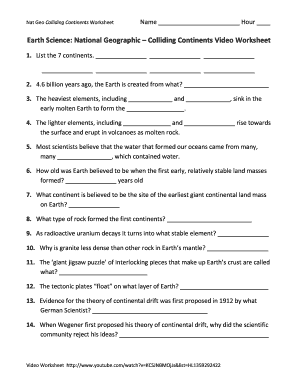
Get National Geographic Colliding Continents Worksheet Answer Key
How it works
-

Open form follow the instructions
-

Easily sign the form with your finger
-

Send filled & signed form or save
How to fill out the National Geographic Colliding Continents Worksheet Answer Key online
Filling out the National Geographic Colliding Continents Worksheet Answer Key online is a straightforward process that ensures accurate documentation of geological concepts. This guide will provide you with step-by-step instructions to help you complete the form accurately and efficiently.
Follow the steps to successfully fill out the worksheet answer key online.
- Click the 'Get Form' button to access the National Geographic Colliding Continents Worksheet Answer Key and open it in your preferred online editor.
- Begin by entering your name and the hour in the designated fields at the top of the form. This information is crucial for organization and tracking.
- Answer the questions sequentially, utilizing available resources such as the video mentioned in the worksheet. For instance, list the seven continents by filling in the blank space provided.
- For questions requiring specific information, such as the age of Earth or types of rocks, ensure your answers are precise and based on the video content.
- Continue through the form, answering each question thoroughly. Questions about tectonic plates and geological formations may require careful consideration of the information you've learned.
- Once you have answered all questions, review your entries to ensure accuracy and completeness. This is an important step to avoid errors.
- After confirming that all answers are correct, proceed to save your changes. You may choose to download or print the worksheet for your records or share it as needed.
Start completing your National Geographic Colliding Continents Worksheet Answer Key online for an engaging educational experience.
When two continental plates collide, one is forced beneath the other. The uppermost plate undergoes breaking and uplift, often forming folded mountains. The Himalayas and Appalachians are two prime examples of mountain ranges formed due to continental collision.