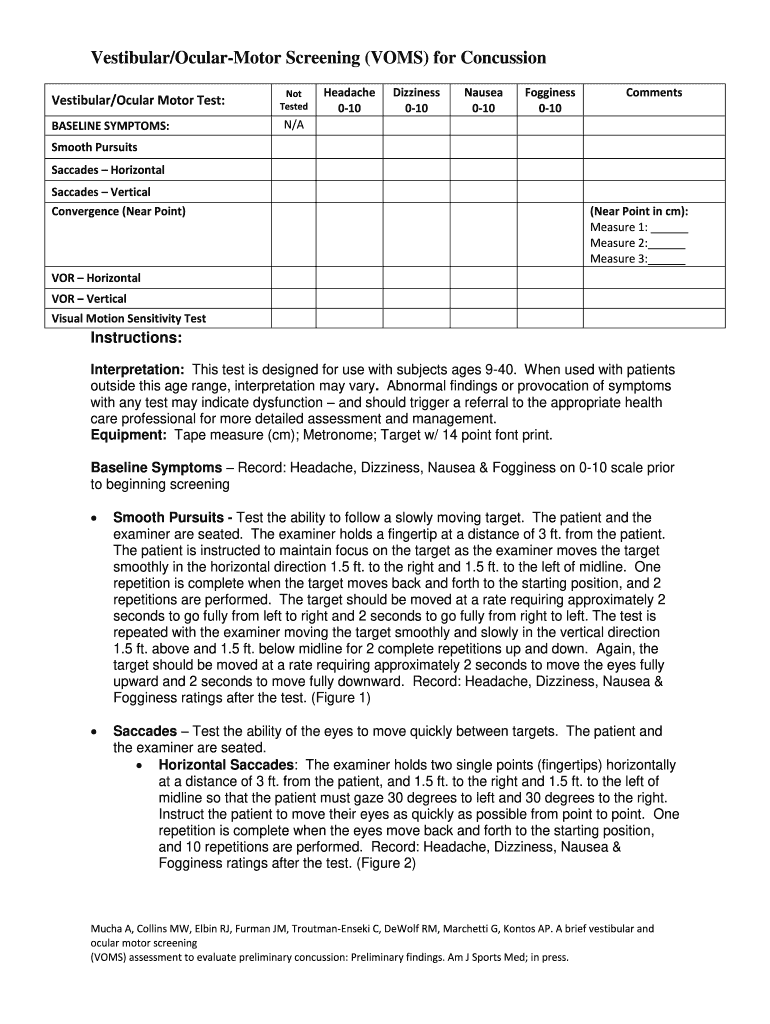
Vestibular/OcularMotor Screening (VOMS) for Concussion Vestibular/Ocular Motor Test: BASELINE SYMPTOMS:Not TestedHeadache 010Dizziness 010Nausea 010Fogginess 010CommentsN/ASmooth Pursuits Saccades.
Loading

Open form follow the instructions

Easily sign the form with your finger

Send filled & signed form or save
How to fill out the Voms Pdf online
The Vestibular/Ocular Motor Screening (VOMS) PDF is a crucial tool for assessing concussion symptoms. This guide provides comprehensive, step-by-step instructions to help you complete the form accurately and efficiently, ensuring your data is clearly recorded.
Follow the steps to fill out the Voms Pdf online.
- Click the ‘Get Form’ button to acquire the Voms Pdf and open it in your preferred digital editor.
- Begin by filling in the baseline symptoms section. Rate your headache, dizziness, nausea, and fogginess on a scale from 0 to 10, marking 'Not Tested' if applicable. Use the comments section for any additional notes.
- Proceed to the Smooth Pursuits section. Test your ability to follow a slowly moving target as instructed. Record your symptoms after completing the test.
- Move to the Saccades section. Perform both horizontal and vertical saccades as outlined. Ensure to record your symptom ratings after each respective test.
- Next, conduct the Convergence test, measuring the distance at which you perceive double vision. Record each measurement over three attempts.
- Continue with the vestibular-ocular reflex (VOR) tests. Perform both horizontal and vertical tests as directed and note your symptom severity afterward.
- Finally, complete the Visual Motion Sensitivity test as described and document your symptoms post-test.
- Once you have filled out all sections, review your entries to ensure accuracy. You can then save the changes, download, print, or share the Voms Pdf as necessary.
Complete your Voms Pdf online today for effective tracking of concussion symptoms.
Experience a faster way to fill out and sign forms on the web. Access the most extensive library of templates available.
Related content
by A Mucha · 2014 · Cited by 446 — The VOMS may augment current assessment tools and...
VOMS SCORING SHEET. Symptoms on a 0 - 10 (severe) scale. Modified from Mucha A, Collins...
H . LoQLARORRO able. SA QR. $1,3. 20V. VT5a. 220V. *...**tem ce voms mamomes. Soov.ee...
Get answers to your most pressing questions about US Legal Forms API.
When do you use VOMS?
Smooth Pursuits The ability of the eyes to slowly follow an object along a pathway with the head remaining in place. Saccades The ability of the eyes to move quickly from one object to another while staying in focus.
What is VOMS testing?
VOMS is a tool designed by the experts at UPMC to detect signs and symptoms of a concussion. It stands for vestibular ocular motor screening and looks at the systems in charge of integrating balance, vision, and movement. The VOMS test needs little equipment just a tape measure and a metronome. ... Symptom assessment.
What does VOR stand for concussion?
Abstract. Normal function of the vestibulo-ocular reflex (VOR) coordinates eye movement with head movement, in order to provide clear vision during motion and maintain balance.
How do I test VOMS?
The patient focuses on a small target (approximately 14 point font size) at arm's length and slowly brings it toward the tip of their nose. The patient is instructed to stop moving the target when they see two distinct images (double vision) or when the examiner observes an outward deviation of one eye.
How do I use VOMS?
The patient focuses on a small target (approximately 14 point font size) at arm's length and slowly brings it toward the tip of their nose. The patient is instructed to stop moving the target when they see two distinct images (double vision) or when the examiner observes an outward deviation of one eye.
What are the types of VOMS?
The Vestibular/Ocular Motor Screening (VOMS) Assessment The VOMS employed in this study consisted of brief assessments in the following 5 domains: (1) smooth pursuit, (2) horizontal and vertical saccades, (3) convergence, (4) horizontal vestibular ocular reflex (VOR), and (5) visual motion sensitivity (VMS).
How do you test for vestibulo-ocular reflex?
VOR is generally tested by turning the patient's head on their long axis and observing for the doll's eyes response (DOLL). The eyes deviate opposite to the direction of head rotation. A possibly related maneuver has been used in infants as a neurologic test.
What is a VOMS?
VOMS is a tool designed by the experts at UPMC to detect signs and symptoms of a concussion. It stands for vestibular ocular motor screening and looks at the systems in charge of integrating balance, vision, and movement.
How do you conduct VOMS?
The patient focuses on a small target (approximately 14 point font size) at arm's length and slowly brings it toward the tip of their nose. The patient is instructed to stop moving the target when they see two distinct images (double vision) or when the examiner observes an outward deviation of one eye.
How do you test the vestibulo-ocular reflex?
Rotational vestibulo-ocular reflex (rVOR) The rVOR compensates for rotation of the head. It should first be tested with relatively low-frequency (0.5 cycle per second) rotation of the head around the horizontal (yaw) and vertical (pitch) axes while the patient fixates on the nose of the examiner.
Use professional pre-built templates to fill in and sign documents online faster. Get access to thousands of forms.
If you believe that this page should be taken down, please follow our DMCA take down process here.