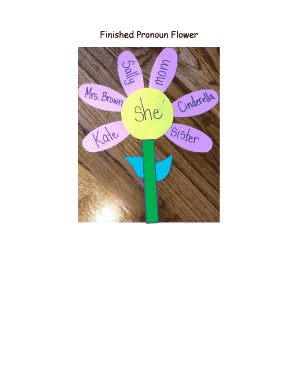
Finished Pronoun Flower. Page 2. he she we they. Page 3. it us it her him. Page4. Petal Template. Page 5. Stem and Sepal Template.

How it works
  • Open form

    Open form follow the instructions

  • Easily sign form

    Easily sign the form with your finger

  • Share form

    Send filled & signed form or save

How to fill out the Pronoun Flower Template online

Navigating the Pronoun Flower Template can enhance your understanding of personal pronouns while fostering inclusivity. This guide provides clear, step-by-step instructions to assist you in completing the template effectively online.

Follow the steps to complete the Pronoun Flower Template with ease.

  1. Click the ‘Get Form’ button to access the template and open it in your preferred online editor.
  2. Begin by identifying each petal section that represents different pronouns. You will see options for 'he,' 'she,' 'we,' and 'they.' Choose the pronouns that resonate with your identity and write them in the respective petals.
  3. Proceed to the center of the flower petal template to fill in any additional information about yourself if needed. This is an optional step to further express your cognitive pronouns.
  4. Move to the stem and sepal areas of the template. Here, you can specify further details associated with your chosen pronouns or how you prefer to be addressed. Use inclusive language that reflects your identity.
  5. Once you have entered all necessary information, review the filled-out template to ensure accuracy and completeness.
  6. Finally, save your changes, then download, print, or share the completed Pronoun Flower Template to enrich your conversation regarding identity.

Begin filling out the Pronoun Flower Template online today to promote inclusive language and personal expression.

Get form

Experience a faster way to fill out and sign forms on the web. Access the most extensive library of templates available.

Related content

Grade 5, Grade 6, Grade 7, Grade 8, Grade 9, Grade...

by B PRICE — trict who offered suggestions, activities, and lesson patterns for the...

Learn more
Pronoun - Antecedent Agreements

Some examples of plural group nouns are: When used in the plural form, a group noun means...

Learn more
Kapampangan language - Wikipedia

Kapampangan language is an Austronesian language, and one of the eight major languages...

Learn more
Questions & Answers

Get answers to your most pressing questions about US Legal Forms API.

Contact support

What are 5 third pronouns?

Third-person pronouns. Examples: he, she, it, they, him, her, them, his, her, hers, its, their, and theirs.

A pronoun (I, me, he, she, herself, you, it, that, they, each, few, many, who, whoever, whose, someone, everybody, etc.) is a word that takes the place of a noun. In the sentence Joe saw Jill, and he waved at her, the pronouns he and her take the place of Joe and Jill, respectively.

Here "I," a pronoun, is the subject and the noun "flowers" is the object. Serena D.

Personal Pronouns: I, me, you, your, they, us, who, it we Possessive Pronouns: my, your, its, our, his, her, their Demonstrative Pronouns: this, that, these, those Indefinite Pronouns: another, both, any, all, several, each, few, none Reflexive Pronouns: ends with self or selves himself, herself, itself

There are seven types of pronouns that both English and English as a second language writers must recognize: the personal pronoun, the demonstrative pronoun, the interrogative pronoun, the relative pronoun, the indefinite pronoun, the reflexive pronoun, and the intensive pronoun.

A pronoun (I, me, he, she, herself, you, it, that, they, each, few, many, who, whoever, whose, someone, everybody, etc.) is a word that takes the place of a noun. In the sentence Joe saw Jill, and he waved at her, the pronouns he and her take the place of Joe and Jill, respectively.

Both of the flowers are lovely. And then, both would be acting as an indefinite pronoun. In this sentence, flowers is acting as the object of the preposition, and both is not modifying it. That means that the pronoun both is the subject, and it has no antecedent.

The English language has just three cases: subjective, possessive and objective. Most nouns, many indefinite pronouns and it and you have distinctive forms only for the possessive case.

Both of the flowers are lovely. And then, both would be acting as an indefinite pronoun. In this sentence, flowers is acting as the object of the preposition, and both is not modifying it. That means that the pronoun both is the subject, and it has no antecedent.

He/she. It. They. Me. Himself. Somebody/everybody/anybody. Many. Each.

Get This Form Now!

Use professional pre-built templates to fill in and sign documents online faster. Get access to thousands of forms.

If you believe that this page should be taken down, please follow our DMCA take down process here.

Get Pronoun Flower Template