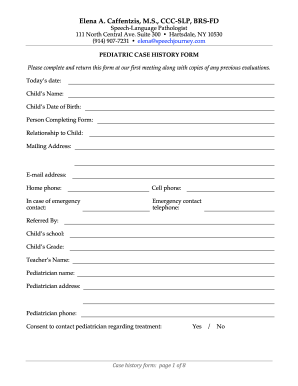
Evaluations. Today s date: Child s Name: Child s Date of Birth: Person Completing Form: Relationship to Child: Mailing Address: E-mail address: Home phone: Cell phone: In case of emergency contact: Emergency contact telephone: Referred By: Child s school: Child s Grade: Teacher s Name: Pediatrician name: Pediatrician address: Pediatrician phone: Consent to contact pediatrician regarding treatment: Case history form: page 1 of 8 Yes / No Elena A. Caffentz.
Open form follow the instructions
Easily sign the form with your finger
Send filled & signed form or save
How to fill out the Pediatric Case History Form online
Filling out the Pediatric Case History Form is an important step in understanding your child's speech and language needs. This guide provides comprehensive instructions to help you complete the form online with ease.
Follow the steps to efficiently complete the Pediatric Case History Form.
- Click 'Get Form' button to access the document and open it for editing.
- Begin by entering today's date and the child's name at the top of the form. This information is essential for record-keeping.
- Fill in the child's date of birth and the name of the person completing the form. Provide your relationship to the child to clarify any relevant background.
- Complete the contact information section, including your mailing address, email address, home phone, and cell phone numbers.
- In the emergency contact section, list a person's name and telephone number who can be reached in case of an emergency.
- Record how you were referred to the specialist, the child's school, and the child's grade. Also, include the name and contact information of the pediatrician.
- Indicate whether you consent to the practitioner contacting your child's pediatrician regarding treatment.
- Describe your child's current speech and language skills in the speech and language history section. Include any concerns you may have.
- Respond to questions regarding any difficulties and patterns of disfluency your child may experience. Check off corresponding observations related to their speech.
- Evaluate your child's physical behaviors associated with speech and document your family's reactions to their disfluency.
- Answer inquiries about your child's awareness and emotional responses to their speech patterns. Consider any situations that may exacerbate or alleviate their disfluency.
- Provide further information regarding your child's speech milestones and any other related concerns.
- Complete the medical, developmental, and family history section, including any relevant pregnancy and birth details, past medical issues, and current medications.
- Fill out the educational and social history part, including school placement and classroom environment.
- Review all entries for accuracy. Once completed, save your changes, and you can download, print, or share the form as needed.
Start filling out the Pediatric Case History Form online today to ensure your child's needs are addressed.
Experience a faster way to fill out and sign forms on the web. Access the most extensive library of templates available.
Related content
The AHRQ Health Literacy Universal Precautions Toolkit, 2nd edition, can help primary care...
... Pathology History Form. Person completing form: □Patient □Spouse...
Adoption is a process whereby a person assumes the parenting of another, usually a child...
Get answers to your most pressing questions about US Legal Forms API.
What do you do at your first speech therapy session?
During the child's first visit the therapist will ask for an overview of your child's strengthens and weaknesses. Be prepared to discuss your concerns regarding your child's speech, language, social, and/or feeding difficulties.
What happens in a speech therapy session?
Your first speech and language therapy appointment will involve assessment. An assessment may involve looking at picture books, playing with toys or talking to the therapist, depending on the child's age. The SLT will also talk to you about your concerns and ask you questions about your child's development.
What is case history in audiology?
Your first audiologist visit: The case history form. If you're ready to visit the audiologist for the first time, one of the main components of this visit is the case history form. When you fill out this form, it gives the audiologist a better idea of your hearing health and how it is currently impacting your life.
What is a case history in speech therapy?
Thank you for the feedback... the Case History Form is a document meant for parents to fill out, which helps SLPs obtain information and decide where they need to probe further.
How do you write a case history?
Identify common psychiatric symptoms. ... Comment on the impact of the illness on the patient's life. ... Note details of previous treatment. ... Integrate current problem and psychiatric issues.
What happens at a speech therapy appointment?
Your first speech and language therapy appointment will involve assessment. An assessment may involve looking at picture books, playing with toys or talking to the therapist, depending on the child's age. The SLT will also talk to you about your concerns and ask you questions about your child's development.
What does a case study include?
A case study is a detailed study of a specific subject, such as a person, group, place, event, organization, or phenomenon. ... A case study research design usually involves qualitative methods, but quantitative methods are sometimes also used.
Is Speech Pathology the same as speech therapy?
What is the difference between speech therapy and speech pathology? They are the same. If you're searching for the inner workings of speech therapy for the first time or have always been involved and never known the difference, you're not left out.
What is case study of a child?
Case studies are in-depth investigations of a single person, group, event or community. Typically, data are gathered from a variety of sources and by using several different methods (e.g. observations & interviews). The case study research method originated in clinical medicine (the.
How do speech therapists collect data?
Tally Marks. Many speech therapists use tally marks to record data. ... Clickers. Some therapists use a clicker to indicate success. ... Speech Therapy Data Sheets. A favorite of speech therapists is a premade data sheet with goals and tally boxes. ... Articulation Chart from 1-100. ... Digital Methods for Speech Therapy Data Collection.
Use professional pre-built templates to fill in and sign documents online faster. Get access to thousands of forms.
If you believe that this page should be taken down, please follow our DMCA take down process here.