Nancial source(s): Insurance source(s): [ ] No financial concerns [ ] Financial concerns [ ] Insurance concerns [ ] Resource education provided 2 [ ] Referred to transplant financial coordinator Relationship History & Current Supportive Relationships (Duration/brief description/why ended/children): 1. 2. 3. 4. SUPPORT SYSTEM Living Space and Current Living Situation [SIPAT#8]: Who lives in your household [SIPAT#6]? Who will be involved as patient’s caregiver support team? Primary: _.
Loading

Open form follow the instructions

Easily sign the form with your finger

Send filled & signed form or save
How to fill out the SIPAT Assessment Long Form online
The SIPAT Assessment Long Form is an essential tool utilized in the evaluation of candidates for transplantation. This guide provides clear, step-by-step instructions to complete the form online effectively, ensuring a smooth process for all users, regardless of their prior experience with such evaluations.
Follow the steps to complete the SIPAT Assessment Long Form online.
- Press the ‘Get Form’ button to access the SIPAT Assessment Long Form and open it in the appropriate editor.
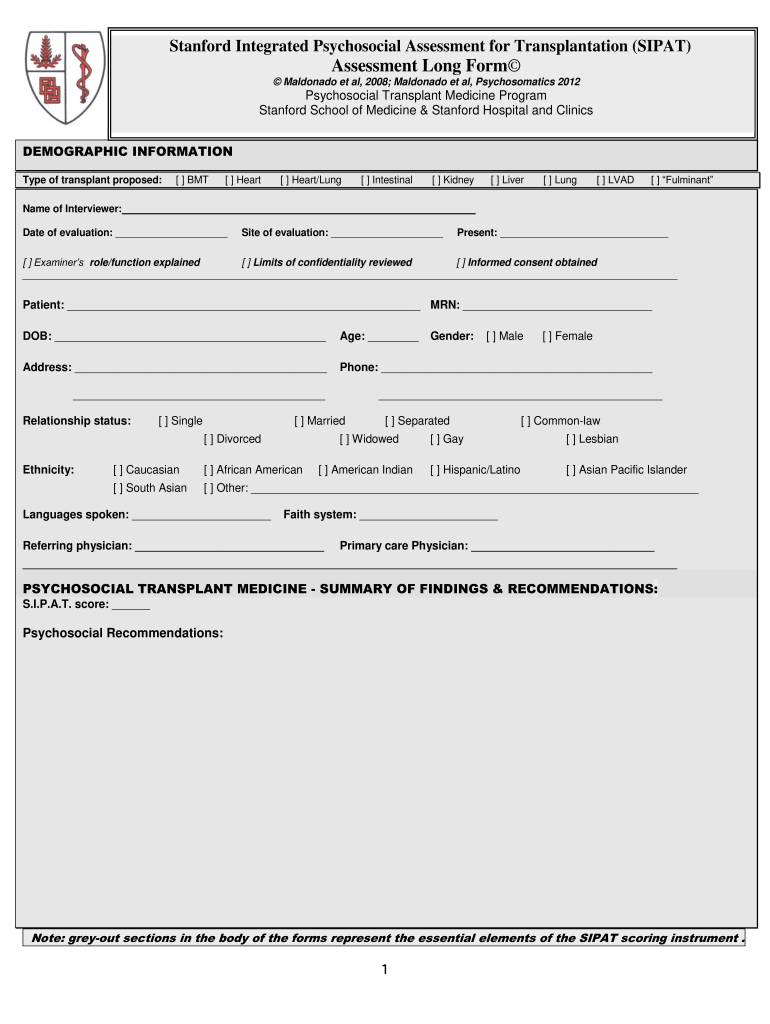
- Begin by filling out the demographic information section. Indicate the type of transplant proposed by selecting the relevant checkbox, and provide the name of the interviewer, date of evaluation, and site of evaluation.
- Enter detailed information about the patient, including their name, medical record number (MRN), date of birth (DOB), age, address, and phone number.
- Complete the relationship status and ethnicity sections by selecting the appropriate checkboxes and providing any additional details required.
- In the psychosocial transplant medicine section, input the SIPAT score and provide any psychosocial recommendations, if applicable.
- Navigate to the history of presenting illness and social history sections. Fill these sections out with relevant medical history and developmental history, ensuring that all fields are completed accurately.
- Proceed to the support system and relationship history sections. Document who resides in the patient’s household, detail the caregiver support team, and note relationship stability.
- Address the relocation requirements section, indicating whether the patient will need to relocate post-transplant and document any potential barriers.
- Fill out the self-management with medical treatment qualities, assessing the patient’s understanding of their medications and their management strategy.
- In the understanding of illness and transplant process section, gather information regarding the patient’s knowledge and willingness to undergo transplantation.
- Complete the psychological health and substance use history segments. Be thorough in documenting any histories related to substance use and mental status.
- Finally, review the entire form for accuracy before saving your changes. Once completed, you can download, print, or share the SIPAT Assessment Long Form as needed.
Complete the SIPAT Assessment Long Form online today to facilitate your transplant evaluation process.
Experience a faster way to fill out and sign forms on the web. Access the most extensive library of templates available.
Related content
by S Deutsch-Link · 2021 · Cited by 67 — The SIPAT assigns a score between 0 and 119...
... SIPAT Long Form, available at nario may affect the ultimate score and eventual...
With PAT, you can determine the clinical efficacy of an active ingredient online by...
Get answers to your most pressing questions about US Legal Forms API.
What is the sipat score?
The SIPAT score is derived from a systematic evaluation within the SIPAT Assessment Long Form, indicating a candidate's suitability for transplant. It reflects various aspects of their psychological and social health, guiding medical teams in their decision-making process. A higher SIPAT score may suggest a need for additional support or interventions before proceeding with transplantation.
What is the psychosocial assessment for transplant?
The psychosocial assessment for transplant is an evaluation that examines a patient's mental and social health before a transplant procedure. It forms part of the comprehensive SIPAT Assessment Long Form, focusing on factors such as emotional stability, support systems, and lifestyle. This assessment promotes holistic care, ensuring patients are prepared for the challenges of transplantation.
What is a sipat?
The SIPAT, or The Severity of Illness: Psychosocial Assessment Tool, is an essential component of the SIPAT Assessment Long Form. It measures various aspects of a patient's psychological and social well-being, which are critical when considering them for a transplant. By using the SIPAT, healthcare teams can ensure a thorough evaluation of candidates.
How to score sipat?
To score the SIPAT Assessment Long Form, healthcare professionals analyze the responses provided by the candidate during the assessment. Each section of the SIPAT yields specific scores that contribute to an overall evaluation, helping to identify potential risks or needs. Accurate scoring is essential for effective communication and planning for the transplant process.
What is the transplant evaluation rating scale?
The transplant evaluation rating scale is a crucial tool used during the SIPAT Assessment Long Form process. It helps healthcare providers assess candidates for transplant eligibility by evaluating psychological, social, and medical factors. Understanding this scale ensures that patients receive the best possible care before undergoing a transplant procedure.
What disqualifies you from getting a transplant?
Factors that may disqualify an individual from receiving a transplant include significant medical, psychological, or social issues that could affect the success of the procedure. For instance, untreated mental health conditions or lack of adequate support can pose serious risks. Utilizing the SIPAT Assessment Long Form helps identify such concerns early and enables healthcare providers to address them effectively.
What is a SIPAT score?
The SIPAT score reflects a donor's or recipient's psychological readiness as determined through the assessment process. Higher scores may indicate stronger psychological stability and support systems, while lower scores suggest areas needing attention. This score provides valuable insights and aids healthcare providers in tailoring their approach during the transplant process.
What is the SIPAT for donors?
The SIPAT for donors evaluates the psychological health and social support systems of individuals wishing to donate organs. This assessment helps identify potential challenges the donor may face, ensuring their readiness and ability to support the transplant journey. Using the SIPAT Assessment Long Form can enhance donor outcomes and contribute to a positive transplant experience.
What is the sipat?
The SIPAT, or Structured Interview for Patient Assessment Tool, is a method used to assess patient eligibility for treatment procedures. By utilizing the SIPAT Assessment Long Form, healthcare providers gain insights into vital health metrics. This assessment supports better decision-making for patient care and enhances treatment outcomes.
What is the meaning of Sipat score?
The Sipat score reflects the results of the SIPAT Assessment Long Form. It quantifies various assessment criteria to help healthcare providers determine a patient’s eligibility for medical interventions. Understanding the Sipat score empowers patients and professionals alike to navigate the transplant journey more effectively.
Use professional pre-built templates to fill in and sign documents online faster. Get access to thousands of forms.
If you believe that this page should be taken down, please follow our DMCA take down process here.