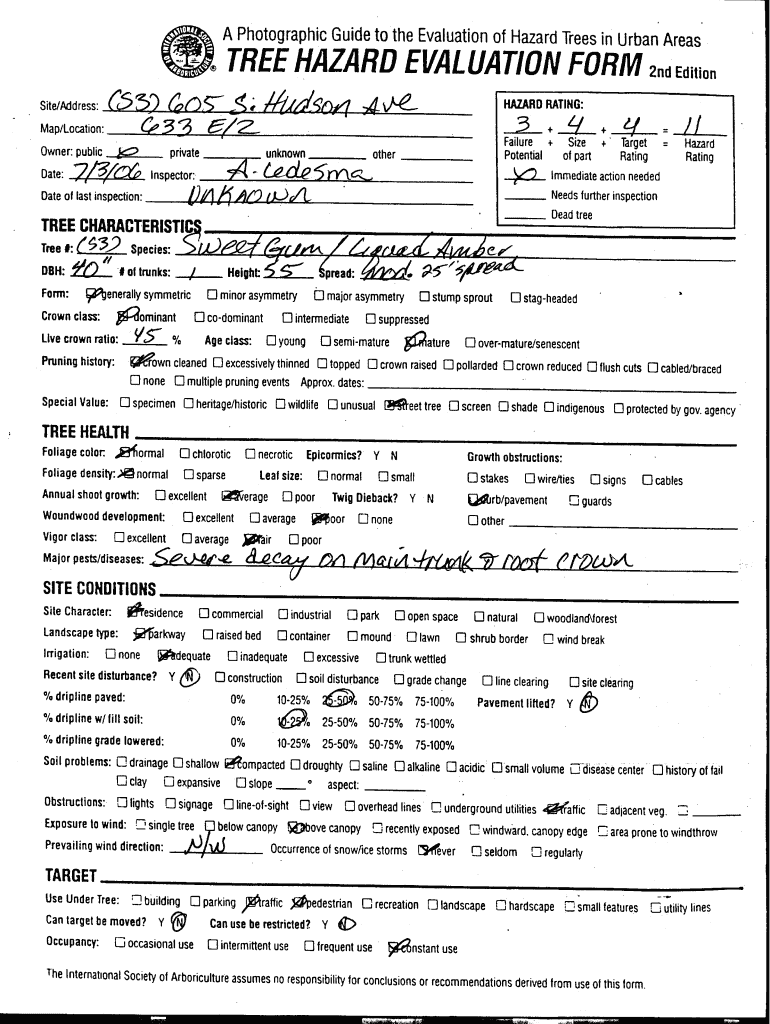
Ocation. A .::.- TT'A!P "')C /2--- Owner: public L.

Open form follow the instructions

Easily sign the form with your finger

Send filled & signed form or save
How to fill out the Tree Hazard Evaluation Form online
Filling out the Tree Hazard Evaluation Form online can help assess the safety and health of urban trees. This guide provides step-by-step instructions to ensure you complete the form accurately and effectively, promoting thorough evaluations.
Follow the steps to complete the Tree Hazard Evaluation Form online.
- Click ‘Get Form’ button to obtain the form and open it in the appropriate editor.
- Begin by entering the site address and map location where the tree is located. This information is crucial for identifying the specific area that requires evaluation.
- Indicate the ownership status of the property using the options provided: public, private, or unknown. This helps clarify responsibility and necessary actions following the evaluation.
- Assess and fill in the hazard rating by selecting an appropriate rating to reflect the potential danger posed by the tree. This involves evaluating its overall condition and the risk it presents.
- Provide the diameter at breast height (DBH) of the tree, which is essential for assessing the size and associated hazards.
- Complete the tree characteristics section by indicating relevant details such as species, crown class, age class, and pruning history. Each field can significantly impact the tree's health and risk level.
- Evaluate the health of the tree by filling out the foliage color, density, and annual shoot growth. Additional observations about twig dieback and any major pests should also be noted.
- Assess site conditions by categorizing the site character and landscape type. Make note of any recent disturbances that may affect the tree's structural integrity.
- Check for any tree defects, particularly those related to roots and trunk issues. Document any visible signs of decay, disease, or structural problems.
- Finally, indicate the hazard abatement measures necessary based on your evaluation. This may include pruning, cabling, or relocating targets to minimize risks.
- After completing all sections, review your responses for accuracy, then save changes, download, print, or share the form as needed.
Take the necessary steps to assess and evaluate trees in your area by filling out the Tree Hazard Evaluation Form online today.
Experience a faster way to fill out and sign forms on the web. Access the most extensive library of templates available.
Related content
Use of the HAZARD TREE EVALUATION Form. Defective trees are potential hazards to people...
Although the ISA Tree Hazard Evaluation Form and the USDA Forest Service Community Tree...
Broadly speaking, a risk assessment is the combined effort of: identifying and analyzing...
Get answers to your most pressing questions about US Legal Forms API.
What is tree hazard assessment?
Tree risk assessment (TRA) is the systematic process used to identify, analyze, and evaluate tree risk. By identifying tree risk before and after a storm event, mitigation can be conducted to reduce risk while preserving trees that have an acceptable level of risk.
What are the three components of tree risk assessment?
The 3 Levels of Risk Assessment Level 1: Limited Visual Tree Risk Assessment. This is used when the tree will be viewed from a defined, limited perspective. ... Level 2: Basic Tree Risk Assessment. ... Level 3: Advanced Tree Risk Assessment.
How do you perform a tree risk assessment?
0:42 2:37 What is a Tree Risk Assessment? - YouTube YouTube Start of suggested clip End of suggested clip Some problems are easier to spot than others if you notice a serious physical defect with your tree.MoreSome problems are easier to spot than others if you notice a serious physical defect with your tree. You can have a professional arborist out to assess it and begin to address. It some problems can be
What is an example of a tree hazard?
Tree hazards include dead or dying trees, dead parts of live trees, or unstable live trees (due to structural defects or other factors) that are within striking distance of people or property (a target). Hazard trees have the potential to cause property damage, personal injury or fatality in the event of a failure.
How to do a tree assessment?
4:04 27:05 Tree Risk Assessment | Peter Gerstenberger | Tree Care Basics YouTube Start of suggested clip End of suggested clip Look at the roots and soil around the tree first. Then work your way up go around the stem. And takeMoreLook at the roots and soil around the tree first. Then work your way up go around the stem. And take a look for defects. There finally examine what most people do first which is the major branches.
What is a Level 1 tree risk assessment?
A Level 1 Limited Visual assessment is where Arborists evaluate designated areas either from vehicles or from walking down paths, streets, or sidewalks to identify high and extreme risk trees. These assessments are intended to cover large areas very quickly with small amounts of details being recorded for each tree.
What is tree hazard?
A "hazard tree" is a tree that has a structural defect that makes it likely to fail in whole or in part. Falling trees are an ever-present hazard when traveling or camping in the forest, yet too often we are unaware of the risks associated with defective trees.
What is involved in a tree assessment?
These assessments may include climbing inspections, examination of the root system using a compressed-air tool (that avoids damage to roots and underground utilities), or one or more of the following: resistance drilling using a precision drilling instrument called a resistograph; or sonic tomography that produces a ...
Use professional pre-built templates to fill in and sign documents online faster. Get access to thousands of forms.
If you believe that this page should be taken down, please follow our DMCA take down process here.