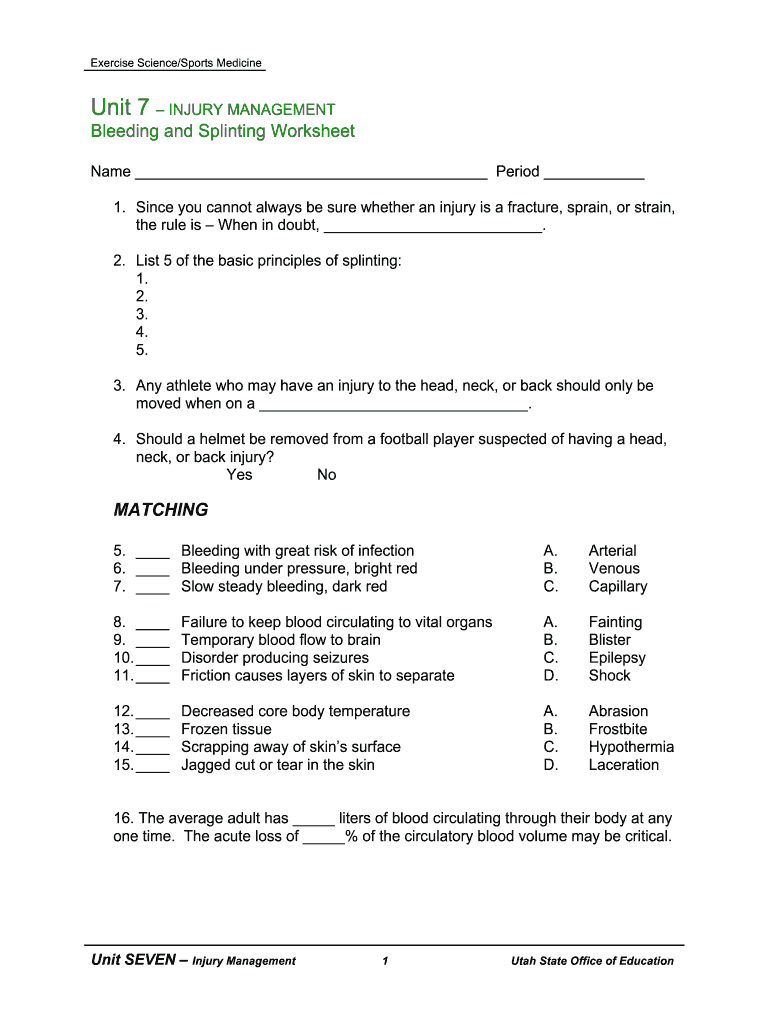
Back Exercise Science/Sports Medicine Unit 7 INJURY MANAGEMENT Bleeding and Splinting Worksheet Name Period 1. Since you cannot always be sure whether an injury is a fracture, sprain, or strain, the.
Loading

Open form follow the instructions

Easily sign the form with your finger

Send filled & signed form or save
How to fill out the Unit 7 Injury Management online
Filling out the Unit 7 Injury Management form is crucial for understanding and managing injuries effectively. This guide provides detailed steps to help users complete the form thoroughly and accurately.
Follow the steps to successfully complete the Unit 7 Injury Management form.
- Click the ‘Get Form’ button to access the form and open it in your editing tool.
- Begin by entering your name in the designated field. Ensure it is spelled correctly to avoid any confusion.
- In question 1, provide the answer to the statement about the rule regarding uncertain injuries. Remember, the guideline is to splint when in doubt.
- List four basic principles of splinting in the provided fields. Use bullet points for clarity.
- For question 3, indicate how an athlete should be moved if they may have head, neck, or back injuries. The answer is to use a backboard.
- For question 4, answer whether a helmet should be removed for a suspected head injury. Select 'Yes' or 'No' as appropriate.
- Complete the matching section by correlating each bleeding type with the correct letter.
- Proceed through questions 16 to 24 by providing the necessary information based on the injury management guidelines, ensuring you give detailed answers where required.
- Review all sections for completeness and accuracy, making any necessary adjustments.
- Once satisfied, save the changes to your document. You may also download, print, or share the completed form as needed.
Complete your Unit 7 Injury Management form online today to ensure thorough injury understanding and management.
Experience a faster way to fill out and sign forms on the web. Access the most extensive library of templates available.
Related content
This free fact sheet by the Substance Abuse and Mental Health Services Administration...
Unit SEVEN – Injury Management. 1. Utah State Office of Education. Unit 7 – INJURY...
2014 — Surgeons may manage ureteral injuries in unstable patients with temporary urinary...
Get answers to your most pressing questions about US Legal Forms API.
What are 4 first aid for acute injuries?
Ice – apply ice to the injured area for 20 minutes every two hours for the first 48-72 hours. Compression – apply a firm elastic bandage over the area, extending above and below the painful site. Elevation – raise the injured area above the level of the heart at all times. Referral – as soon as possible, see a doctor.
How do you deal with serious injuries?
Get it on Ice. You'll want to ice immediately following an injury and throughout the recovery process. ... Get (the Right) Help. If your injury hasn't improved after a week, it's time to seek a professional opinion. ... Keep Moving. ... But if it Hurts, Don't Do It! ... Breathe. ... Pay Attention to your Body. ... Reach Out. ... Focus on Something Else.
How do you manage acute and chronic injuries?
For relief from an acute or chronic injury, and to reduce swelling, use the RICE method: Rest to prevent further injury. Ice for 10-20 minutes every 3 hours. Compress the injured area to reduce swelling. Elevate an injured arm or leg above the heart to reduce swelling.
What are the management of injuries?
RICE stands for protection, rest, ice, compression and elevation. Rest – avoid exercise and reduce your daily physical activity. ... Ice – apply an ice pack to the affected area for 15 to 20 minutes every 2 to 3hours. ... Compression – use elastic compression bandages during the day to limit swelling.
What are the objectives of injury management?
Injury management is the process of restoring those who are ill or injured to their fullest physical, psychological and vocational capability. Injury management aims to assist staff members to return to meaningful and productive work at the highest possible level of functioning following illness or injury.
What is sports injury management?
What is Sports Injury Management? Sports Injury Management is the management of a specific injury to allow an individual to return or continue their chosen sport without damaging or compromising their body.
What is the first step to treating an acute injury?
When an acute injury occurs, initial treatment should involve the RICE protocol. The hallmarks of the RICE protocol are: Rest, ice, compression, elevation. Rest. Avoid the activity that caused the injury.
How do you manage acute injuries?
How do you treat acute injuries? Rest the injury. Ice the injury once every hour for 20 minutes. Compress the injury by wrapping it with an ace bandage or immobilize with a splint. Elevate the injury above the heart to decrease blood flow and reduce swelling.
Use professional pre-built templates to fill in and sign documents online faster. Get access to thousands of forms.
If you believe that this page should be taken down, please follow our DMCA take down process here.