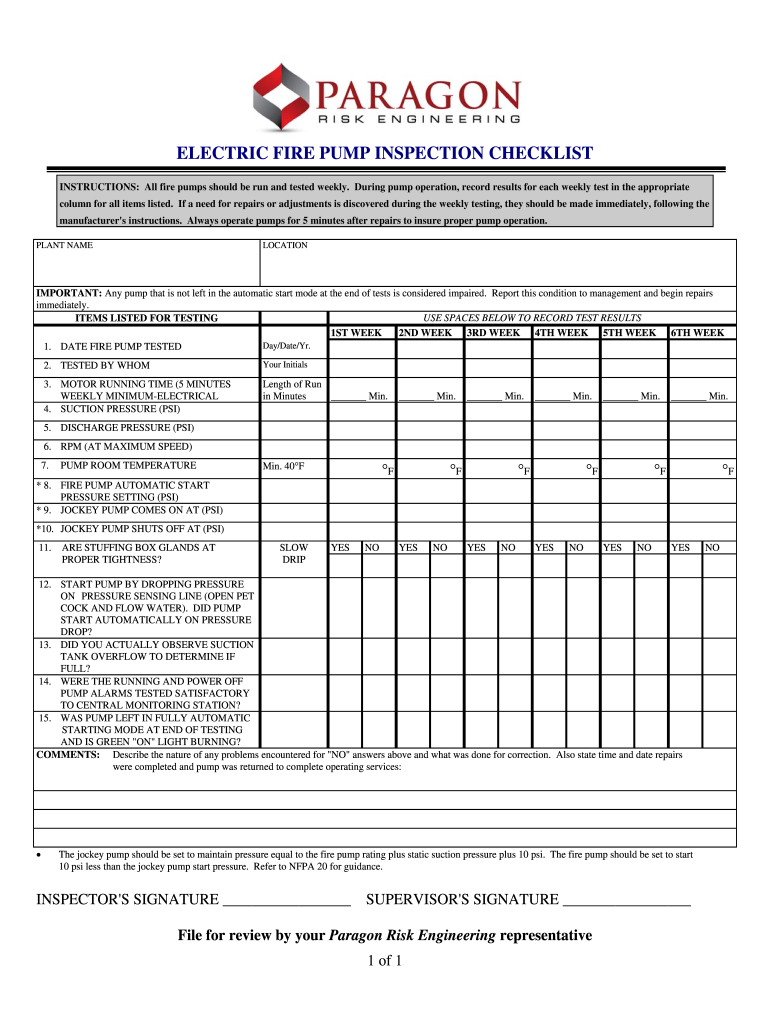
ELECTRIC FIRE PUMP INSPECTION CHECKLIST INSTRUCTIONS All fire pumps should be run and tested weekly. During pump operation record results for each weekly test in the appropriate column for all items listed* If a need for repairs or adjustments is discovered during the weekly testing they should be made immediately following the manufacturer s instructions. Always operate pumps for 5 minutes after repairs to insure proper pump operation* PLANT NAME LOCATION IMPORTANT Any pump that is not left in the automatic start mode at the end of tests is considered impaired* Report this condition to management and begin repairs immediately. USE SPACES BELOW TO RECORD TEST RESULTS ITEMS LISTED FOR TESTING 1ST WEEK 2ND WEEK 3RD WEEK 4TH WEEK 5TH WEEK 6TH WEEK Day/Date/Yr. 1. DATE FIRE PUMP TESTED 2. TESTED BY WHOM Your Initials 3. MOTOR RUNNING TIME 5 MINUTES WEEKLY MINIMUM-ELECTRICAL 4. SUCTION PRESSURE PSI Length of Run in Minutes Min* 5. DISCHARGE PRESSURE PSI 6. RPM AT MAXIMUM SPEED PUMP ROOM TEM....
Loading

Open form follow the instructions

Easily sign the form with your finger

Send filled & signed form or save
How to fill out the Paragon Electric Fire Pump Inspection Checklist online
Filling out the Paragon Electric Fire Pump Inspection Checklist online is essential for maintaining fire safety standards. This guide provides step-by-step instructions to help users efficiently complete the checklist with clarity and accuracy.
Follow the steps to fill out the checklist accurately.
- Click ‘Get Form’ button to access the checklist and open it in your preferred online editor.
- Begin by entering the plant name and location in the designated fields at the top of the form.
- Record the date of the fire pump test, filling in the 'date fire pump tested' field in the appropriate column.
- Indicate who performed the test by writing their initials in the 'tested by whom' section.
- Note the motor running time in minutes, ensuring it meets the minimum requirement of 5 minutes per week.
- Fill in suction and discharge pressure readings in PSI in their respective fields.
- Document the RPM at maximum speed, making sure to observe the pump during operation.
- Measure and record the pump room temperature, ensuring it is at least 40°F.
- Enter the fire pump automatic start pressure setting and jockey pump pressure settings in the provided fields.
- Check the stuffing box glands for proper tightness and document your observations.
- Conduct the pressure drop test by opening the petcock and observing whether the pump starts automatically.
- Confirm that the suction tank overflows indicate it is full.
- Test and confirm that the running and power off pump alarms are satisfactory to the central monitoring station.
- Ensure the pump is left in fully automatic starting mode at the end of testing, and check that the green 'on' light is illuminated.
- If any issues were encountered, provide comments detailing the problems, corrections made, and the date and time repairs were completed.
- Finally, have both the inspector and supervisor sign the checklist to validate completion.
- Save any changes made to the document. You can also download, print, or share the form as needed.
Complete your Paragon Electric Fire Pump Inspection Checklist online today to ensure your fire safety protocols are up to standard.
Experience a faster way to fill out and sign forms on the web. Access the most extensive library of templates available.
Related content
Nov 12, 2024 — The unit began the inspection period at or near rated thermal power. On...
The inspection checklist – with notification timeframes and contact information –...
Checklist for proper operation: Salt. 3000 to 4000 ppm ... of operation include single...
Get answers to your most pressing questions about US Legal Forms API.
How often should electric fire pumps be tested?
Electric fire pumps should be tested quarterly to ensure they operate as required during an emergency. These tests validate system integrity and help identify any underlying issues. Utilizing the Paragon Electric Fire Pump Inspection Checklist simplifies these routine checks, allowing for thorough and effective inspections.
Who is responsible for the inspection, testing, and maintenance of the fire pump?
The property owner is primarily responsible for the inspection, testing, and maintenance of the fire pump. Depending on local regulations, they may hire certified professionals to ensure compliance and safety. Using the Paragon Electric Fire Pump Inspection Checklist empowers property owners and operators to meet their responsibilities efficiently.
What is the NFPA standard for fire truck pump testing?
The NFPA standard for fire truck pump testing outlines the necessary procedures to verify pump performance and ensure firefighter safety. This testing usually occurs annually and includes checking capabilities such as flow rate and pressure. Leveraging the Paragon Electric Fire Pump Inspection Checklist can streamline this testing, ensuring comprehensive compliance with NFPA standards.
How often should a fire pump be serviced?
Fire pumps should be serviced at least once a year to ensure they are in optimal working condition. Regular servicing helps identify potential issues before they become significant problems. Incorporating the Paragon Electric Fire Pump Inspection Checklist into your maintenance schedule can ensure consistency and efficiency in your servicing routine.
What is required for a fire pump inspection?
A fire pump inspection requires reviewing various components such as valves, piping, and the pump itself. Technicians assess physical conditions, evaluate any signs of wear, and ensure the entire system meets safety standards. The Paragon Electric Fire Pump Inspection Checklist can guide you through this process, ensuring you don’t overlook any critical aspects.
How often is NFPA 25 testing required?
NFPA 25 testing is required annually, as part of regular maintenance for fire protection systems. This standard mandates that systems, including fire pumps, undergo inspections and tests to ensure their operational readiness. Following the guidelines from the Paragon Electric Fire Pump Inspection Checklist helps keep you compliant with these rigorous standards.
What is the NFPA annual fire pump test?
The NFPA annual fire pump test is a crucial assessment that verifies that fire pumps are functioning correctly and effectively. This test measures flow and pressure to ensure that your system meets safety standards. Utilizing the Paragon Electric Fire Pump Inspection Checklist can simplify this process by providing clear steps and criteria to follow during the test.
How to do a pump inspection?
To conduct a pump inspection, begin by reviewing the Paragon Electric Fire Pump Inspection Checklist. Check the pump’s physical condition, listen for unusual noises, and ensure all valves are operational. It's important to inspect electrical connections, monitor pressure levels, and test the pump’s performance under load to ensure everything functions as intended.
What is required for fire pump inspection?
Fire pump inspections require a comprehensive approach to ensure optimal performance. Begin with an assessment of the pump's physical conditions, and check that all safety and operational features are intact. It is crucial to document findings for compliance and future reference. The Paragon Electric Fire Pump Inspection Checklist serves as an invaluable tool for achieving thorough inspections while meeting all requirements.
What are the requirements for an NFPA 20 fire pump test?
Conducting an NFPA 20 fire pump test requires adherence to specific protocols to verify performance. Tests should evaluate the pump's flow rate, pressure, and general operational mechanics. Continuous monitoring and accurate documentation of results are vital for compliance purposes. The Paragon Electric Fire Pump Inspection Checklist simplifies these requirements, helping you execute tests correctly every time.
Use professional pre-built templates to fill in and sign documents online faster. Get access to thousands of forms.
If you believe that this page should be taken down, please follow our DMCA take down process here.