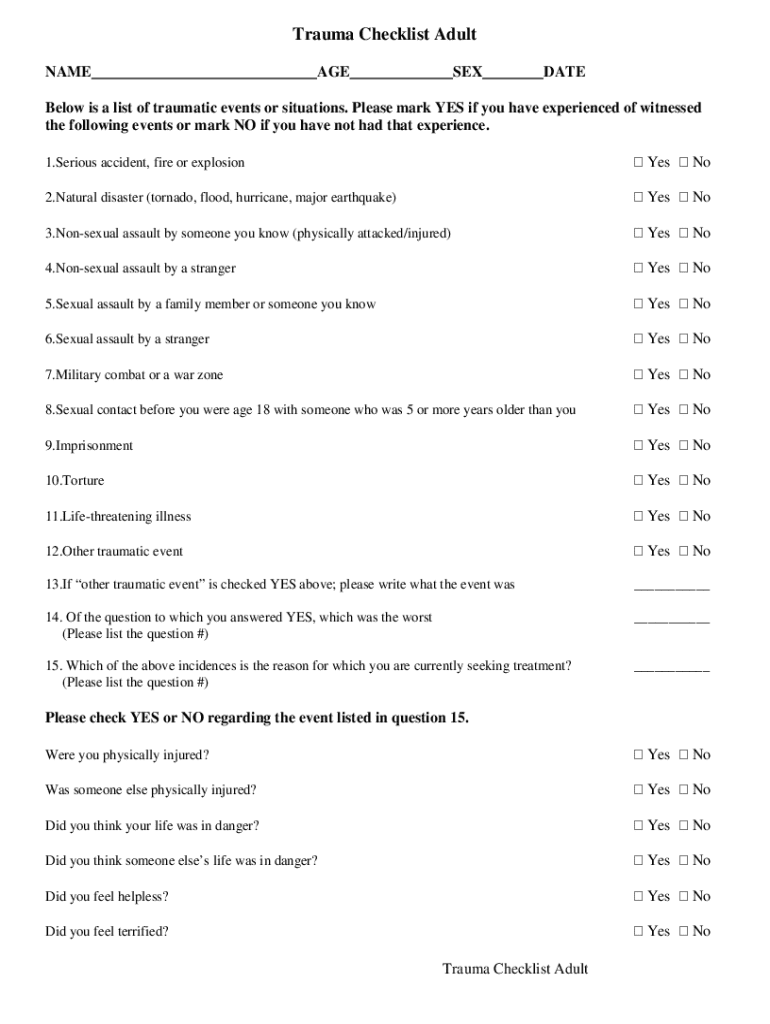
NSLIJHS TRAUMA HISTORY CHECKLIST AND INTERVIEW Date: Interviewer: Eval #: Sometimes things happen to people that are extremely upsetting, things like being in a lifethreatening situation. Id like.
Loading

Open form follow the instructions

Easily sign the form with your finger

Send filled & signed form or save
How to fill out the NSLIJHS Trauma History Checklist and Interview Date - Mc Vanderbilt online
This guide provides step-by-step instructions for completing the NSLIJHS Trauma History Checklist and Interview. Users will find clear and supportive guidance to help them accurately fill out the necessary information.
Follow the steps to effectively complete the form.
- Click the ‘Get Form’ button to access the NSLIJHS Trauma History Checklist and Interview. This will allow you to open the form in an editable format.
- Begin by filling out the date of the interview at the top of the form. Record today's date to ensure accurate documentation.
- Next, provide the name of the interviewer in the specified field. Ensure that the spelling is correct for proper identification.
- Enter the evaluation number in the designated space. This number will help track the assessment associated with this form.
- In the checklist section, answer each trauma-related question by placing a 'Y' for yes or 'N' for no before each item. Ensure that your responses reflect your experiences honestly.
- For questions you answer 'Y,' provide additional details in the specified area. Include the age of onset and duration of the trauma as relevant.
- Once you have filled out all the necessary information in the checklist, identify and document the most significant traumatic event at the bottom of the sheet. This information should include the date, age at occurrence, and a brief description.
- After completing the form, review all provided information to ensure clarity and accuracy. Ensure all fields are properly filled before finalizing.
- Save your changes, and consider downloading or printing a copy for your records. You also have the option to share the completed form if required.
Complete your NSLIJHS Trauma History Checklist and Interview online today.
Experience a faster way to fill out and sign forms on the web. Access the most extensive library of templates available.
Related content
Feb 25, 2013 — Linda Ashford, PhD, Vanderbilt University Monroe Carrel Children's...
Aug 12, 2011 — System (NSLIJHS) Trauma History Checklist and Interview. ® UCLA PTSD...
Get answers to your most pressing questions about US Legal Forms API.
How do you ask a patient about trauma history?
Ask for a 2-3 sentence or <25 word description to get a gener- al sense of the trauma. Be directive and feel free to stop the discussion if you see the patient is having trouble containing their emotions. descriptions of the trauma. Don't start with a checklist!
What are the steps of a trauma assessment?
Rapid patient assessment SCENE SURVEY. SIMULTANEOUS ACTIONS. Assessment of AIRWAY. Assessment of BREATHING. Supporting VENTILATIONS. Assessment of CIRCULATION. CONTROL BLEEDING. ASSESS THE HEAD (quickly through) DCAP-BTLS for obvious injury (inspect and palpate)
What is trauma history questionnaire?
The Trauma History Questionnaire (THQ) is a 24-item self-report measure that examines experiences with potentially traumatic events such as crime, general disaster, and sexual and physical assault using a yes/no format.
How to do a trauma history?
The Trauma History Screen (THS) is a brief, 14-item self-report measure that inquires about 13 event types and "other" events. For each event, respondents are asked to indicate whether the event occurred ("yes" or "no"). Next, respondents are asked to mark the number of times endorsed events happened.
What is included in a trauma history?
Examples of potentially traumatic events include, but are by no means limited to, being involved in a road traffic accident; experiencing or being threatened with physical or sexual assault; being in a life-threatening car or other form of accident; combat exposure or being in a place of war or conflict; or witnessing ...
Use professional pre-built templates to fill in and sign documents online faster. Get access to thousands of forms.
If you believe that this page should be taken down, please follow our DMCA take down process here.