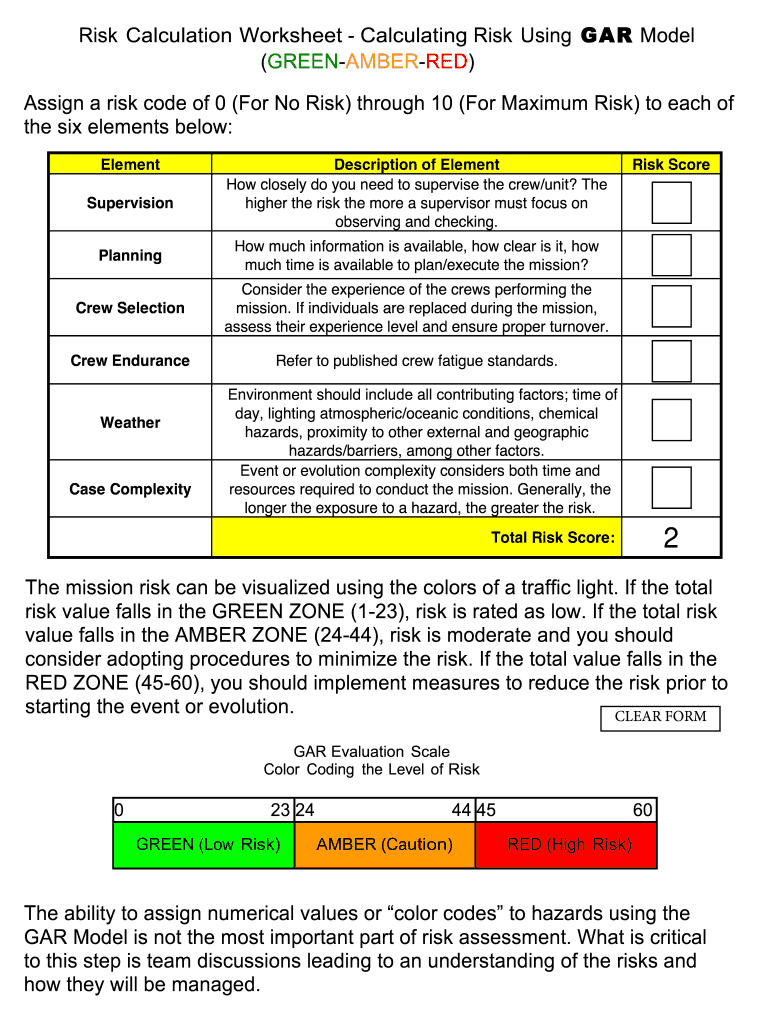
Risk Calculation Worksheet - Calculating Risk Using GAR Model GREEN-AMBER-RED Assign a risk code of 0 For No Risk through 10 For Maximum Risk to each of the six elements below Element Supervision Description of Element How closely do you need to supervise the crew/unit The higher the risk the more a supervisor must focus on observing and checking. If the total value falls in the RED ZONE 45-60 you should implement measures to reduce the risk prior to starting the event or evolution. CLEAR FORM GAR Evaluation Scale Color Coding the Level of Risk GREEN Low Risk AMBER Caution RED High Risk The ability to assign numerical values or color codes to hazards using the GAR Model is not the most important part of risk assessment. Planning How much information is available how clear is it how much time is available to plan/execute the mission Crew Selection Consider the experience of the crews performing the mission* If individuals are replaced during the mission assess their experience level and....

Open form follow the instructions

Easily sign the form with your finger

Send filled & signed form or save
How to fill out the Gar Risk Assessment online
The Gar Risk Assessment is a crucial tool for identifying and managing risks associated with various missions. This guide provides a comprehensive overview of how to accurately complete the assessment online, ensuring clarity and thoroughness in your risk evaluation process.
Follow the steps to complete the Gar Risk Assessment online.
- Click ‘Get Form’ button to obtain the form and open it in the editor.
- Begin with the first element, 'Supervision.' Assess how closely supervision is required for the crew or unit involved. Assign a risk code from 0 to 10 based on the level of supervision needed. The higher the risk, the greater the focus required.
- Next, fill in the 'Planning' section. Evaluate the availability of information, clarity, and the time at your disposal for planning and executing the mission. Assign a risk code reflecting the planning adequacy.
- Proceed to 'Crew Selection.' Consider the experience level of the crew members and any potential replacements during the mission. Assign a risk code based on crew experience.
- For 'Crew Endurance,' refer to published crew fatigue standards to assess endurance levels. Assign an appropriate risk score.
- Evaluate 'Weather' conditions. Assess environmental factors such as time of day, visibility, wind conditions, and their potential to affect mission safety. Assign a risk code.
- In the 'Case Complexity' section, consider the time and resources needed to conduct the mission. The longer the exposure to a hazard, the greater the complexity. Assign a risk code accordingly.
- Calculate the total risk score by summing the individual risk scores assigned to each element. Identify the color zone (Green, Amber, Red) associated with the total risk score for easy visualization.
- Lastly, ensure to assess any additional environmental conditions, such as weather and tidal conditions, by adding relevant points to the total score where applicable. Then finalize your assessment by saving changes, downloading, or printing the completed form.
Complete your Gar Risk Assessment online now to ensure a safe and effective mission.
Experience a faster way to fill out and sign forms on the web. Access the most extensive library of templates available.
Related content
NOAA Small Boat Operational Risk Assessment (GAR) Form · Document tags · Document...
Surface Operations Risk Calculation Worksheet. Calculating Risk Using the GAR Model...
Broadly speaking, a risk assessment is the combined effort of: identifying and analyzing...
Get answers to your most pressing questions about US Legal Forms API.
What is risk assessment equation?
What does it mean? Many authors refer to risk as the probability of loss multiplied by the amount of loss (in monetary terms).
What is the GAR model?
Calculating Risk Using the GAR Model. (GREEN-AMBER-RED) This Worksheet should be used for all surface operations unless other GAR forms have been mandated by local OIAs. GAR IS BASED ON A TEAM DISCUSSION TO UNDERSTAND AND EVALUATE THE RISKS ATTENDANT TO A MISSION AND HOW THEY WILL BE MANAGED.
What is risk management assessment?
The Risk Management Assessment, or RMA, is the first step in developing a comprehensive risk management program. The RMA identifies, analyzes, and reports on an organization's material risk exposures. ... Ask a series of questions designed to uncover risk exposures and prepare an action plan to protect against these risks.
What are the 3 components of risk management?
values. hazard. probability.
What are the first three steps for completing a risk assessment?
Step 1: Identify the hazards. In order to identify hazards you need to understand the difference between a 'hazard' and 'risk'. ... Step 2: Decide who might be harmed and how. ... Step 3: Evaluate the risks and decide on control measures. ... Step 4: Record your findings. ... Step 5: Review your assessment and update as and when necessary.
What is risk index formula?
Calculate Risk Index (R) The Risk Index is calculated as follows: R = (1- C/100*Q/100*S/100)*100 and is expressed in percent. R will never be greater than 100%. If a negative number is calculated (due to having a Completeness greater than 100%), round R up to 0.
What is the 3rd step of risk management?
Step 1 Identify the hazards. Step 2 Assess the hazards. Step 3 Develop controls and make risk decisions.
How is risk assessment impact calculated?
Scoring. ... Step 1: Step Back and Use Logic. ... Step 2: Select an Impact Score. ... Step 3: Select a Probability Score. ... Step 4: Multiply the Scores. ... Step 5: Evaluate the Results. ... Step 6: Draw Conclusions and Develop a Plan.
How do you calculate risk impact?
For businesses, technology risk is governed by one equation: Risk = Likelihood x Impact. This means that the total amount of risk exposure is the probability of an unfortunate event occurring, multiplied by the potential impact or damage incurred by the event.
What are the main three steps in risk assessment?
In doing so, we'll break risk assessment down into three separate steps: risk identification, risk analysis, and risk evaluation.
Use professional pre-built templates to fill in and sign documents online faster. Get access to thousands of forms.
If you believe that this page should be taken down, please follow our DMCA take down process here.