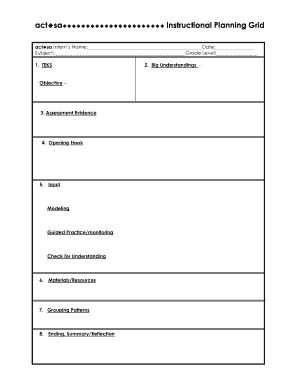
____________________________________________________Grade Level:_________________ 1. TEKS Objective – 3. Assessment Evidence 4. Opening Hook 5. Input Modeling Guided Practice/monitoring Check for Understanding 6. Materials/Resources 7. Grouping Patterns 8. Ending, Summary/Reflection 2. Big Understandings - .

How it works
  • Open form

    Open form follow the instructions

  • Easily sign form

    Easily sign the form with your finger

  • Share form

    Send filled & signed form or save

How to fill out the Instructional Planning Grid online

The Instructional Planning Grid is a vital tool for educators to outline their teaching strategies and ensure an effective learning experience. This guide will walk you through each component of the form and provide step-by-step instructions for completing it online.

Follow the steps to successfully complete the Instructional Planning Grid.

  1. Press the ‘Get Form’ button to access the Instructional Planning Grid and open it in your preferred online platform.
  2. Begin by entering the intern’s name in the designated field at the top of the form. This helps to identify who is responsible for the planning.
  3. Next, input the date in the specified field to document when the instructional plan is created.
  4. Provide the subject area and grade level for which the lesson is being planned. This information is crucial for aligning with educational standards.
  5. In the ‘TEKS’ section, establish clear objectives. These should reflect the knowledge and skills students are expected to acquire.
  6. Outline the ‘Big Understandings’ that you aim to convey through the lesson. This segment should capture the essential concepts students should grasp.
  7. Document the ‘Assessment Evidence’ outlining how you plan to evaluate student understanding throughout the lesson.
  8. Design the 'Opening Hook' to engage students right from the start. Think about an activity or question that will pique their interest.
  9. Detail the ‘Input’ strategies for delivering information to students. Include methods such as lectures, demonstrations, or multimedia.
  10. Specify the ‘Modeling’ techniques used to exemplify the concepts taught.
  11. Plan for ‘Guided Practice/monitoring’. Outline how you will support students while they practice the new concepts.
  12. Include a strategy for ‘Check for Understanding’. Describe how you will gauge student comprehension during the lesson.
  13. List the ‘Materials/Resources’ needed for the lesson to ensure that all necessary tools are prepared ahead of time.
  14. Define the ‘Grouping Patterns’ that will facilitate collaboration among students.
  15. Conclude with the ‘Ending, Summary/Reflection’ section to summarize key points and reflect on the lesson's effectiveness.
  16. Once you have filled out all sections of the Instructional Planning Grid, review your changes to ensure accuracy.
  17. Finally, you can save your changes, download the document, print it out for your records, or share the completed form as needed.

Start filling out the Instructional Planning Grid online today to enhance your instructional planning.

Get form

Experience a faster way to fill out and sign forms on the web. Access the most extensive library of templates available.

Related content

ED030418 - A Curriculum Organization Grid System:...

by GH Voegel · 1969 · Cited by 4 — ... Curriculum Organization Grid include a...

Learn more
Course Planning Grid

It is an organizational tool that shows the connection between learning outcomes and...

Learn more
Building Perspective - TI Education

The Planning Screen is divided into three main sections: the Target City (the goal for...

Learn more
Questions & Answers

Get answers to your most pressing questions about US Legal Forms API.

Contact support

What is an instructional plan?

An instructional plan is a detailed framework that outlines how to deliver educational content effectively. It typically includes objectives, teaching strategies, materials, assessments, and a timeline. Incorporating an Instructional Planning Grid can simplify the creation of such plans, allowing educators to see connections between different instructional elements. This tool not only organizes lessons but also ensures they are engaging and aligned with learning goals.

The five parts of DLP, or Daily Lesson Plans, include the learning objectives, introduction to the lesson, instructional procedures, assessment strategies, and reflection on the lesson. An Instructional Planning Grid can effectively encompass these elements, making it easier to distribute and manage them across your teaching schedule. This structured approach enhances clarity for both teachers and students. Furthermore, it aids in maintaining alignment with educational standards.

The five steps in the lesson planning process are defining learning objectives, selecting instructional materials, designing activities, determining assessment methods, and evaluating the effectiveness of the lesson. Using an Instructional Planning Grid during these steps can streamline the organization of your ideas. This method allows you to ensure that all learning components are aligned and support your educational goals. Ultimately, this leads to a more coherent and effective lesson plan.

An instructional plan typically includes an overview of the learning goals, the sequence of activities, and assessment methods. It may feature a structured layout, often outlined in an Instructional Planning Grid for clarity. This grid format makes it easier for educators to visualize the lesson flow and identify key components at a glance. Overall, it ensures that all necessary elements are covered.

To write an instructional plan, start with clearly defined learning objectives. Next, outline the teaching methods and materials you will use. Include a timeline for each lesson and incorporate assessments to measure student understanding. An Instructional Planning Grid can help you organize these elements effectively.

The five steps in a lesson plan include setting objectives, preparing materials, engaging students, assessing understanding, and reflecting on the lesson. Leveraging the Instructional Planning Grid can help you organize these steps cohesively. This structured process promotes clarity and effectiveness in teaching.

The five parts of a lesson plan generally consist of objectives, materials, procedures, assessment, and closure. Use the Instructional Planning Grid to map these elements effectively, ensuring coverage of each aspect. A well-structured lesson plan addresses learner engagement and outcomes.

When writing a lesson plan format, start by clearly defining your learning objectives. Then, utilize the Instructional Planning Grid to detail the sequence of activities and assessments required. This systematic approach simplifies the plan creation process and enhances your overall effectiveness as an educator.

The seven basic parts of a lesson plan include the title, objectives, materials, introduction, main activities, assessment methods, and closure. By employing the Instructional Planning Grid, you can easily visualize how these components interact and support your teaching goals. This clarity improves both your preparation and delivery.

A lesson plan format typically includes sections for objectives, materials, activities, and assessments. By using the Instructional Planning Grid, you can create a structured plan that highlights each part clearly. This organized approach not only aids in your teaching but also ensures a smooth flow during the lesson.

Get This Form Now!

Use professional pre-built templates to fill in and sign documents online faster. Get access to thousands of forms.

If you believe that this page should be taken down, please follow our DMCA take down process here.

Get Instructional Planning Grid