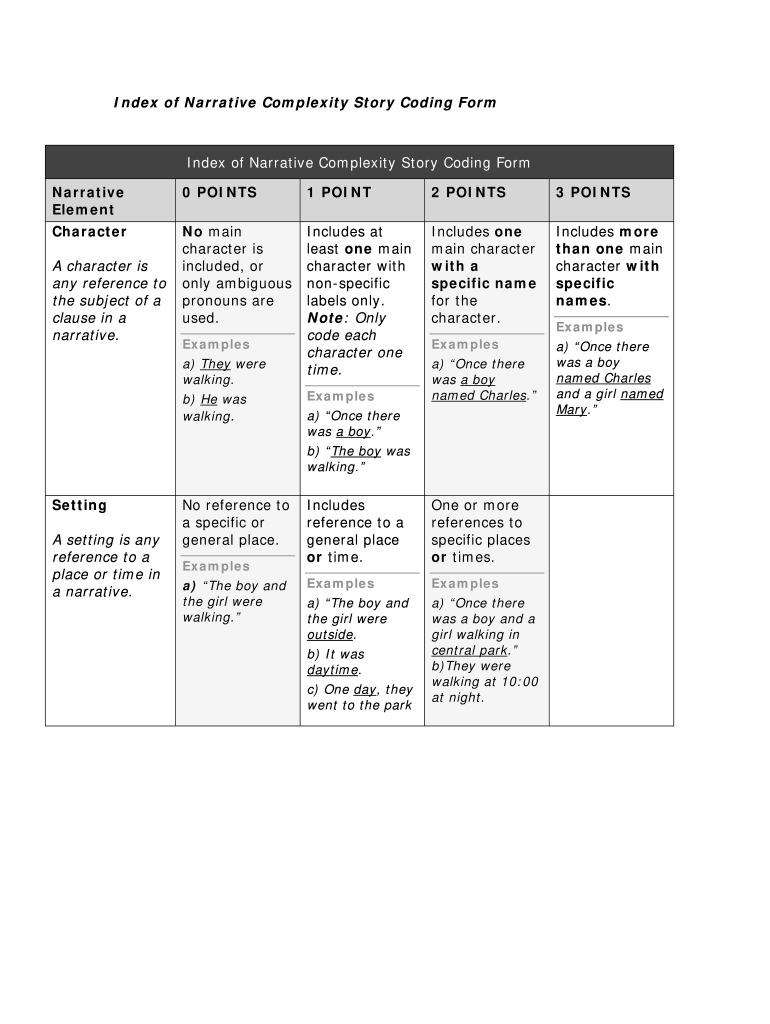
Or only ambiguous pronouns are used. Includes at least one main character with non-specific labels only. Note: Only code each character one time. Includes one main character with a specific name for the character. Includes more than one main character with specific names. A character is any reference to the subject of a clause in a narrative. Examples a) They were walking. b) He was walking. Examples Examples a) “Once there was a boy named Charles.” a) “Once there was a boy.” b) .

Open form follow the instructions

Easily sign the form with your finger

Send filled & signed form or save
How to fill out the Index of Narrative Complexity Story Coding Form online
This guide provides essential steps for users to fill out the Index of Narrative Complexity Story Coding Form online. Follow the instructions carefully to ensure accurate and comprehensive information is recorded.
Follow the steps to successfully complete the form.
- Press the ‘Get Form’ button to access the Index of Narrative Complexity Story Coding Form online. This action retrieves the form and opens it for you to fill out.
- Begin with the 'Character' section. Identify and code the main characters present in the narrative, ensuring that each character is labeled appropriately according to the guidelines. Use specific names for higher point scores.
- Next, fill out the 'Setting' section. Reference places or times depicted in the narrative, categorizing them as general or specific to meet scoring criteria.
- Proceed to the 'Initiating Event.' Document any events or problems that prompt responses from the characters. This section should reflect the key moments that drive the narrative.
- Complete the 'Internal Response' section by detailing characters' emotions or thoughts in relation to the events described. Ensure these are clearly connected to the initiating events.
- Address the 'Plan' where you outline the characters' intentions or strategies in response to the events. Include any cognitive verbs to signify the planning process.
- In the 'Actions' segment, describe the actions taken by characters in response to the initiating events. Ensure these actions are explicitly connected to what was previously stated.
- Continue to the 'Complication' section where you should note any events that interfere with the characters' plans. Code any distinct complications appropriately.
- Fill out the 'Consequence' section, indicating whether the problem has been resolved and including any clearly stated outcomes.
- For the 'Formulaic Markers,' ensure to include any standard phrases or markers that signal the beginning or end of the narrative.
- Finally, include 'Temporal Markers' by identifying any relevant time indicators present in the narrative to illustrate the sequence of events.
- Once all sections are complete, review your entries for accuracy. You can now save changes, download, print, or share the completed form as needed.
Complete your documents online today for a streamlined experience.
Experience a faster way to fill out and sign forms on the web. Access the most extensive library of templates available.
Related content
by LH Finestack · 2014 · Cited by 53 — ... Index of Narrative Complexity coding should...
by LM Justice · 2006 · Cited by 520 — It typically focuses on children's inclusion of...
May 5, 2022 — into a story and form a cohesive and captivating narrative. It takes even...
Get answers to your most pressing questions about US Legal Forms API.
What is narrative complexity?
Narrative complexity refers to the layers of meaning and structure within a story that require careful interpretation. It encompasses various components such as plot intricacies, character development, and thematic depth. The Index of Narrative Complexity Story Coding Form provides a valuable tool for breaking down these elements, enabling readers and analysts to appreciate the richness of complex narratives.
What is the nap in the narrative assessment protocol?
The nap, or Narrative Assessment Protocol, focuses on assessing various aspects of storytelling, such as coherence, cohesion, and detail. This protocol aids in evaluating how effectively a narrative communicates its intended message. By leveraging the Index of Narrative Complexity Story Coding Form, you can align your findings within the framework of the nap to achieve a comprehensive understanding of narrative quality.
What is the difference between narrative analysis and analysis of narratives?
Narrative analysis focuses on the methods and tools used to examine narratives, while the analysis of narratives refers to the broader understanding of individual stories and their contexts. The tools like the Index of Narrative Complexity Story Coding Form can facilitate narrative analysis by providing a framework for examining specific elements within narratives. This process enhances the appreciation of storytelling techniques.
What is an example for narrative?
An example of a narrative can be found in classic fairy tales, which often feature a clear beginning, middle, and end with well-defined characters and morals. These stories illustrate the power of storytelling to convey important life lessons. The Index of Narrative Complexity Story Coding Form can be useful in disassembling these narratives, allowing for a deeper understanding of their structure and themes.
What is the microstructure of a narrative?
The microstructure of a narrative refers to the small-scale elements that build the story, such as word choice, sentence structure, and stylistic techniques. These components contribute to the overall tone and meaning of the narrative. By using the Index of Narrative Complexity Story Coding Form, you can analyze these microstructural elements and uncover how they enhance the storytelling.
What is the meaning of complex narrative?
A complex narrative involves intricate plot structures and character relationships that challenge the reader’s understanding. It often incorporates nonlinear timelines or simultaneous storylines that require careful analysis. The Index of Narrative Complexity Story Coding Form aids in coding these elements systematically, making it easier to appreciate the narrative's complexity.
What is an example of narrative complexity?
An example of narrative complexity can be found in novels that employ multiple viewpoints to tell the same story. These narratives often intertwine different characters' perspectives, creating a richer experience for the reader. The Index of Narrative Complexity Story Coding Form can help analyze how these different viewpoints contribute to the story's depth.
What is strong narrative assessment procedure?
Strong narrative assessment procedure focuses on the thorough evaluation of a narrative's elements, including themes, character arcs, and plot coherence. This method allows writers and analysts to identify strengths and weaknesses within the narrative structure. With the Index of Narrative Complexity Story Coding Form, you can enhance your assessment accuracy and improve your storytelling skills.
What is the strong narrative assessment procedure?
The strong narrative assessment procedure is a systematic process designed to evaluate the depth and quality of narratives in a structured manner. This procedure involves the analysis of character development, plot structure, and emotional engagement. By applying the Index of Narrative Complexity Story Coding Form, you can streamline your assessment and gain valuable insights into narrative effectiveness.
What is the narrative complexity of TV?
Television's narrative complexity is predicated on specific facets of storytelling that seem uniquely suited to the series structure that sets television apart from film and literature, and distinguish it from conventional modes of episodic and serial forms.
Use professional pre-built templates to fill in and sign documents online faster. Get access to thousands of forms.
If you believe that this page should be taken down, please follow our DMCA take down process here.